Reimagined Places | Conscious Design Observatory

May 20, 2026 – 4:00 pm
CET
10:00 am EST
4:00 pm CET
8:30 pm IST
12:30 am (May 6) ACT
1.5 hours

Online

This event is open to CCD Members and Partners
Responsive principle icon
Learning & ExplorationPurpose & MeaningSkills & Productivity

What happens when we choose to reimagine?

Across many contexts, the assumption that new construction is the default is beginning to shift. Increasingly, design starts not with a blank slate but with inherited conditions; existing buildings, materials, infrastructures, and landscapes. The challenge becomes transforming what already exists, to keep places relevant and aligned to the needs of communities.

At the upcoming Conscious Design Observatory, we will explore how land, buildings, and materials can be reimagined in the roles they play. Some sites are rewilded, returning built land to thriving ecosystems. Industrial structures become new forms of urban infrastructure, while underused buildings find unexpected new lives through adaptive reuse.

This shift also changes how projects begin. Instead of designing first and sourcing materials later, designers ask: How can a project respond to what already exists? Salvaged components, dismantled structures, and overlooked materials become starting points rather than constraints. Reimagining requires new skills, recognising latent value in what might appear obsolete and working creatively with uncertainty.

But reimagining is not only material. It also involves reconsidering the social and cultural roles of places and assets, and whose perspectives shape these transformations. Imagining futures is a practice from which many are structurally excluded. When we reimagine places, we’re also reshaping our future selves.

In this session of The Centre for Conscious Design Observatory, we explore Conscious Design Principle 09: Reimagined — “Project goals are periodically reconsidered, affirmed, or reimagined.”

Three speakers will share case studies from their practice, showing how land, buildings, and materials can be reinterpreted to reveal new uses, meanings, and futures. The session will include time for discussion and Q&A.

The Observatory is a CCD event series where we observe emerging shifts in practice that reflect our community’s vision. Through real projects, we explore how conscious design principles are applied in the built environment.


Dr. Asma Mehan is an Assistant Professor at the Huckabee College of Architecture, Texas Tech University, USA, where she directs the Architectural Humanities and Urbanism Lab (AHU_Lab). She currently serves as Editor-in-Chief of plaNext: Next Generation Planning. Her research sits at the intersection of architectural humanities, critical urban studies, industrial heritage, adaptive reuse, public space, climate resilience, and spatial justice. Dr. Mehan has authored four books and edited two volumes. Her first book, Kuala Lumpur: Community, Infrastructure, and Urban Inclusivity (Routledge, 2020), examines how infrastructure shapes social equity and urban inclusivity in the Malaysian metropolis. Her second book, Tehran: From Sacred to Radical (Routledge, 2022), offers a critical analysis of political transformation and public space in Tehran from a Global South perspective. Her third authored book, The Affective Agency of Public Space: Social Inclusion and Community Cohesion (De Gruyter Brill, 2024), explores how public spaces in cities such as Amsterdam and Houston foster civic interaction, urban connection, and community cohesion. Her newest book, Decolonizing Industrial Heritage: Adaptive Reuse, Community Engagement, and Climate Resilience (Edward Elgar Publishing, 2026), investigates how post-industrial sites can be reimagined as civic, ecological, and community-centered infrastructures. She has also edited After Oil: A Comparative Analysis of Oil Heritage, Urban Transformations, and Resilience Paradigms (Springer, 2025), which examines post-industrial urban futures, and City, Public Space, and Body: The Embodied Experience of Urban Life (Routledge, 2025), which explores embodied, affective, and spatial experiences of urban life.

Elisha V. Charley, a Nihok’aa Diyin Dine’e (holy surface people), grew up in Dennehotso, AZ, in the northern region of the Navajo Nation. Her clans are the Folded Arms People clan, born for the Start of the Red Streak people clan, her maternal grandfather is from the Water Edge People clan, and her paternal grandfather is from the Red Running into the Water People clan. Charley’s research is deeply rooted in Diné place-based knowledge and guided by Indigenous Planning frameworks. She centers dialogic practices that advocate for Navajo housing data justice and critically examine Navajo land use conditions. She explores Indigenous-led participatory housing development models and incremental approaches to homebuilding within the Navajo Nation. She is currently engaged in her doctoral studies in Urban Planning at Arizona State University’s (ASU) School of Geographical Sciences and Urban Planning. Her research is dedicated to advancing scholarship in Native American housing and land use. In addition, she holds the position of Clinical Professor at The Design School at ASU in Tempe, Arizona.

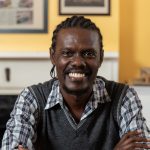
Kimwelle’s architectural studies and professional experience span from Kenya to South Africa with global collaborations in USA, Germany, and India. His focus has led him into community development work in South Africa, where he is currently based. His doctoral research in the use of alternative design (materials & technology) technology as agent towards social change merges the environmental aspects with the socioeconomic impact and applies a transdisciplinary and multidisciplinary approach. Kimwelle’s research development and innovation work engages several academic institutions in Africa, Europe and the US. His work emerges from a foundation of a people-centred design approach, while responds to the urgency towards social and environmental justice by merging business, environment, and technical knowledge towards a holistic application. Well-travelled in the Eastern and Southern Africa, and Central Europe, his work explores alternatives grounding the green agenda in affordable sustainable solutions. He was finalist for the 2017 Design Indaba’s MBOISA (Most Beautiful Object in South Africa). He was 2018 SAPOA Winner for the Overall Most Transformational Project in South Africa. He has won the 2019 SAIA-EC (South African Institute of Architects) Regional Award followed by the 2023 Regional Commendation to the nationals award in 2024. He has been numerously featured on news articles such as The Guardian, Mail & Guardian, SABC television, Deutsche Welle Television, MNet’s Carte Blanche etc. He has also been featured in architectural magazines such as Architectural Record (New-York), Metropolis Magazine (New York). He has participated in several global movements such as the 2023 Copenhagen Film Festival for UIA (International Union of Architects) under UNSDG Leave No One Behind, the transformative promise of the 2030 Agenda. He was formed part of the Creative Climate Coalition 2022 Climate Change Conference COP27 in Egypt.

Hosted/Organised by