

risky-ming-4TervgZZeAo-unsplash

Spotlight Research

Summary and Analysis:

Space Syntax And Spatial Cognition: Or Why the Axial Line?

Keywords

Space syntax research has found that spatial configuration alone, represented and measured in a specific manner, explains a substantial proportion of the variance between aggregate human movement rates in different locations in both urban and building interior space. Although it seems possible to explain how people move on the basis of these analyses, the question of why they move this way has always seemed problematic because the analysis contains no explicit representations of either motivations or individual cognition. One possible explanation for the method’s predictive power is that some aspects of cognition are implicit in space syntax analysis. This article reviews the contribution made by syntax research to the understanding of environmental cognition. It proposes that cognitive space, defined as that space which supports our understanding of configurations more extensive than our current visual field, is not a metric space, but topological. A hypothetical process for deriving a nonmetric space from the metric visibility graph involving exploratory movement is developed. The resulting space is shown to closely resemble the axial graph.

Summary and Analysis

View support quotes and references at the bottom of the page.

Overview of Research Area

Bill Hillier’s “Cities as Movement Economies” (1996) established that the configuration of streets generates movement, and that land use follows movement rather than the other way round. This was a powerful finding for urban design. But it left a gap in the theory. Space syntax could predict where people would move with considerable accuracy, and yet it offered no account of the cognitive mechanism by which this happened. The analysis does not include any representation of intentions, destinations, or mental maps. It is a mathematical description of spatial relationships. Why should it predict human behaviour?

Penn’s 2003 paper addresses this directly. Its central argument is that the cognitive processes people use to navigate environments are not based on precise measurements of distance and angle, as most models of wayfinding had assumed. They are based on topological relationships: which spaces connect to which others, how many steps it takes to move from one to another, and what the structure of visible space from any given position reveals about the wider configuration. This is a subtle but important distinction. You do not navigate your neighbourhood by knowing the exact distances between junctions. You navigate it by knowing, roughly, how it hangs together: which streets connect to which, where the main through routes are, which turns lead inward and which lead outward. That knowledge is topological, not metric.

Penn’s contribution is to show that this kind of topological spatial knowledge is not stored in advance but built up through movement itself. As you move through a new environment, looking ahead and making decisions based on what you can see from where you are, you accumulate a set of connections between visible locations. Over time, the structure of those connections comes to resemble an axial map, the fundamental tool of space syntax analysis. The method works, Penn argues, because it is an approximation of the cognitive structure that human spatial navigation actually produces and relies upon.

This matters well beyond academic theory. If the cognitive representation of space is topological rather than metric, it means that what makes environments easy or hard to navigate is not primarily about distances or signage. It is about whether the spatial structure of the environment supports the formation of a coherent topological map. And that is something that can be analysed, tested, and designed for.

This is also, as it turns out, something that can be deliberately subverted. Which brings us to IKEA.

Why is this Research of Interest?

For practitioners in architecture, Penn is closing the gap that  has direct consequences for how we think about what we are doing when we design space.

Standard design evaluation tends to focus on what a space contains: the programme, the uses, the adjacencies. When wayfinding is considered, it is typically addressed through signage strategies and landmark placement. These responses assume that the underlying spatial structure is broadly navigable and that the problem is one of communication. Penn’s research suggests this assumption is often wrong. The deeper question is whether the spatial configuration itself supports or undermines the formation of the topological mental model that people rely on to orient themselves. Signage cannot fully compensate for a spatial structure that prevents cognitive map formation.

Penn’s research suggests that the question is not simply “is this near enough?” but “does the spatial structure of the building make this space part of the cognitive map that people carry with them as they move through the building?” A resource that is well-connected in topological terms, that lies on a route people naturally take and can see from positions they naturally occupy, will be used as a social space. 

Most simulation tools are well equipped to model flow and density once a layout is defined. They are less well equipped to test whether a proposed layout will support or suppress the cognitive processes by which people come to understand and navigate their environment. Penn’s paper is a theoretical foundation for asking that prior question more rigorously. It shifts the design brief from “make the space clear” to “make the cognitive structure of the space legible,” which is a different, and tractable problem.

An open question lies in –  if agents navigate through exploratory movement, what happens in an environment deliberately designed to prevent that process? The answer is instructive, and it is demonstrated every weekend in a large Swedish furniture store.

What are the Findings of this Research?

1. Space syntax works because cognition is topological, not metric

Penn argues that the reason space syntax analysis reliably predicts movement without representing individual cognition is that the method captures the same structural properties that human spatial cognition uses. People do not build mental maps of space in the way a surveyor would, recording distances and angles. They build topological representations: networks of connected locations, ordered by how accessible each is from every other. 

2. The axial line emerges from movement through visible space

Penn develops a formal account of the axial map, a representational tool of space syntax which can be derived from the process of exploratory movement through a visibility graph (a map of all the lines of sight available within a given spatial configuration). An individual moving through a new environment, choosing routes based on what they can see from where they stand, accumulates a set of connections between visible locations. The structure that emerges from this process closely resembles the axial graph. The tool is an approximation of a real cognitive process.

3. Spatial intelligibility determines how well cognitive maps form

Intelligibility, in space syntax terms (and a gloss is warranted here: intelligibility refers to the degree to which local spatial relationships in a space predict global ones, or how well what you can see around you tells you about the structure of the whole), is not just a measure of navigational convenience. Penn’s account establishes it as a measure of cognitive supportiveness: how well the environment enables people to build accurate mental representations of the spaces beyond their current visual field. High intelligibility means that the environment teaches you its own structure as you move through it. Low intelligibility means that local information is unreliable as a guide to the whole.

4. Configuration shapes cognition before it shapes behaviour

Previous space syntax research established a causal chain from configuration to movement. Penn’s paper inserts a stage: configuration shapes cognition, and cognition shapes movement. This matters because it means that the effects of spatial configuration on behaviour are not just about physical accessibility. They are about whether people develop the mental model needed to use a space confidently, to plan routes, to return to locations, and to build the kind of spatial familiarity that generates attachment, confidence, and social use.

5. The framework applies at building scale, not only urban scale

Penn demonstrates that the same principles that explain pedestrian movement in urban street networks also explain movement within buildings. The cognitive process of building a topological map from exploratory movement operates in a shopping centre, a hospital, a workplace, or a museum in precisely the same way it operates in a city. This is not particularly easy given speciality functions. It means that the analytical tools developed for urban space syntax, including integration analysis and intelligibility measures, can be applied directly to interior space, with comparable predictive power for where movement will concentrate and where social life will form.

6. The same mechanism that enables natural navigation can be deliberately disrupted

Penn’s account of how cognitive maps form from visibility-based exploration also describes, in precise terms, what happens when an environment is designed to prevent that process. Fragmenting sightlines, eliminating landmarks, suppressing the visual cues that allow topological map formation, these are not accidental design failures. They are available as design strategies. Penn’s framework makes the mechanism explicit, which means it can be understood in both directions.

A Note on the Data: 

The quantitative results of the Turner and Penn model are worth noting. In their test building, the correlation between simulated agent movement density and observed pedestrian counts was strong enough to confirm that visibility-based navigation, with no knowledge of destinations or building contents, could account for the broad pattern of where people went and did not go.

Research drawing on this framework has since been applied across a range of building types. In hospital settings, space syntax agent modelling has been used to identify corridors that will carry higher than expected staff movement, helping to inform placement of team bases and shared resources. In workplace research, visibility integration has been found to predict informal interaction rates more reliably than proximity alone. Two desks that are close in distance but separated by a visual barrier generate fewer chance interactions than two desks further apart but within each other’s sightlines.

Perhaps the most direct illustration of the principle in commercial practice comes from Alan Penn’s own account of his first visit to IKEA. He went to buy a mattress. He left, several hours later, with a mattress and a significant quantity of additional items he had not planned to buy. He is a professor of architectural and urban computing at UCL who has spent his career studying how spatial configuration shapes behaviour. The layout got him anyway.

Penn estimates that around 60 percent of purchases at IKEA are unplanned. This is not a coincidence of product range or pricing. It is an outcome of a deliberate spatial strategy, and it is the applied inversion of everything Turner and Penn’s model describes.


On IKEA: Or, What Happens with Space Syntax

[Researcher’s note: this section is intended as a lighter reflection on the applied side of the research. See visualisation note below.]

Most retail environments aim for efficient navigation. The standard model that emerged from post-war supermarket design uses what Penn has called a library structure: clear categories, legible signage, a layout that is easy to understand and easy to move through. You find what you came for, feel good about the experience, and come back. The spatial logic is high integration, high intelligibility: move freely, orient yourself easily, spend what you planned to spend.

IKEA does the opposite. Deliberately.

The store layout is what Penn calls a “long natural path”: a single forced route through the entire showroom, with no meaningful shortcuts and no way to retrace your steps without moving against the flow of everyone around you. The room displays that line the route fragment sightlines and block any view of what lies ahead. There are no external windows, no clocks, and no fixed landmarks in the showroom section. The spatial environment is configured precisely to prevent the formation of the kind of topological cognitive map that Penn’s paper describes as the basis of normal human navigation.

The consequence, as Penn explains it, is that visitors revert to a mode of navigation based almost entirely on immediate visual engagement with what is directly in front of them. Without a cognitive map to rely on, and without the habitual spatial knowledge that guides movement in familiar environments, visitors look at the products because there is nothing else to orient themselves by. “They waste your first half hour, at least, before they even let you have the trolley,” Penn has observed. “And at that point you start treating yourself, because by then you realise there is no way you are ever going to find anything again.”

The spatial disorientation is the mechanism, not a side effect. By delaying the shopper’s ability to complete their mission while maintaining a state of visual alertness, the layout licenses impulse purchases. Penn mentions: “By delaying the ability of the shopper to fulfil their mission, at the same time as disorienting them and dissociating them from everyday life, when eventually they are allowed to start buying, the shopper feels licensed to treat themselves.”

Penn’s 2003 paper contributes to this analysis of  theoretical precision. IKEA is not simply a confusing shop. It is a spatial environment engineered to suppress topological map formation, to prevent the cognitive process that Penn identifies as the foundation of natural movement, and to redirect the visual attention that would normally support navigation towards the products that line every wall of the route. The spatial logic that, in a well-configured city or building, generates social life, chance encounter, and confident use of space is here inverted to generate a specific commercial outcome.

This is uncomfortable knowledge, in the sense that it is impossible to unknow. It does not make IKEA uniquely villainous. The same spatial logic, applied with different intentions, underlies the design of casinos, airports, and certain museums. But it is worth naming, because Penn’s research makes clear that the mechanism is available to anyone who designs space, and the question of what we choose to do with it is not a technical one.
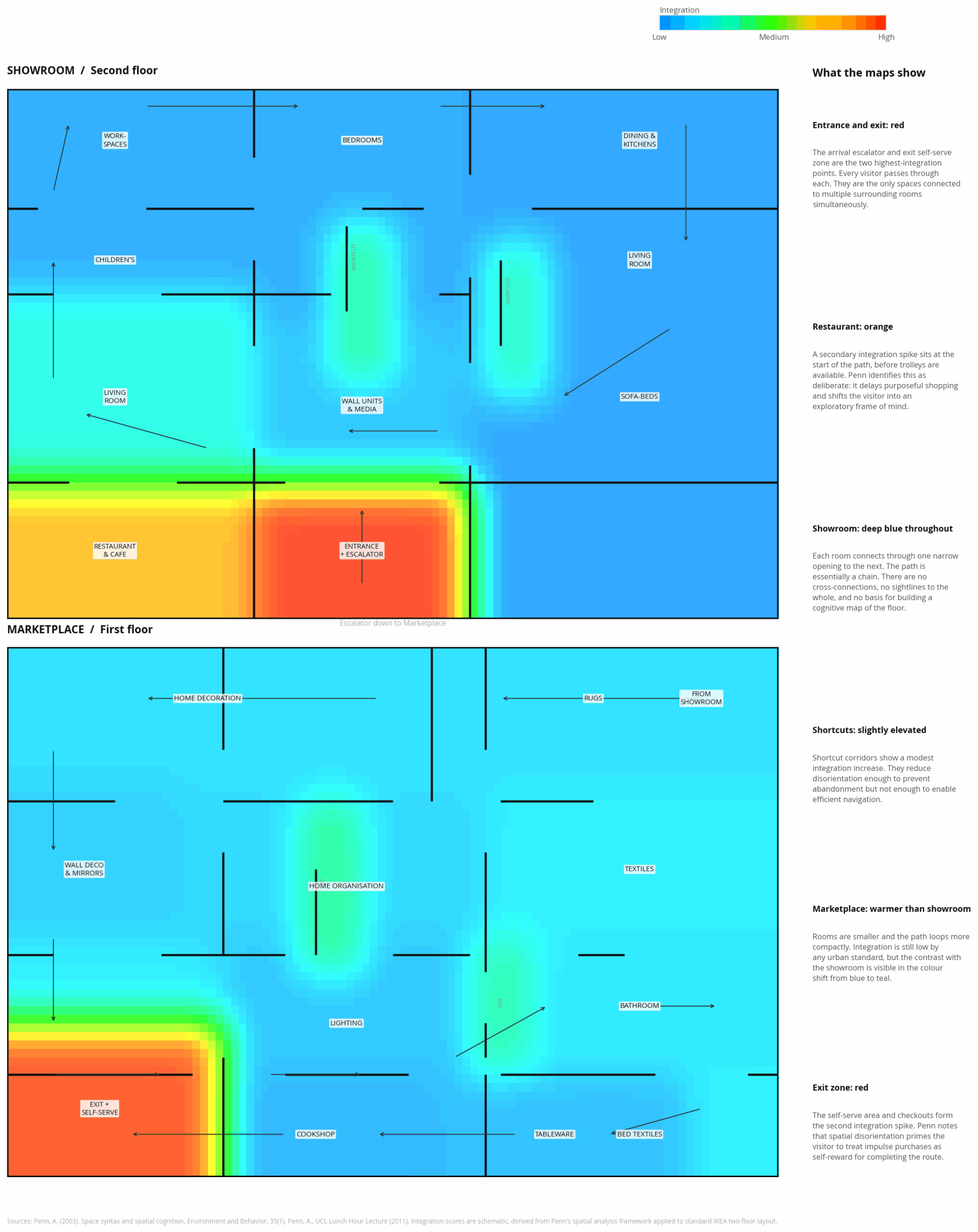
Space syntax integration analysis of a standard two-floor IKEA store layout.
Colour scale : red indicates high integration (many connections to the surrounding network), blue indicates low integration (spatially isolated). Thick black lines represent walls; gaps indicate doorways. Dashed arrows show the forced customer path. Scores are schematic, derived from Penn’s (2003) spatial analysis framework.

 

Planned versus actual average purchases per visit to an IKEA store, broken down by product category.
Grey bar shows items planned on entry (P); coloured bar shows items actually bought, with the grey portion representing the planned fraction and the colour representing unplanned additions (A). Percentage labels indicate the unplanned share of each category’s actual total. Figures are schematic estimates consistent with Penn’s 60% unplanned purchase rate (UCL, cited in Deseret News, 2012).

How do the Findings Relate to the CCD's Designing for Life Themes?

Connection and Belonging: Penn’s research establishes that the cognitive processes underpinning natural movement are also the processes that generate chance encounter and social co-presence. When spatial configuration supports topological map formation, people move through shared spaces with confidence and regularity, and the social life of a building or neighbourhood emerges from those patterns of movement. When configuration suppresses map formation, people become uncertain in their movement, avoid unfamiliar areas, and encounter each other less. The design implication is not to add social spaces but to configure the environment so that the routes people naturally build cognitive maps of are also the routes where shared spaces are placed.

Place Attachment: Penn’s account of how cognitive maps form through movement suggests something specific about how attachment to place develops: it grows from spatial familiarity, and spatial familiarity is a cognitive product of navigating an intelligible environment over time. Places with high intelligibility become deeply known because the structure of the environment teaches itself to you as you move through it. Places with low intelligibility remain spatially uncertain even to long-term occupants. The IKEA experience is a precise illustration of the inverse: you cannot become attached to a space you cannot map. Whether this applies to poorly configured residential neighbourhoods and housing estates is a question the research raises with some urgency.

Comfort and Accessibility: Spatial comfort is partly physical and partly cognitive. An environment in which you can reliably predict what lies around the next corner, because the spatial structure is intelligible, is cognitively comfortable even when it is complex. An environment in which local information provides no reliable guide to the whole is cognitively exhausting even when individual spaces are pleasant. Penn’s framework gives designers a way to test cognitive comfort through intelligibility analysis, before a building or urban space is built. This is distinct from accessibility in the standard sense, and it matters: a fully accessible building that is spatially unintelligible is accessible in body but not in mind.

How Can Insights from this Research be Applied to Design?

1. Analyse intelligibility before analysing anything else

Before evaluating a design proposal for programme fit, aesthetic quality, or structural logic, run an intelligibility analysis. The DepthmapX software, which is free, produces intelligibility scores as part of its standard visibility graph analysis. A high intelligibility score means the environment is cognitively supportive: what people can see from where they stand reliably tells them about the structure of the whole space. A low intelligibility score means the opposite, and that has consequences for wayfinding, social use, and spatial confidence that no amount of signage will fully resolve.

2. Place shared resources at topologically connected positions, not just proximate ones

Two locations that are close in distance can be far apart in topological terms if a visual barrier or a spatial discontinuity separates them. Penn’s research suggests that what determines whether a shared space is used as a social resource is not its metric proximity to workstations or wards, but whether it falls on the routes that people’s cognitive maps include as natural paths of movement. Test placement decisions against visibility graph analysis, not against a distance matrix.

3. Design for the first-time visitor and the habitual user separately

Penn’s account of how cognitive maps form through exploratory movement implies that the same space is experienced differently by someone encountering it for the first time and someone who knows it well. First-time visitors rely almost entirely on the spatial structure, because they have no habitual knowledge to draw on. Regular occupants can compensate for low intelligibility through familiarity. In healthcare environments, where patients and visitors are often first-time users in conditions of anxiety, the spatial structure carries much more cognitive weight than it does for staff. Designing for intelligibility is especially important for environments where the user population is routinely encountering the space for the first time.

4. Use configurational analysis to evaluate wayfinding before deploying signage

Signage is a compensatory strategy. It responds to an environment that has already created navigational difficulty and attempts to resolve it through information. Penn’s framework suggests that the prior question is whether the spatial structure itself makes the environment intelligible, and if not, whether configurational changes (opening sightlines, creating visual connections between key spaces, restructuring the spatial hierarchy) could address the problem more effectively than adding signs. This is a more demanding design challenge, but it produces environments that are navigable without instruction.

5. Be explicit about what spatial design is doing to people’s cognitive agency

Penn’s research on IKEA, and on the mechanism by which spatial disorientation enables commercial outcomes, is a reminder that the power to configure space is also the power to shape cognitive experience, including the cognitive experience of choice. This is not unique to retail. Any environment in which designers control spatial configuration is also an environment in which they influence how occupants form mental models, how confidently they navigate, and how much cognitive resource they have available for purposes beyond finding their way. Being explicit about this, in briefs, in design reviews, and in post-occupancy evaluation, is part of what evidence-based practice in spatial design should involve.

Penn, A. (2003). Space syntax and spatial cognition: or why the axial line? Environment and Behavior, 35(1), 30–65. https://doi.org/10.1177/0013916502238864

Hillier, B. (1996). Cities as movement economies. Urban Design International, 1, 41–60. https://doi.org/10.1057/udi.1996.5

Hillier, B., Penn, A., Hanson, J., Grajewski, T., and Xu, J. (1993). Natural movement: or, configuration and attraction in urban pedestrian movement. Environment and Planning B: Planning and Design, 20(1), 29–66. https://doi.org/10.1068/b200029

Turner, A., Doxa, M., O’Sullivan, D., and Penn, A. (2001). From isovists to visibility graphs: a methodology for the analysis of architectural space. Environment and Planning B: Planning and Design, 28(1), 103–121. https://doi.org/10.1068/b2684

Penn, A. (2011). Who enjoys shopping in IKEA? UCL Lunch Hour Lectures. https://www.youtube.com/watch?v=NkePRXxH9D4

Retail Customer Experience (2012). Opinions vary on IKEA store maze layout. https://www.retailcustomerexperience.com/articles/opinions-vary-on-ikea-store-maze-layout/

Join and experience more as a Member

  • Access all our publications
  • Attend our events and access recordings
  • Offers from Partners in our network
  • Support the Conscious Cities movement!
  • Receive updates on new content and events

Access all our publications

Attend our events and access recordings

Offers from Partners in our network

Support the Conscious Cities movement!

Receive updates on new content and events

Cancel any time