Casa Tejida (Woven House)

Write-up Contributor:

Conscious Design Principles

Aware principle iconCollaborative principle icon

Designing for Life

Agency & AutonomyCreativity & ExpressionEcological Health

C. de Belmonte de Tajo, 55, 4b, Carabanchel, 28019 Madrid, Spain

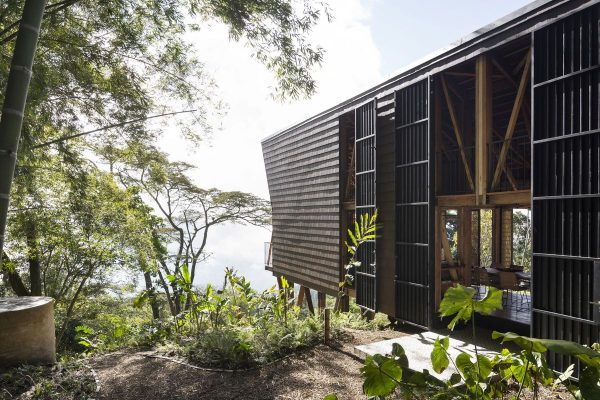
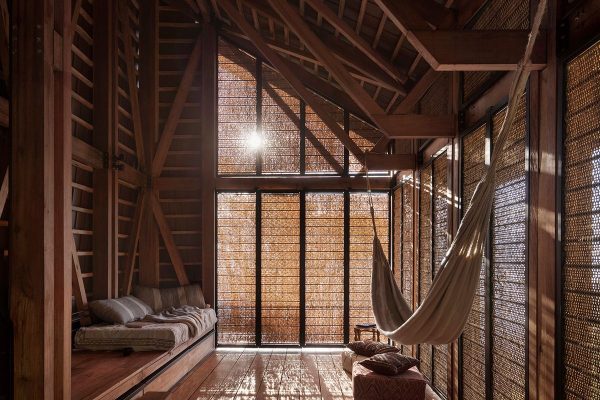
Casa Tejida is a modular, community-built home in rural Colombia that excels as an example of local craftsmanship, open-source design, and ecological sensitivity. Developed collaboratively by architects Juan Chacón and Santiago Pradilla, the project weaves together traditional knowledge, natural materials, and participatory processes to create a house that lives in harmony with its environment and community.

Zuloark is a distributed architecture, urbanism and culture office founded in 2001 in Madrid, with current offices in Madrid, Berlin, Coruña, Bologna, Amsterdam, Athens and La Palma. Its collaborative model, based on co-responsibility and shared authorship, is organized through “fluid hierarchies” and rotating roles, supported by an international network of collaborators.

Conscious Design Principles

Conscious Design Principles promote the emergence of healthy built environments and a generative people-place dialogue. The principles highlight the importance of collaborative processes, more aware decision-making based on context and evidence, and responsive qualities that enable adaptation and attunement over time. Explore how this project applied the principles:

Collaborative

01-Co-Imagined-transp

Co-imagined

02-Co-Designed-transp

Co-designed

03-Co-Created-transp

Co-created

04-Co-Stewarded-transp

Co-stewarded

Casa Tejida, though a private residence, emerged from a deeply collaborative process involving local community members and workers. Instead of starting with a predetermined architectural vision, the project evolved through on-site co-design and co-creation.

Several key actions supported this approach:

  1. The team lived in an on-site camp for over two months, building trust and learning the rhythms of daily life both of the community and the ecosystem.
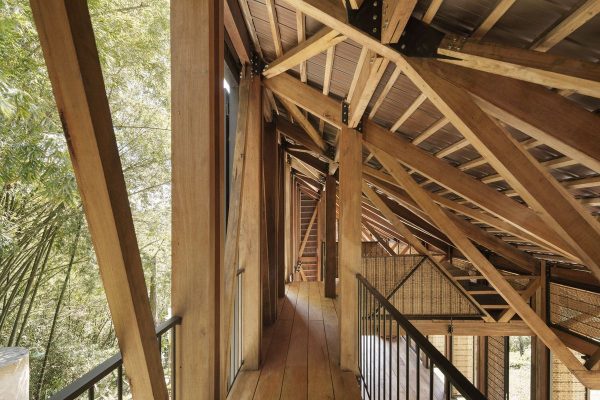
  2. Construction was divided into two phases. One focused on the structure, and the other on the finishes, creating an intentional pause for reflection and adaptation of the design.
  3. Woodworkers, metalworkers, transporters, neighbors, and craftspeople were brought into the design process from the beginning, and their knowledge helped guide the material and structural choices of both phases.
  4. Blueprints and details were designed to be shared under an open-source license for others to use, adapt, and build upon. This also promoted a collaborative exchange of knowledge and skills with the local workshops and craftspeople involved in the project’s development.


As a result the house is…

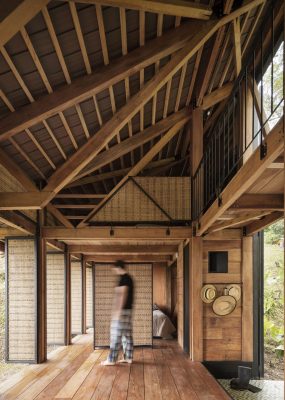
  • Rich of a new architectural language rooted in traditional craft. In particular thanks to the collaboration of local artisan Maria, who guided by a shared spirit of experimentation, co-developed the woven façade technique using bejuco yaré, blending ancestral knowledge with contemporary design. This innovation, born from community and place, became a symbol of the house’s identity.
  • Less resource-intensive due to a strong understanding of transportation limitations in the remote, muddy landscape, and the use of local materials and techniques.
  • A construction system that others can learn from and replicate its approach, extending its impact far beyond La Vereda Fical.

Aware

05-Context-Driven-transp

Context Driven

06-Evidence-Based-transp

Evidence Based

07-Integrated-transp

Integrated

08-Observational-transp

Observational

The project was guided by a process that is both context-driven and integrated. Its goals and approach arose from a commitment to understanding and supporting the social and ecological conditions of La Vereda Fical, and the construction methods developed to work in harmony with those realities.

Several key actions supported this approach:

  1. The clients and design team embraced the concept of building less to stay within budget and disrupt the ecological setting as little as possible.
  2. Time spent on-site allowed the team to learn directly from neighbors and local workers about daily rhythms, community dynamics, the natural environment and its diverse biodiversity. The team’s lived awareness of the site’s limited access and scarce resources also informed the decision to rely on local materials and nearby workshops, reducing transport impacts and supporting local economies.
  3. Contact with small manufacturing companies in Bogotá helped inform cost-efficient material and structural decisions. For example, a local wood manufacturer assisted the team in identifying the most efficient options for wood sourcing, while a metal manufacturer collaborated on the design of the metal joints, adapting them to the capabilities of the machinery available in his workshop.
  4. Construction techniques were adapted from regional practices, using lightweight, locally sourced components suited to the temperate tropical climate and the site’s rugged hillside, while integrating with the surrounding landscape.


As a result, the house is…

  • More carefully sited in the lot to align with the natural topography and is surrounded by ecologically responsive gardening areas, enriching local biodiversity while minimizing disruption. For example, outdoor spaces were shaped around existing vegetation and natural water flows, reducing disturbance and supporting small-scale ecological regeneration.
  • Less resource-intensive, relying on local materials, labor, and transport.
  • Supportive of and informed by its social context, from engaging nearby craftspeople in the development of unique pieces and techniques, to benefiting from the labor and local knowledge of immediate neighbors.
  • A building system and integrated design process whose logic can inform similar rural, community-rooted projects.