Write-up Contributor:

Conscious Design Principles


Designing for Life


This project was developed for a new progressive, women-led law firm Cleveland and Co, experiencing rapid growth. As their first office, the firm required spaces that embodied its collaborative, non-hierarchical ethos, supported flexible and remote working patterns, and attracted new talent.
The project was completed in 2019 by Matter Space Soul, carrying out architectural and interior design services and integrating specialist input from an Environmental Psychologist and Neuroarchitecture research as part of the studio’s process. The design development was discussed collaboratively to shape the project to a variety of psychological needs, benefits and impacts. Co-creation design processes with the client and end users were also key in realising a human-centric office space that reflected their non-traditional ethos and translated their emerging sense of shared identity into physical form, alongside integrating scientific insights.
Key design objectives included:
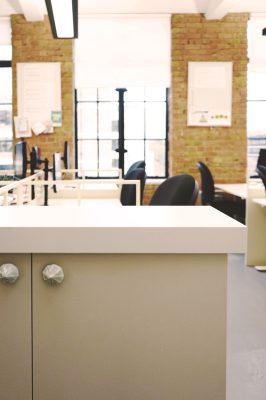
Conscious Design Principles promote the emergence of healthy built environments and a generative people-place dialogue. The principles highlight the importance of collaborative processes, more aware decision-making based on context and evidence, and responsive qualities that enable adaptation and attunement over time. Explore how this project applied the principles:

Co-imagined

Co-designed

Co-created

Co-stewarded
A central aspect of the process was engaging with the company founder and key team members to embed the firm’s culture and values into the spatial design. This collective approach ensured the space reflected shared meaning and purpose, contributing to wellbeing and happiness.
Co-creation as core part of design process
Natasha Reid / Matter Space Soul had previously been engaged to transform and renovate the founder’s family home in London, which gave a strong foundation of trust and an understanding of her preferences and values. Building on this, the process of developing the office space design involved ongoing discussions over time, taking on the characteristic intimacy of domestic design projects to discuss how the space could feel, the client’s aspirations and the user’s lived experiences, rather than through formal workshops or user surveys.
The close relationship with the founder of the company was key to shaping the space to;
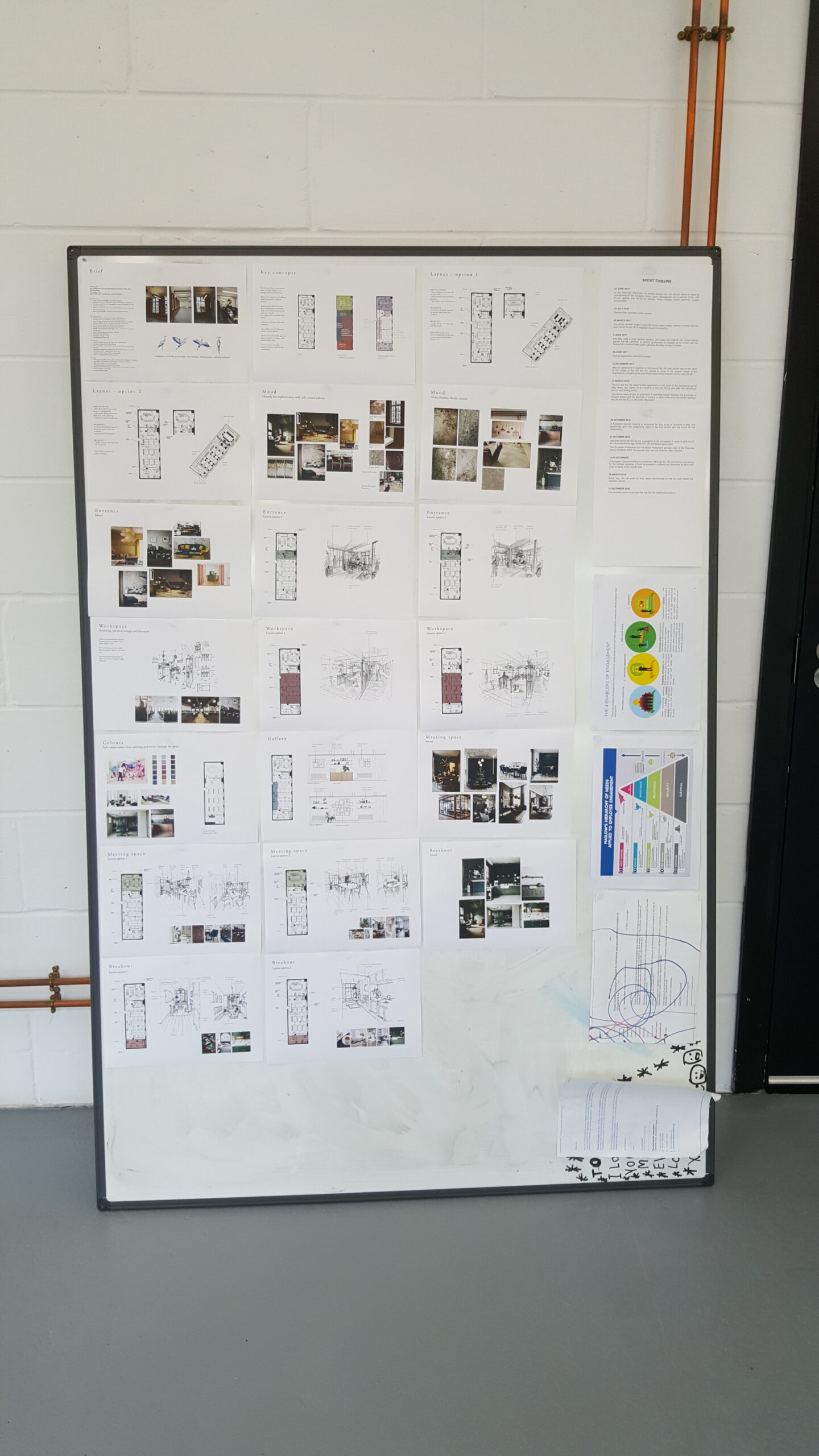
Designs were presented and options explored directly with the founder and her core team, who could then discuss them with the wider team to get more feedback. Plans, visuals and presentation materials were put up in the office space as the team started to work there, and as the team quickly grew over time the design evolved as well.
The design material was discussed and evolved over time in close conversation with the founder in order to embody, express and spatialise her company’s values through physical form.
The nature of work in a law firm guided the spatial strategy, such as creating separation and privacy for confidential conversations, for focus needed for knowledge work, for collaboration needed for innovation and team connectedness and belonging. The founder also noted spaces were needed for more “human” activities, such as having a space where people could feel like they could take a break, share their emotions freely if they wanted, or have team celebrations. This led to the careful configuration of a compact space, to enable a very wide variety of uses and psychological “conditions” in the same physical footprint.
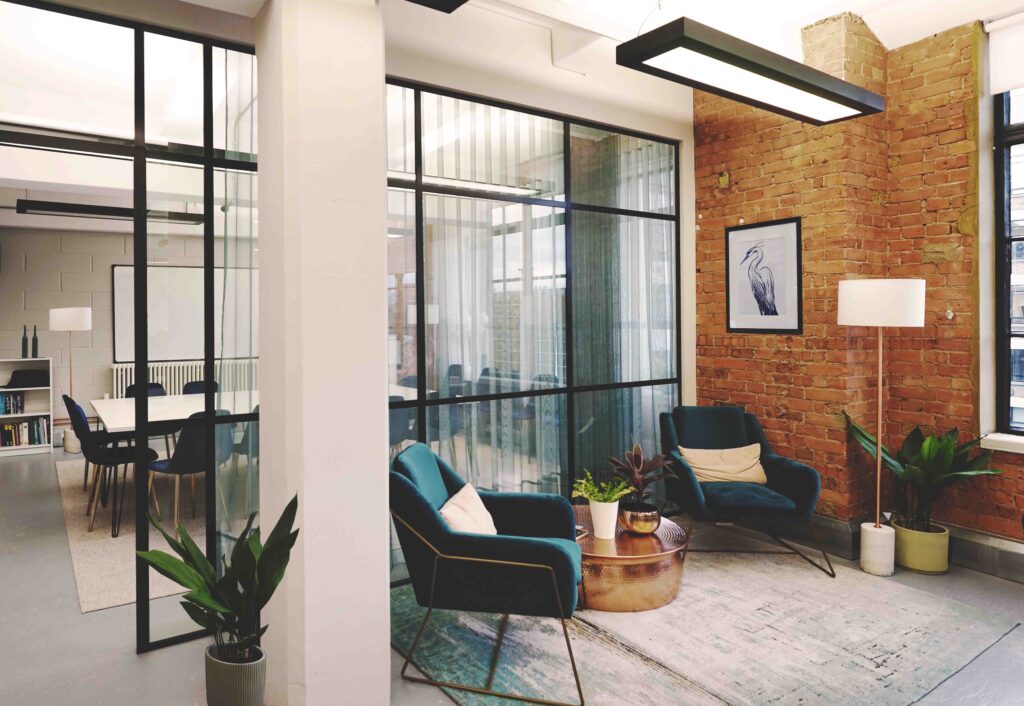
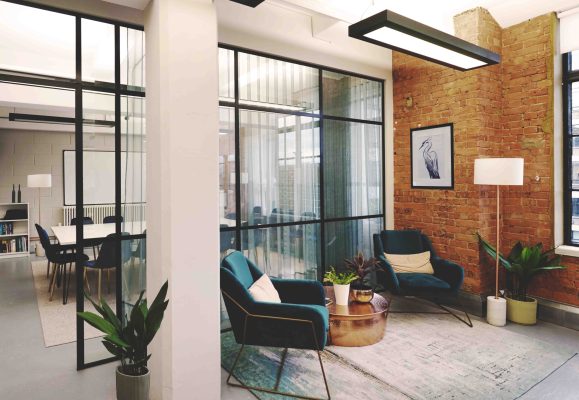
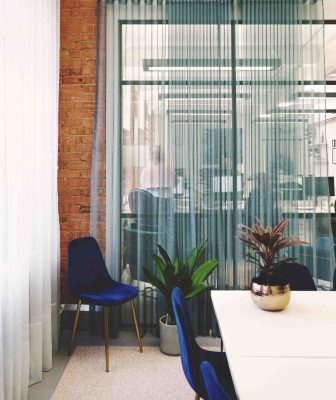
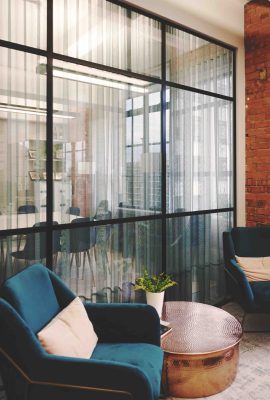
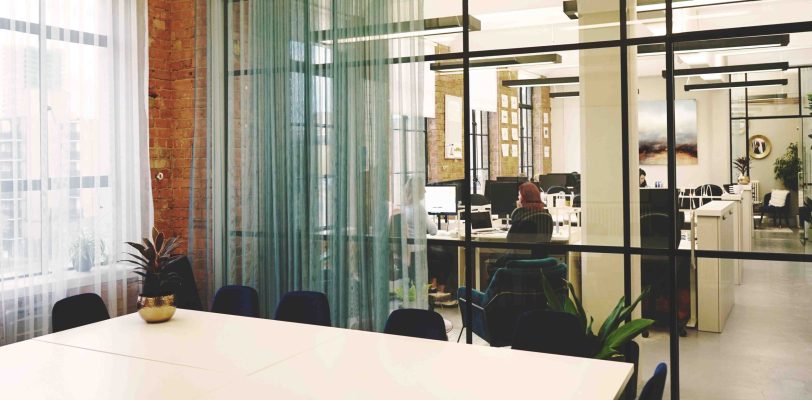
The company’s symbol of the heron was important from the start, as a way to materialise intangible values such as intelligence, grace, resourcefulness and determination. The refined forms and lightness of touch in this brand identity was translated into physical form, such as the use of the blue colour and fine metal in many details and layering through simple means such as translucent curtains. This approach builds a sense of distinctiveness, place attachment, pride and belonging for the team.
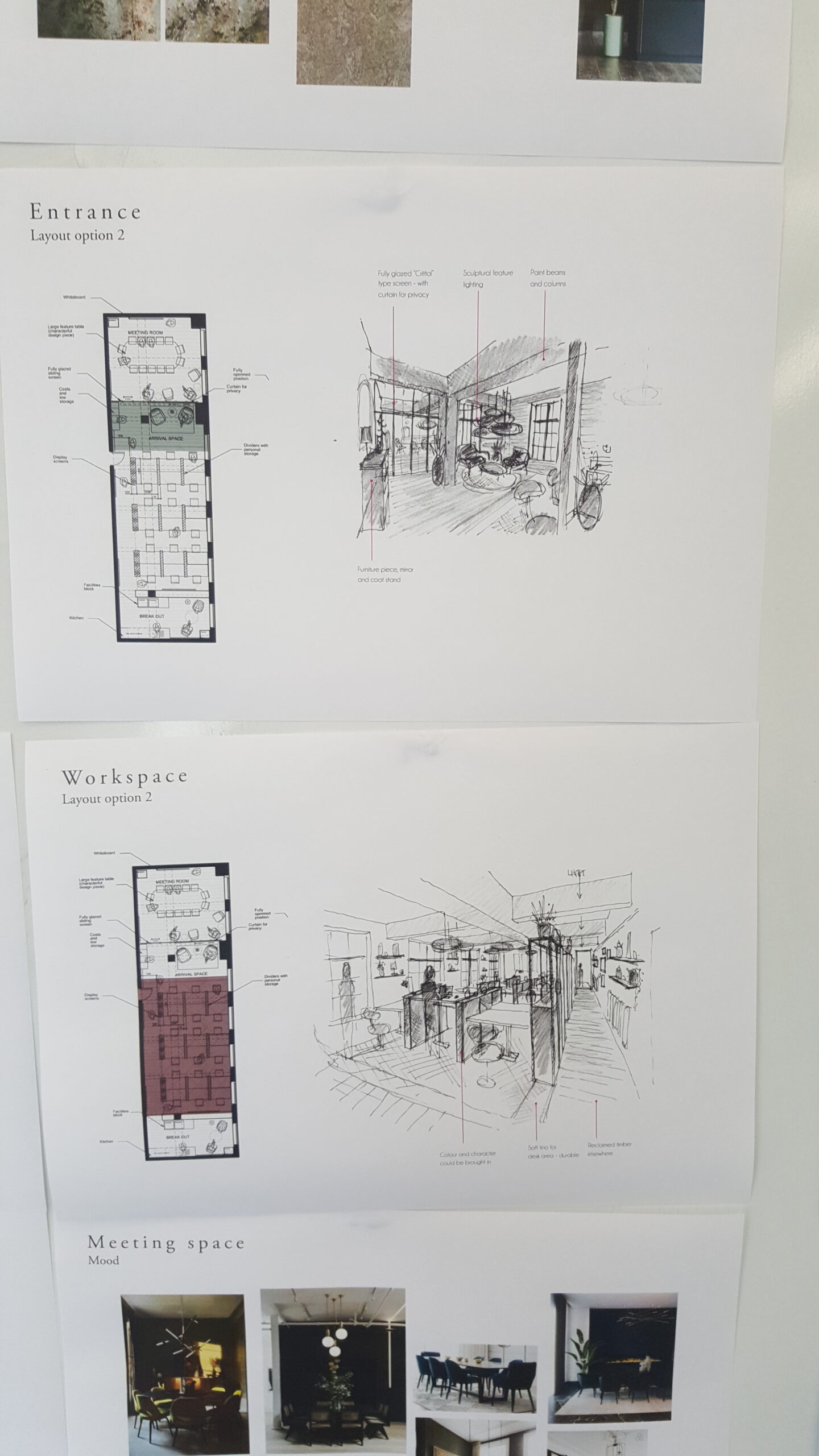
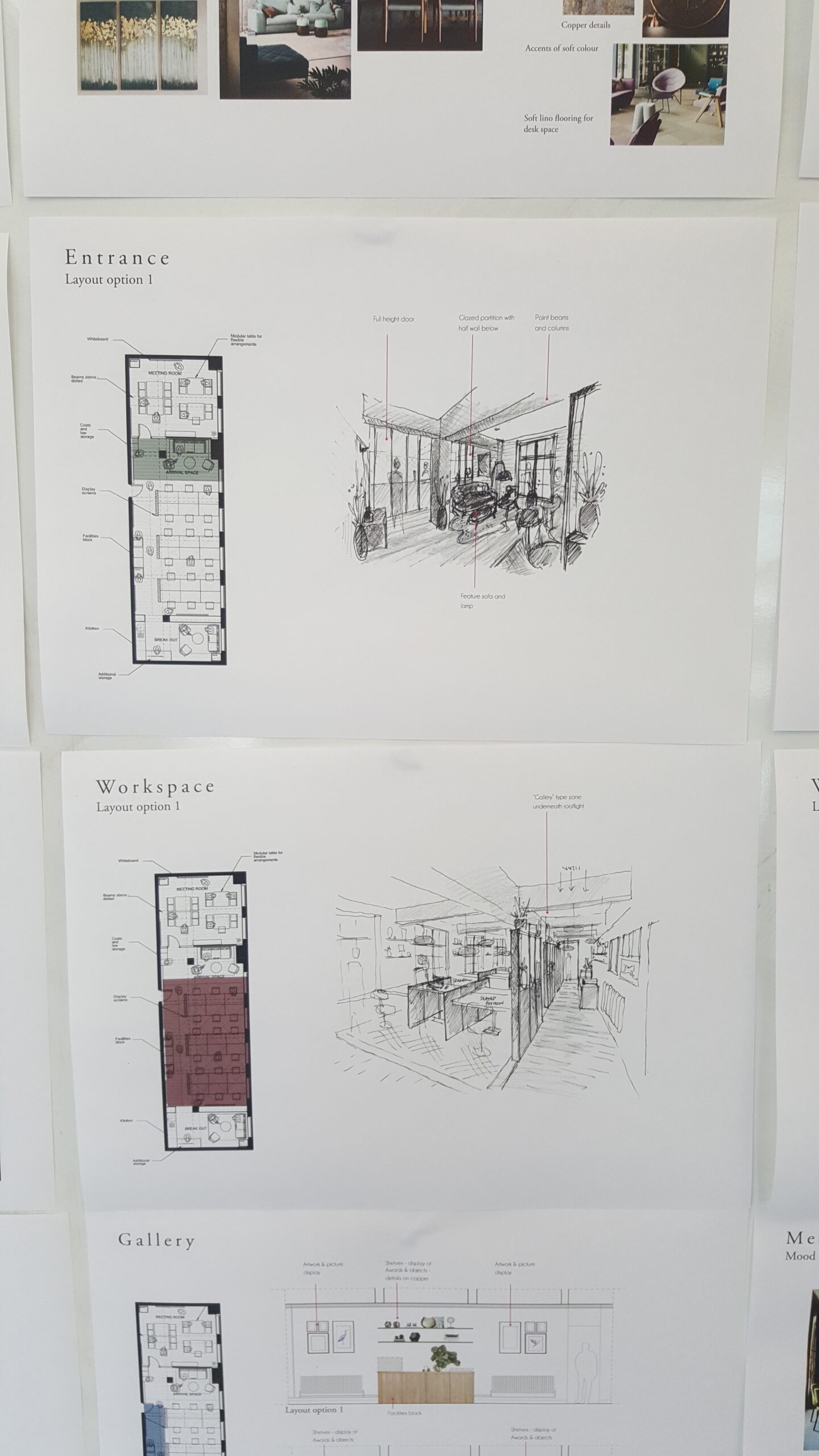
Images: The team were consulted through sharing plans, visuals, mood boards, diagrams and sketches to show the human experience, potential effects and human impacts of the spatial strategies and details.

Context Driven

Evidence Based

Integrated

Observational
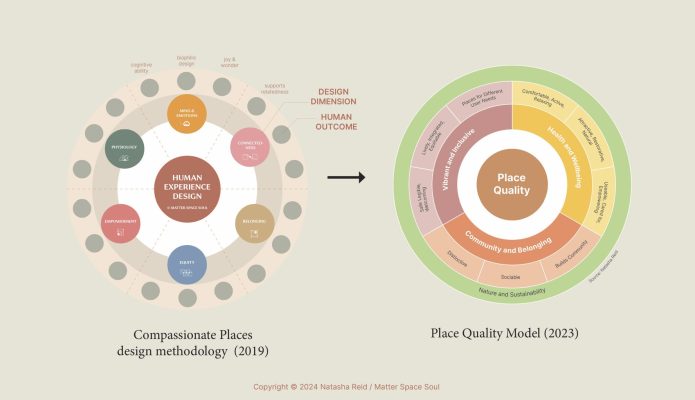
Experience-led and Evidence-based Design Strategies were used in this project to support: cognitive comfort, focus, agency, social connection and belonging. The Compassionate Places Method (Reid 2025), developed by Matter Space Soul was applied in this project. It is a structured methodology for built environment design to enable positive human experiences. It combines insights about human needs, nature and experience. The core principles of Compassionate Places Method are:
Note: The method used (Compassionate Places Method) is for experience-led strategies and spatial qualities, rather than led by physical design features or principles, as the outcomes can be created in through many different design solutions, principles and features.
Examples of design strategies / spatial qualities:
States of experience: Supporting different psychological conditions and feeling states through designing a set of spaces with different spatial conditions. The flexibility to change surroundings based on the task (e.g., moving to a quiet zone for deep work or a collaboration area for teamwork) supports different work styles and enhances focus.
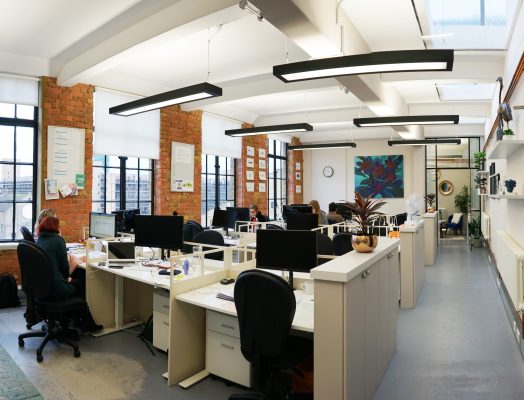
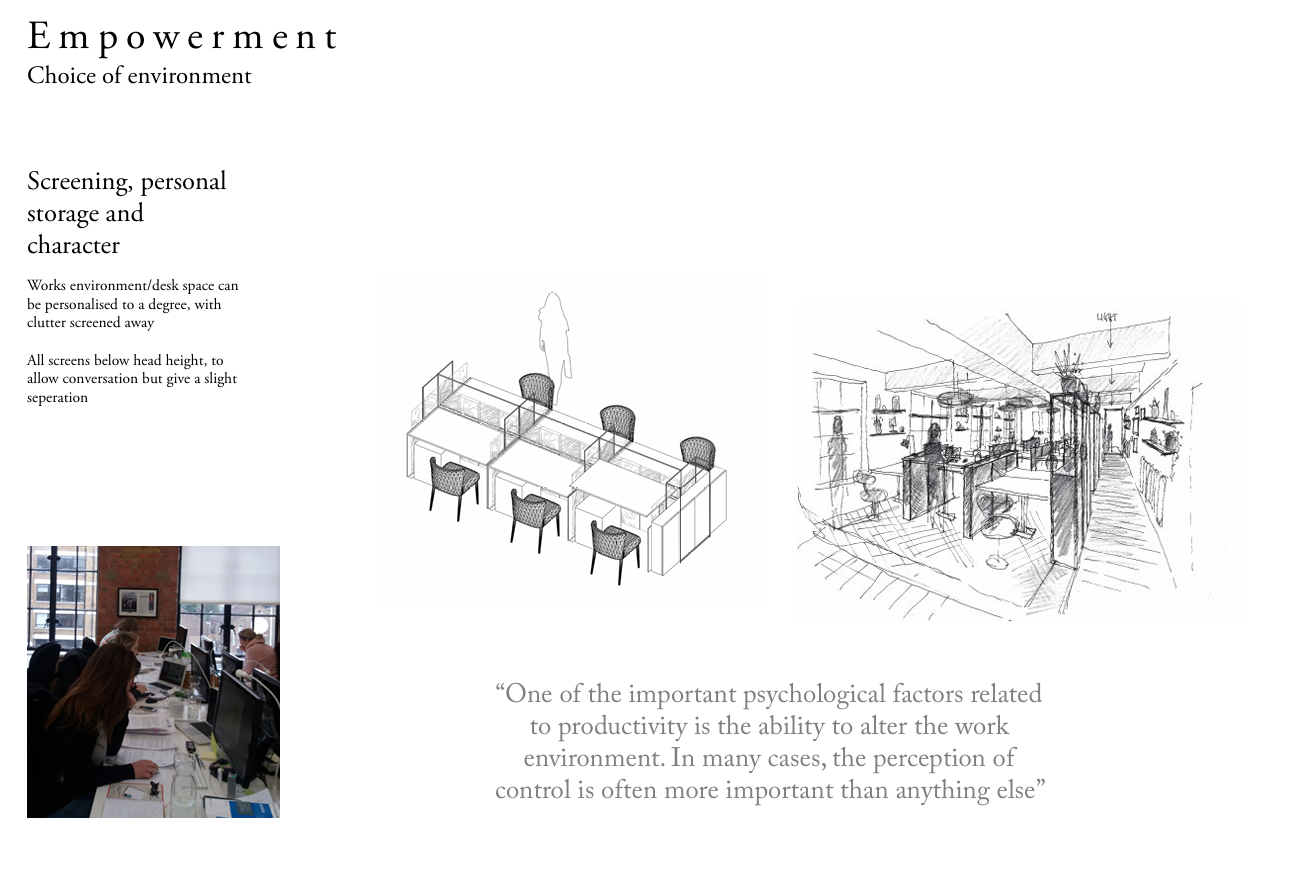
User Personalisation, Empowerment and Psychological Ownership: The act of “making” a workspace—adapting it to suit individual needs—enhances well-being and helps employees feel “at home” in their work setting. The spaces are designed to be highly reconfigurable, such as through curtains, for different levels of privacy, adaptable desks and tables for different layouts, group activities or individual working positions.
“One of the important psychological factors related to productivity is the ability to alter the work environment. In many cases, the perception of control is often more important than anything else” (Haworth, 2024).
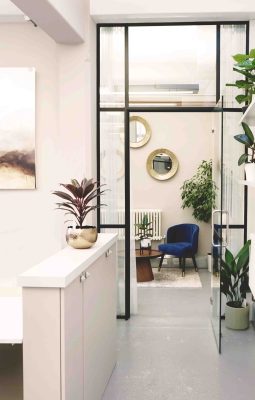
Coherence, Fascination & Homeliness: Carefully configured lines of sight, defined visual connectivity between spaces and overall principles of spatial legibility were used to define key zones and how the different space and experience typologies flow and interact together as a coherent journey. The design of different elements brought in visual richness and interest, whilst a domestic character of design was introduced to soften the industrial space to be more inviting, comfortable and homely.
The spatial qualities of coherence (ease with which one organizes and comprehends a scene), fascination (a scene’s informational richness and generated interest), and hominess (extent to which a scene feels comfortable, personal and home-like to user) are linked to positive emotional response. (Chatterjee et al., 2021, Coburn et al., 2020)
Place Identity, atmosphere and symbolism: The metaphor and feeling of home was created to invite a more intimate form of inhabitation than a conventional law firm office, which is often associated with spaces that communicate prestige and supports highly formal relationships and interactions. The design was shaped to facilitate different types of behaviours, togetherness and more connected, informal relationships. Intimacy of scale was used to support different patterns of perception, such as a sense of welcome.
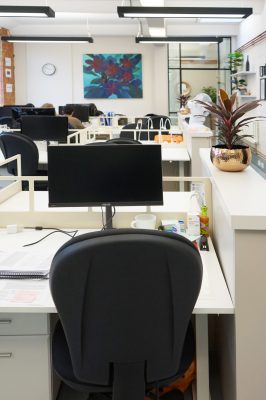
Cognitive attunement: Attention to reducing visual load, particularly for the views from the desks in order to support focused work. Visual calm is balanced with visual delight and aesthetic appeal through decorative elements. Collaborative spaces are shaped to stimulate the senses and interaction through material and formal richness.
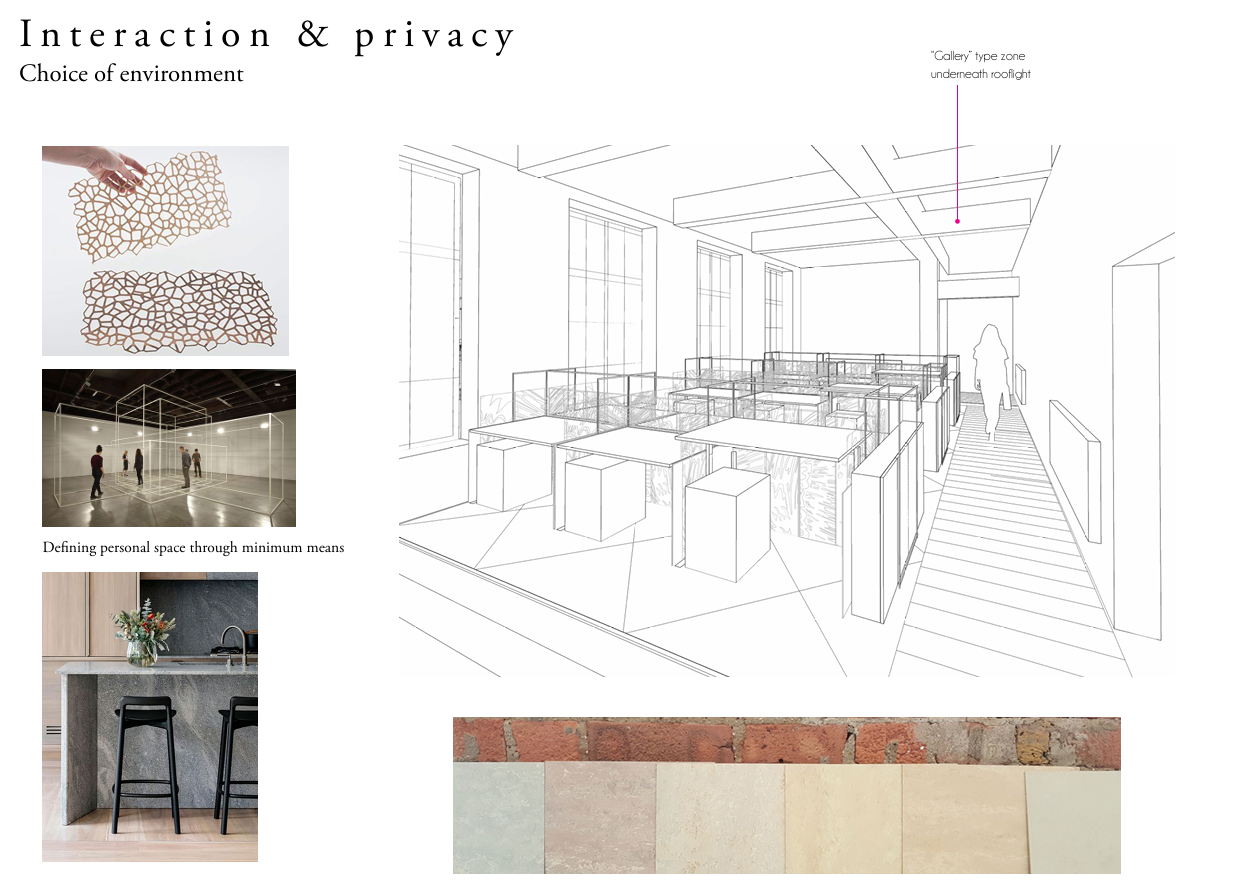
Proxemics and human scale details – Careful configuration of desk screens (widths and heights) in relation to zones of personal space, to enable users to feel they have a territory of their own, whilst maintaining social interaction and the ability to have a conversation and eye contact with their co-workers.
Biophilic design: Some biophilic attributes (Kellert et al., 2008), were used to bring a connection to nature in a highly industrial, urban site and within a limited budget. These include natural elements (in paintings and plants), Complexity and Order (detailed elements and decoration such as desk screens design, glass partition design with the pattern of black metal, and decorative metal elements to match such as bespoke table legs, together with the office’s legible layout), Sensory Variability (tactility of materiality and transparencies). All elements in the spaces, such as chairs, tables, mirrors, plant pots, decorative items on shelves and even the door knobs for the desk storage blocks were chosen to support the qualities of biophilic design, including curved shapes and in the detail of materials.

Reimagined

Redesigned

Adaptive

Evolving
“In many industries, traditional corporate working patterns and rigid expectations do not take into account the realities of the critical multi-faceted roles and demands women often hold in society – often without recognition – which impacts their careers. For example, inhospitable work contexts and unflexible environments can lead to women not returning to work after maternity leave, lower pay levels or limited career progression.” Natasha Reid, MATTER SPACE SOUL
As such, the concept of the office is reimagined as a “living” asset that responds deeply to the needs of the users and the organisation as it grows. As a dynamic, and reconfigurable habitat, it creates an anchor for human interaction, collaborative dynamics, productivity, creativity and a sense of purpose and belonging.
To provide the best experiences, we use technologies like cookies to store and/or access device information. Not consenting or withdrawing consent, may adversely affect certain features and functions.
