Write-up Contributor:
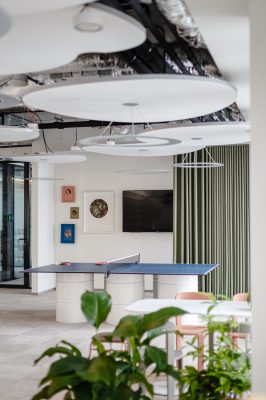
Arup’s Warsaw office is a human-centred workplace designed to support collaboration, restoration and everyday wellbeing within a standard project budget.
The project was developed through close collaboration between architects Workplace.pl, end users, and human-science specialists IMPRONTA.
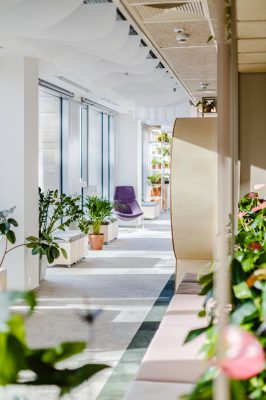
IMPRONTA’s task was to establish the design principles for how the office supports restoration. Grounded in neuroscientific research, behavioural insight and observation of everyday work patterns, the design embedded restoration into daily movement through a calm, multisensory transition corridor. Carefully balanced light, colour, materials, and spatial geometry reduce cognitive load and support mental regulation without demanding attention or instruction from users.


Conscious Design Principles promote the emergence of healthy built environments and a generative people-place dialogue. The principles highlight the importance of collaborative processes, more aware decision-making based on context and evidence, and responsive qualities that enable adaptation and attunement over time. Explore how this project applied the principles:
Co-imagined
Co-designed
Co-created
Co-stewarded
Arup’s Warsaw office was developed through a collaborative design process that brought together architects, users, and human-science specialists from the earliest stages.
User workshops and shared working sessions helped surface everyday work rhythms, moments of cognitive strain, and informal recovery practices that often remain unspoken.
The design evolved through iterative dialogue between disciplines, with behavioural insight, spatial constraints, and architectural intent informing one another directly. This collaboration led to a shared experiential goal: supporting restoration within the flow of daily work rather than separating it into designated wellbeing zones. The resulting concept of a restorative transition corridor emerged from this co-design process and was refined through ongoing exchange during implementation.
Comment from the consultant Natalia Olszewska:
The most difficult perspectives to include were those connected to implicit user needs. Unlike stated preferences or expressed frustrations, implicit needs – such as cognitive load, subtle stress responses, or unrecognised recovery requirements – are rarely articulated directly.
In this project, we did not use physiological or behavioural measurement tools that could have helped surface these implicit dimensions. As a result, we did not generate a formalised “implicit needs” framework from the workshop process itself.
This absence became a challenge. While participants were able to describe aspects of their experience, the less conscious layers of spatial experience remained largely unspoken. To address this gap, we turned to science-informed design research. Instead of extracting implicit needs directly from participants, we translated findings from environmental psychology and cognitive science into spatial strategies.
In this way, implicit needs were not captured firsthand, but were indirectly addressed through translational research on attention, stress, and restoration in work environments.
Context Driven
Evidence Based
Integrated
Observational
The project was shaped by a strong awareness of the cognitive demands typical of contemporary office work and the risk of superficial wellbeing responses. Rather than focusing on symbolic gestures, the design was grounded in a context-driven understanding of cumulative mental load, attentional fatigue, and the need for subtle opportunities for recovery within everyday environments. The effects were not directly recorded through physiological or cognitive measurements within the workforce. The design framework was informed by translational research in environmental psychology and neuroscience, rather than by in-situ biometric testing.
Design decisions were informed by neuroscientific and psychological research, including:
These findings guided choices related to light conditions, material character, colour ranges, and spatial geometry, prioritising reduction, balance, and restraint over stimulation.
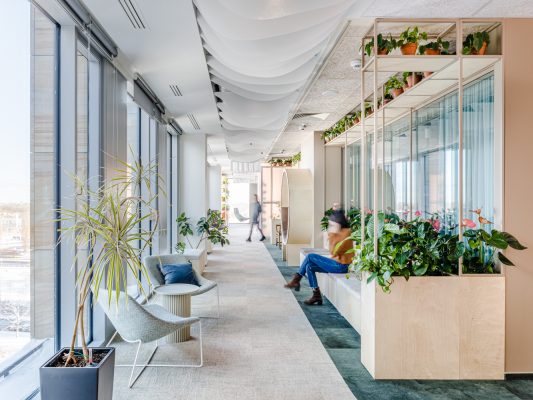
One example of how research informed the spatial outcome can be seen in the treatment of the primary circulation route along the façade. Rather than organising movement through compressed corridors and sharp transitions, the pathway unfolds in a continuous, curved trajectory that maintains visual depth and access to natural light. This geometry supports what environmental psychology describes as prospect and “soft fascination”, allowing the mind to disengage momentarily without losing orientation. The uninterrupted flow also reduces abrupt perceptual shifts, which can subtly increase vigilance in high-demand work settings.
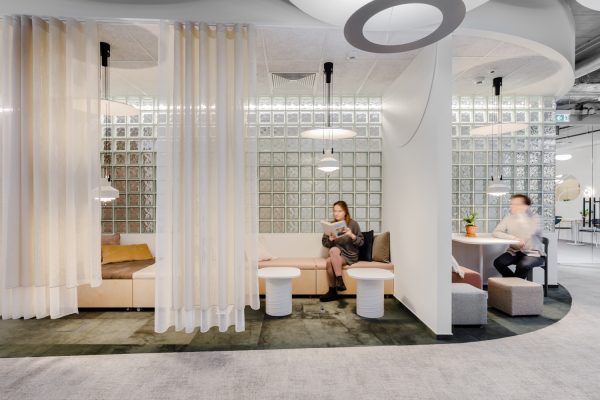
A second translation of research into spatial form can be seen in the introduction of “embracing” spatial pockets along the restorative route. Drawing on stress recovery theory and the prospect–refuge framework, the design incorporates recessed seating niches that provide a sense of enclosure without isolation. These spaces allow the user to withdraw visually and socially while maintaining orientation to the broader environment.
Comment from the consultant Natalia Olszewska:
One important shift came from questioning the assumption that adding more “positive” stimuli would automatically support restoration. Evidence from research and practice indicated that in high-demand contexts, even well-intended spatial features can unintentionally increase cognitive and sensory load, rather than reduce them.
This led to a change in direction away from enrichment and added features, and toward reduction, restraint, and simplification as more reliable supportive strategies.
Features often introduced in the name of wellbeing – such as dynamic lighting schemes or highly immersive biophilic installations – can, when overly intense or visually dense, fragment attention and sustain low-level vigilance. In cognitively fatigued states, the nervous system does not necessarily interpret stimulation as vitality; it may register it as additional demand.
The goal became not to energise the user, but to regulate the environment. Restoration was approached as the removal of unnecessary cognitive demand rather than the addition of positive distraction.
Reimagined
Redesigned
Adaptive
Evolving
Responsiveness was embedded through an intentionally low-specificity design approach. The restorative corridor was not assigned a fixed programme or prescribed behaviour, allowing it to adapt to changing work patterns, organisational culture, and individual needs without losing its core function.
Rather than responding to feedback through overt redesigns, the space supports ongoing adjustment through subtle means. Lighting can be tuned, materials can age or be replaced, and adjacent spaces can evolve while maintaining the corridor’s restorative role. This adaptability is enabled by the project’s focus on functional intent rather than stylistic expression.
Learning from use is carried forward through application rather than formal feedback systems. Insights gained from this project have already informed subsequent work and discussions, shaping how restoration is approached in other contexts. The environment remains open-ended and resilient, designed to evolve gradually while continuing to support everyday wellbeing over time.
To provide the best experiences, we use technologies like cookies to store and/or access device information. Not consenting or withdrawing consent, may adversely affect certain features and functions.