
“There are things we can possess only by following them into the realm of disguise. There, we may be given a quarry altered, more pungent and wilder and stranger than we had surmised.”
– Jane Hirshfield, Nine Gates: Entering the Mind of Poetry1
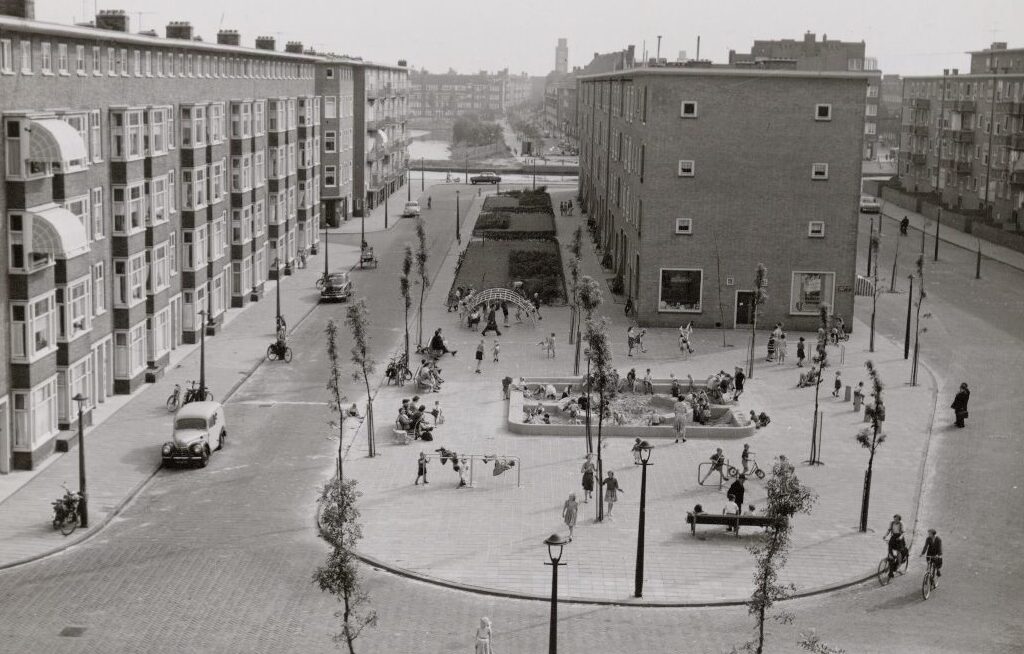
Anecdotal evidence suggests that ambiguity is associated with human creativity. The research of R. Withagen and S. Caljouw on aesthetics, affordances, and creativity points to Aldo van Eyck’s mid-century urban playgrounds as an example of this positive association2 (see Figures 1 and 2). Likewise, philosopher and architect Sarah Robinson suggests that the open-ended quality of van Eyck’s playgrounds, characterized by strikingly simple structures, inspire creativity in children by enabling vast possibilities of imaginative play.3 Withagen and Caljouw discuss ambiguity as a phenomenon in the context of affordances, or the cues that suggest possible engagements with objects or places; for instance, an elevator affords standing, a chair affords sitting, and a bed affords lying down.4 Van Eyck sought to create “tools for imagination”5 by designing play structures with multiple and open-ended affordances. Within the built environment, humans are accustomed to explicit affordances—in fact, it is often the architect’s goal to incorporate well-defined spatial cues. But could environments with ambiguous affordances, like Aldo van Eyck’s playgrounds, offer certain benefits for human creativity?
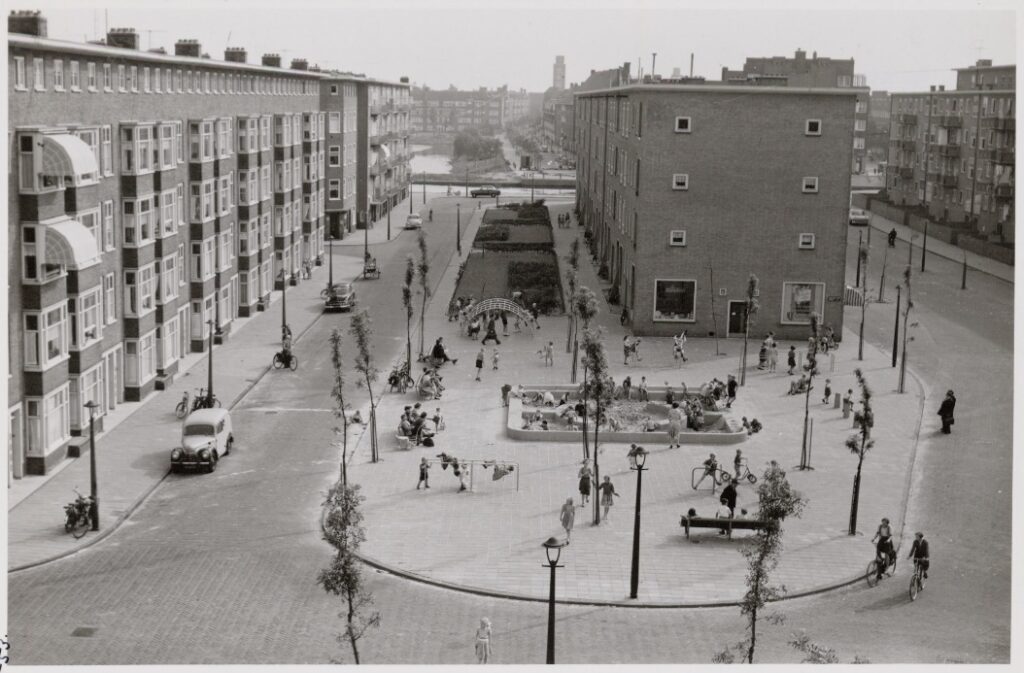
Figure 1
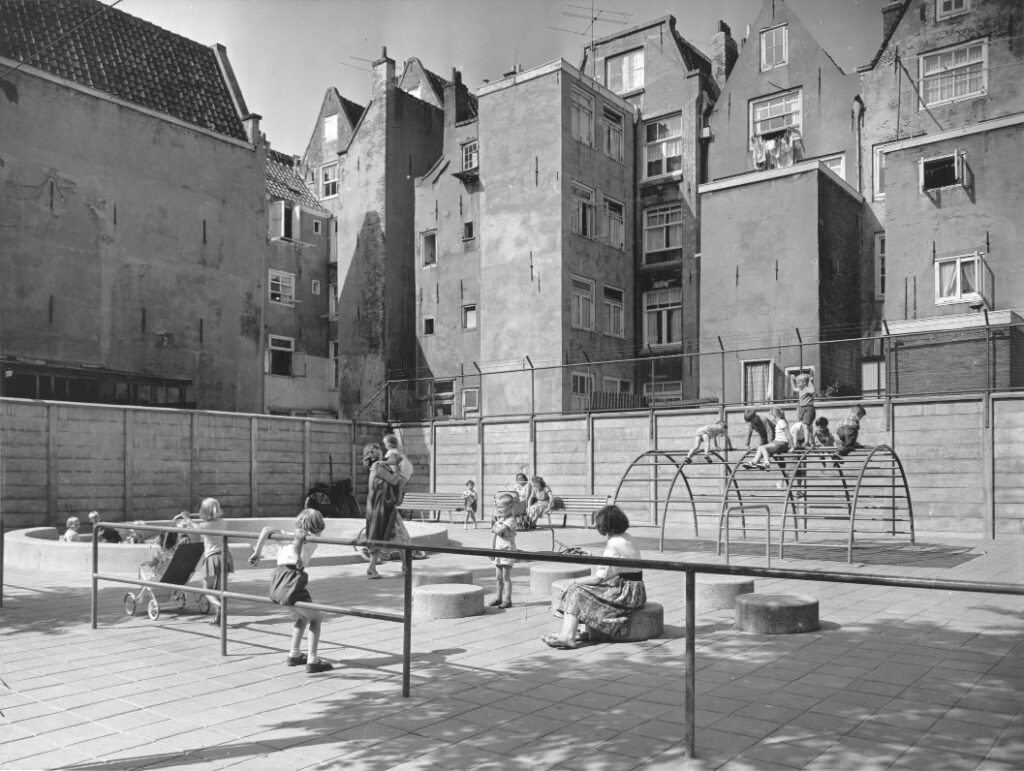
Figures 1 and 2. Two neighborhood playgrounds in Amsterdam where the demarcation between the street and play areas are undefined. The invitations for play are simple structures open to a broad spectrum of improvisational games.
Figure 1 – Aldo van Eyck’s playground at the Buskenblaserstraat
Figure 2 – a playground at the Laagte Kadijk. Courtesy of the Amsterdam City Archive.
In this paper, we present a brief review of theoretical and empirical work informing a proposed line of research exploring cognitive and behavioral effects of spatial ambiguity. Specifically, we argue that it would be valuable to empirically address the question of whether spatial ambiguity—the presence of multiple, equally valid, and diverse possibilities for engagements within a space—can affect human creative processes and output. We believe this line of inquiry will have important implications for architecture by uncovering strategies to facilitate creative thinking through design.
Empirical research examining the relationship between spatial ambiguity and creativity would build on previous work in behavioral psychology and biological sciences connecting ambiguity with creativity. Many creativity researchers have offered that the creative process inherently involves navigating ambiguity.6,7,8 More specifically, forming original or novel ideas often involves complex and ambiguous situations; and the problem-solving associated with creative thought itself may be an ambiguous process.9,10 Anna Abraham, whose work focuses on the neuroscience of creativity, posits that creative thinking is “called for in contexts that are unclear, vague and open-ended.”11 Similarly, vision scientist Semir Zeki uses a neurobiological perspective to establish a definition of ambiguity as “the certainty of many, equally plausible interpretations,”12 which he argues is a core feature of compelling works of art, and a significant part of what drives aesthetic appreciation for creative work.13 For instance, when discussing the manifold narratives of Jan Vermeer’s A Lady at the Virginals with a Gentleman, Zeki writes,
The painting, I believe, derives its grandeur from the way in which its technical virtuosity is used to generate ambiguity. Here I use the term ambiguity to mean its ability to represent simultaneously, on the same canvas, not one but several truths, each one of which has equal validity with the others . . . Through its stored memory of similar past events, the brain can recognize in this painting the ideal representation of many situations.14
Zeki’s definition of ambiguity as the coexistence of multiple, equally valid possible engagements informs how we conceptualize spatial ambiguity, especially insofar as visual aesthetic appreciation is neurologically part of architectural experience.
Outside the realm of architecture, in psychological work, ambiguity and creativity have been linked both at trait (i.e., personality) and experimental levels. At the trait level, researchers have demonstrated that those who are better able to tolerate ambiguous situations are also more likely to be more creative.15,16 Experimentally, bistable images (i.e., pictures with two interpretations; see Figure 3 for examples) have been used to show that viewing ambiguous stimuli is associated with heightened creativity17 and insight.18 However, to our knowledge, the link between ambiguity and creativity has not yet been tested within the domain of architecture. What can architecture do to stimulate creativity?
In the following sections, we will discuss extant findings and establish key classifications for a future line of study. The relevant definitions of our terminology will frame how the influence of spatial ambiguity on human creative processes may be measured.

Figure 3. Examples of bistable images, with a Necker cube on the left and faces/vase on the right. Each image has two separate interpretations.
Defining spatial ambiguity and creativity
Spatial Ambiguity
For our purposes, we define spatial ambiguity as the presence of multiple, equally valid, and diverse affordances or possibilities for engagements within a space. We define spatial ambiguity by way of James Gibson’s theory of affordances, which states that environmental perception involves the awareness of affordances, or action possibilities within a space or with an object.19 As invitations for engagement, affordances depend as much on the physical form of the object or environment as the user’s familiarity and past experiences, cultural and behavioral norms, and goals.20 The body’s physical capacity to engage with a space or object, which may vary from one user to another, also plays a role in the perception of affordances.21 For instance, to an adult with familiarity and past experience with conference rooms, a conference table with chairs likely affords sitting; but a toddler, faced with the same chair, might see an invitation to hide underneath or build a fort. Because spatial ambiguity involves the perception of affordances, it is dependent on an interplay between the environment and the experiences of the body. Yet while spatial ambiguity presents a subjective experience from a user’s perspective, it is also a quality of a space that an architect can intentionally incorporate into their building design.
Creativity
“Creativity is the defeat of habit by originality.” – Arthur Koestler, The Act of Creation22
In simple terms, creativity lies at the intersection of ideas that are new and ideas that are appropriate to a particular situation; it “reflects our capacity to generate ideas that are original, unusual or novel in some way.”23 Creativity can be measured in two ways: in terms of actual creative output (e.g., artistic or scientific outputs, such as a painting or a new scientific methodology), or creative potential, which comprises creativity measured through personality as well as indirect measures of creative thought and behavior.24 The most widely used measures of creative potential are divergent thinking tasks, which measure the ability to generate many different solutions to a given problem.25,26 Divergent thinking is often contrasted with convergent thinking, which is the ability to identify the single most appropriate solution to a given problem.27 While divergent thinking is not the sole component of creativity, it is considered central by many researchers and is one of the most widely used measures of creativity.e.g.,28 For this reason, we propose that divergent thinking tasks are the most useful and appropriate measures for our inquiry. Divergent thinking measures would best be applied to spaces intended for developing new ideas and products.
Ambiguity in architecture
Architecture is the setting for the scenes of our daily practice: private, shared, and cultural. While many studies have investigated how social and organizational factors can facilitate or hinder creativity,e.g.,29 there are, by contrast, few studies exploring the effect of the physical environment on creativity. The existing work in this field has demonstrated relationships between creativity and various physical environmental factors, such as lighting, noise, furniture, and views of nature.30,31 A study mentioned earlier demonstrates that observing a Necker cube, an ambiguous visual image, can enhance one’s creative ability.32 This research seems to suggest there are ways to prime the mind to be more creative: Could spatial ambiguity be one of these ways?
Spatial ambiguity, as we describe it, reflects the architect’s sense about space: We understand both through professional expertise and from the biological sciences that one’s engagement with the built environment is action-oriented. Within spatially ambiguous environments, opportunities for action offer themselves up as equal potentialities awaiting our physiological, cultural, or desired needs of the moment. In architectural design studios, students often create architectural ambiguities to draw users into buildings, demonstrating an intuitive understanding of this experiential phenomenon. This may be what architects mean when they say a building is poetic: a space that is endowed with multiple potential affordances that a user sorts through based on their context, such as their mood and immediate needs.
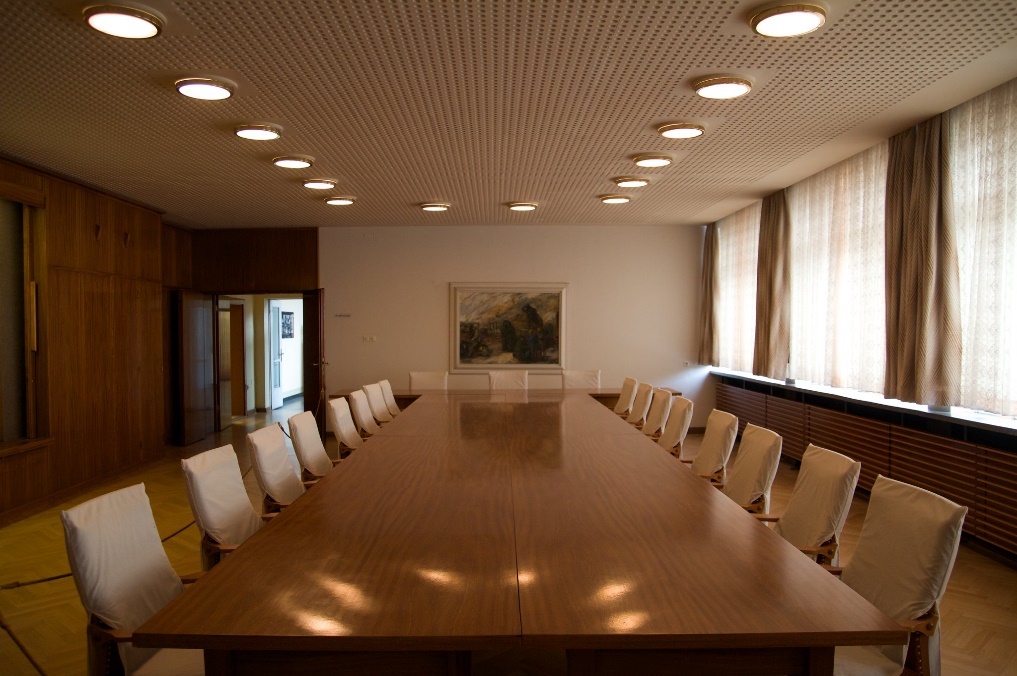
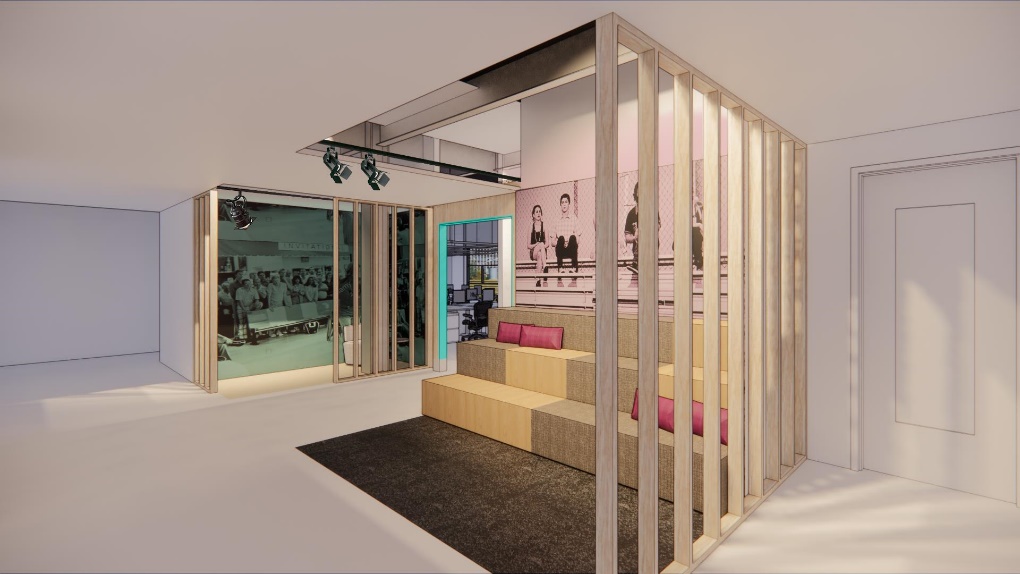
Figures 4 and 5. Corporate and business workplaces may provide another example of how spatial ambiguity can affect creative processes. The well-known archetype of the boardroom (see Figure 4) shows the unambiguous nature of the behaviors expected in this space. On the other hand, an open plan (see Figure 5) carries many possible scripts for engagement. In which of these spaces do you think you would feel more playful or inspired? Figure 4: Courtesy of Jesse Garrison. Figure 5: Courtesy of Perkins Eastman.
Indeed, the theoretical connection between ambiguity and creativity has been applied to the recent trend of “purpose-free” spaces in workplace design (see Figures 4 and 5 above). With the intent to spark creativity and collaboration, companies have introduced open-ended zones for employees to use as they wish. Like Aldo van Eyck’s playgrounds, these spaces are intentionally devoid of explicit purpose and open to interpretation. Exemplifying this trend, for instance, a “Town Hall” space at the offices of the news outlet Quartz is fitted with oversized steps that are “as much a play structure as a platform.”33 The growing popularity of “purpose-free” spaces is rooted in the assumption that open-ended spaces may encourage collaboration and foster creativity. We believe that this architectural assumption, supported by theoretical connections between spatial ambiguity and creativity, presents an opportunity to empirically test this link using psychological methods.
Implications and applications
What role does one’s physical environment have in sparking creativity? The evidence reviewed here points to the possibility that the architecture of a room can facilitate creativity. That a room, a place, or an architectural design might afford the possibility of an occupant making a creative work is the designer’s task. What if we could uncover this architectural intuition from a scientific perspective? As mentioned, in workplace design, “purpose-free” spaces are a popular and growing trend. These furniture-free, landscape-like spaces are intuitively linked to creativity, although we lack evidence to confirm this relationship. Our proposed line of research has the potential to demonstrate empirically what we know intuitively—that spatial ambiguity is linked to creativity—and to transform our assumption into scientific knowledge that can be applied to architectural design to enhance creativity.
We are currently working to develop a research design and collect data to test this assumption. Although our specific methods are beyond the scope of this paper, they follow that of previous work showing measurable effects on creativity from viewing ambiguous images.34,35 However, this inquiry would benefit from various methods, including field work.
The prospect that human creativity can be stimulated by spatial ambiguity presents exciting possibilities for the practice of architecture and design. A data-driven, phenomenological approach will support a more substantial understanding of ambiguity in the practice of architecture as an atmospheric stimulus for creativity. After a relationship between spatial ambiguity and creativity is established, future work can further explore this relationship, for instance by determining how the effects of spatially ambiguous spaces may change over time or with familiarity, as well as whether these effects can transfer to other environments. In addition, work can explore how creativity is impacted by individual differences in the experience of spatial ambiguity and one’s behavior within a space (e.g., exploratory vs. goal-oriented behavior). Indeed, too much flexibility in a space could distract a person depending on their goals or the norms governing the space’s use;36 spatial ambiguity may be more or less beneficial for creativity based on the task and goal at hand.
Our inquiry follows on a long-instituted question on the mystery of the built environment’s role in creativity. As Frank Lloyd Wright said, “We need to know more about the kinds of environments that foster—or smother—creativity and high performance. What kinds of support do creative workers need from supervisors, colleagues, society in general?”37 With empirical support, spatial ambiguity may become another evidence-based strategy in the architect’s toolkit to invite a more creative mind.
References
- Hirshfield, J. (1997). Nine gates: Entering the mind of poetry (p. 109). Harper Collins.
- Withagen, R., & Caljouw, S. R. (2017). Aldo van Eyck’s playgrounds: Aesthetics, affordances, and creativity. Frontiers in Psychology, 8(1130), 1–9. https://doi.org/10.3389/fpsyg.2017.01130
- Plab 2003 S. (2019, May 14). Articulating Affordance: Towards a New Theory of Design. By Sarah Robinson [Video]. Youtube. https://www.youtube.com/watch?v=1D4s0KJCnNI&t=9s
- Withagen, R., & Caljouw, S. R. (2017). Aldo van Eyck’s playgrounds: Aesthetics, affordances, and creativity. Frontiers in Psychology, 8(1130), 1–9. https://doi.org/10.3389/fpsyg.2017.01130
- de Roode, I. (2002). The play objects: More durable than snow. In L. Lefaivre & I. de Roode (Eds.), Aldo van Eyck: The playgrounds and the city (pp. 84–101). NAi Publishers.
- Abraham, A. (2108). The neuroscience of creativity. Cambridge University Press.
- Tegano, D. W. (1990). Relationship of tolerance of ambiguity and playfulness to creativity. Psychological Reports, 66(3), 1047–1056. https://doi.org/10.2466/pr0.1990.66.3.1047
- Zenasni, F., Besançon, M., & Lubart, T. (2008). Creativity and tolerance of ambiguity: An empirical study. The Journal of Creative Behavior, 42(1), 61–73. https://doi.org/10.1002/j.2162-6057.2008.tb01080.x
- Tegano, D. W. (1990). Relationship of tolerance of ambiguity and playfulness to creativity. Psychological Reports 66(3), 1047–1056. https://doi.org/10.2466/pr0.1990.66.3.1047
- Zenasni, F., Besançon, M., & Lubart, T. (2008). Creativity and tolerance of ambiguity: An empirical study. The Journal of Creative Behavior, 42(1), 61–73. https://doi.org/10.1002/j.2162-6057.2008.tb01080.x
- Kaufman, S. B. (2019, January 4). The neuroscience of creativity: A Q&A with Anna Abraham. Beautiful Minds, The Scientific American. https://blogs.scientificamerican.com/beautiful-minds/the-neuroscience-of-creativity-a-q-a-with-anna-abraham/
- Zeki, S. (2004). The neurology of ambiguity. Consciousness and Cognition, 13(1), 173–196. https://doi.org/10.1016/j.concog.2003.10.003
- Zeki, S. (1999). Inner vision: An exploration of art and the brain (p. 24).Oxford University Press.
- Ibid.
- Tegano, D. W. (1990). Relationship of tolerance of ambiguity and playfulness to creativity. Psychological Reports, 66(3), 1047–1056. https://doi.org/10.2466/pr0.1990.66.3.1047
- Zenasni, F., Besançon, M., & Lubart, T. (2008). Creativity and tolerance of ambiguity: An empirical study. The Journal of Creative Behavior, 42(1), 61–73. https://doi.org/10.1002/j.2162-6057.2008.tb01080.x
- Wu, X., Gu, X., & Zhang, H. (2019). The facilitative effects of ambiguous figures on creative solution. The Journal of Creative Behavior, 53(1), 44–51. https://doi.org/10.1002/jocb.161
- Laukkonen, R. E., & Tangen, J. M. (2017). Can observing a Necker cube make you more insightful? Consciousness and Cognition, 48, 198–211. https://doi.org/10.1016/j.concog.2016.11.011
- Gibson, J. J. (1979). The ecological approach to visual perception. Houghton Mifflin.
- Rietveld, E., & Kiverstein, J. (2014). A rich landscape of affordances. Ecological Psychology 26(4), 325–352. https://doi.org/10.1080/10407413.2014.958035
- Ibid.
- Koestler, A., quoted in Abraham, A. (2108). The neuroscience of creativity (p. 1). Cambridge University Press.
- Abraham, A. (2108). The neuroscience of creativity. Cambridge University Press.
- Villani, D., & Antonietti, A. (2013). Measurement of creativity. In E. G. Carayannis (Ed.), Encyclopedia of creativity, invention, innovation and entrepreneurship (pp. 1234–1238). Springer. https://doi.org/10.1007/978-1-4614-3858-8_377
- Ibid.
- Reiter-Palmon, R., Forthmann, B., & Barbot, B. (2019). Scoring divergent thinking tests: A review and systematic framework. Psychology of Aesthetics, Creativity, and the Arts, 13(2), 144–152. https://doi.org/10.1037/aca0000227
- Hennessey, B. A., & Amabile, T. M. (2010). Creativity. Annual Review of Psychology, 61(1), 569–598. https://doi.org/10.1146/annurev.psych.093008.100416
- Guilford, J. P. (1967). Creativity: Yesterday, today, and tomorrow. TheJournalofCreativeBehavior,1(1), 3–14. https://doi.org/10.1002/j.2162-6057.1967.tb00002.x
- Amabile, T. M., Conti, R., Coon, H., Lazenby, J., & Herron, M. (1996). Assessing the work environment for creativity. Academy of Management Journal, 39(5), 1154–1184. https://doi.org/10.5465/256995
- Ceylan, C., Dul, J., & Aytac, S. (2008). Can the office environment stimulate a manager’s creativity? Human Factors and Ergonomics in Manufacturing & Service Industries, 18(6), 589–602. https://doi.org/10.1002/hfm.20128
- Steidle, A., & Werth, L. (2013). Freedom from constraints: Darkness and dim illumination promote creativity. Journal of Environmental Psychology, 35, 67–80. https://doi.org/10.1016/j.jenvp.2013.05.003
- Zeki, S. (1999). Inner vision: An exploration of art and the brain.Oxford University Press.
- Coester, D. (2017, October 18). How to design workspaces that spur collaboration. The American Press Institute. https://www.americanpressinstitute.org/publications/reports/strategy-studies/spaces-collaboration/
- Wu, X., Gu, X., & Zhang, H. (2019). The facilitative effects of ambiguous figures on creative solution. The Journal of Creative Behavior, 53(1), 44–51. https://doi.org/10.1002/jocb.161
- Laukkonen, R. E., & Tangen, J. M. (2017). Can observing a Necker cube make you more insightful? Consciousness and Cognition, 48, 198–211. https://doi.org/10.1016/j.concog.2016.11.011
- Mizere, M. (2017). Managing flexibility in workplace design. Conscious Cities Anthology 2018: Human-Centered Design, Science, and Technology.
- Wright, F. L., quoted in Serraino, P. (2016). The creative architect (p. 16). The Monacelli Press.