

A cool start to the morning in mid-September 2025 relents as the temperature quickly warms the streets of Toronto. People are restless with anticipation for one of the last warm Saturdays of the year. Torontonians know that each 20°C plus day could be the last for months, and they are not about to waste it. Here in Toronto’s queer enclave – the Church-Wellesley Village (“the Village”) – people come across an unusual sight.
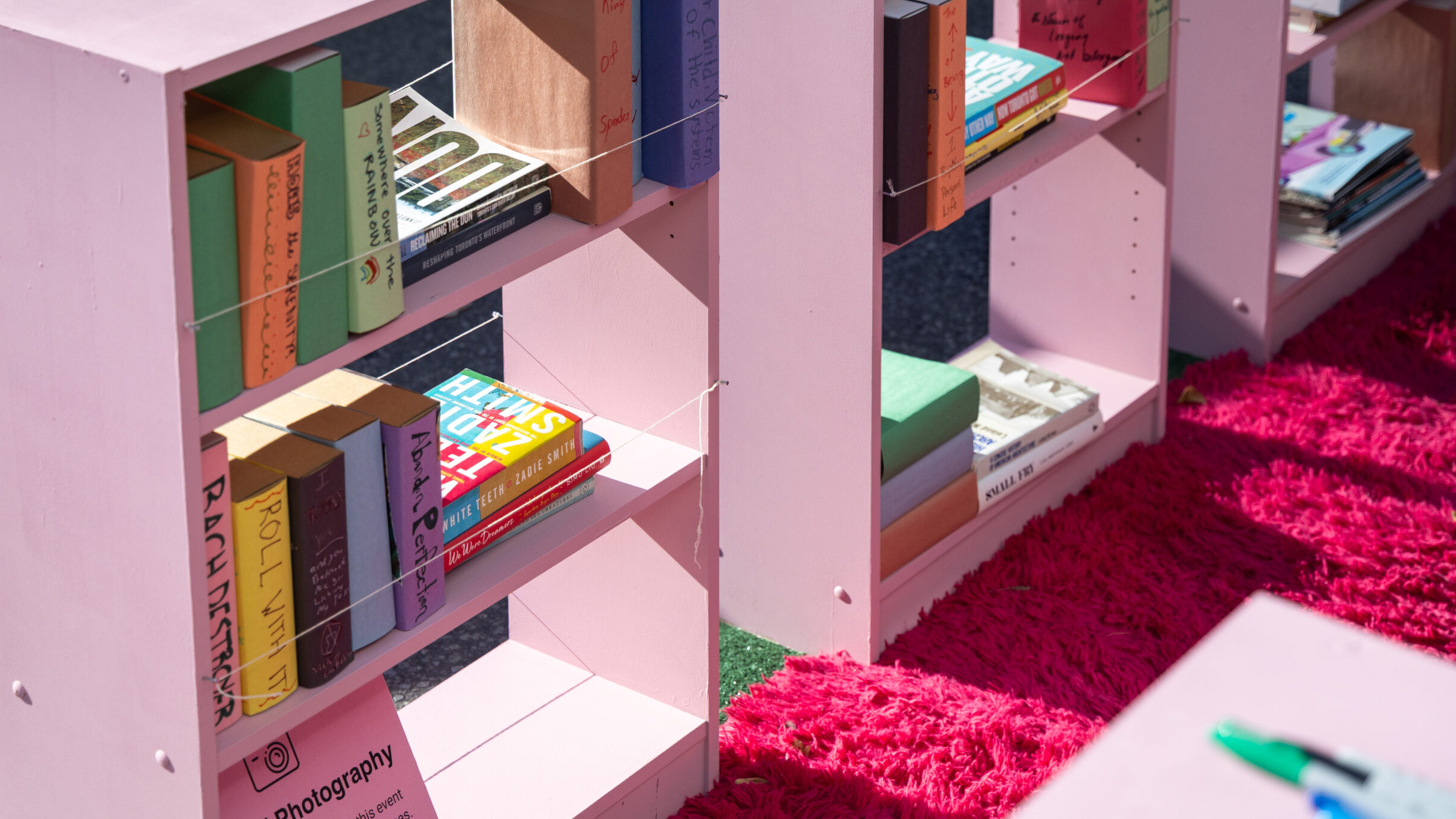
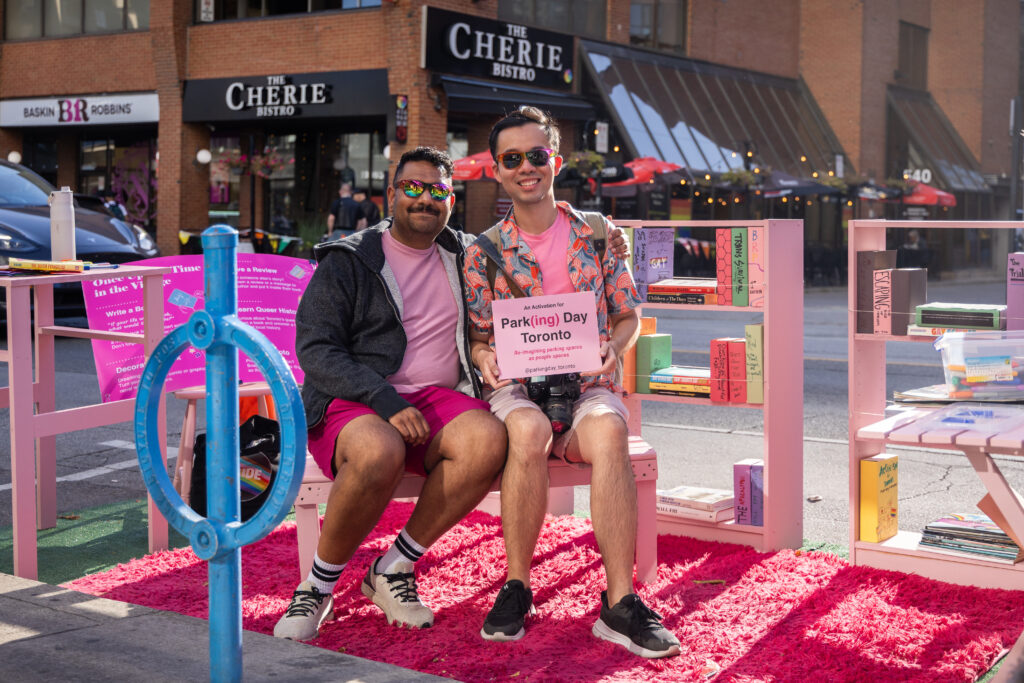
Near the famous intersection of Church Street and Wellesley Street in Downtown Toronto, a street parking spot is occupied with glistening pink bookshelves, tables, chairs set atop a pad of colourful turf. An adjacent poster reads: “If your life were a book, what’s the title?” Passersby gather around this tiny space at the curb, curiously browsing the setup. This is Once Upon a Time in the Village – a public space activation for Park(ing) Day Toronto.
Park(ing) Day is a global movement to temporarily convert parking spaces into mini “parks” for art, play, and activism.1 Each September, for over two decades, public space lovers and activists around the world have dedicated themselves to this initiative to bring people together and imagine more equitable and safer cities. In Toronto – one of the world’s most diverse cities, yet also known as “the loneliest place in Canada”2, Park(ing) Day presents a unique opportunity to create connection, combat urban isolation, and strengthen belonging with each other and within the city.
We, a queer creative duo, take this opportunity further by shifting the attention to local queer spaces. Queer space, while never having a strict definition, is often understood as both a physical and metaphorical spatial condition where queer individuals find safety and belonging. Throughout Toronto’s urban history, many queer spaces, including queer-serving bars, clubs, and community venues, have been lost to gentrification and broader society change.3,4 One of the most recent losses is the Glad Day Bookshop, the world’s oldest surviving queer bookstore.
After operating in and around the Village for over four decades, Glad Day was forced to relocate to the city’s west end amid rising real estate costs and financial struggles.5
Today, Glad Day’s empty storefront on Church Street is a stinging reminder of the harsh reality queer spaces face in our city. Glad Day was unique. It was a hub for many queers who were excluded by mainstream queer culture and stereotypes. Its events and programs were as diverse as its patrons, often serving as a catch-all for 2SLGBTQIA+ community members who weren’t white cisgender gay men of a certain age. Though relocated, the local landmark where many of us felt we belonged was gone. The sense of loss was felt deeply, and we knew we weren’t the only ones.
So we thought to ourselves: what if we could bring a bit of Glad Day back to the Village, even if only for one day? As queer people, our life’s journeys often have common and individual experiences of resilience, discovery, disconnection, and reconnection, especially through chosen family. We all have a story to tell.
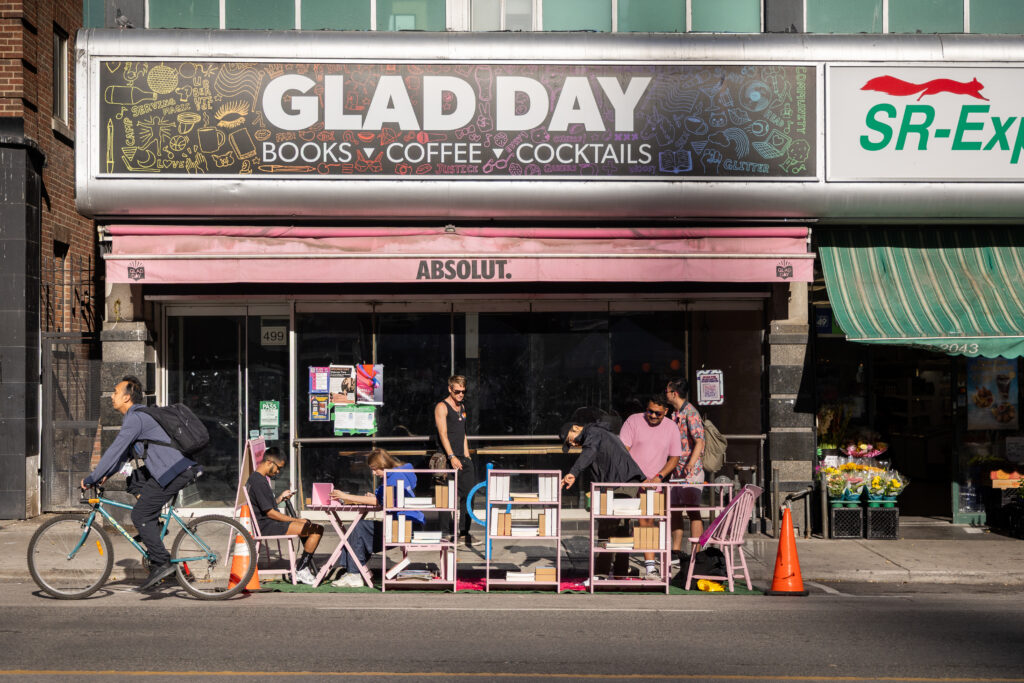
Our vision was clear: create a fun public space, an outdoor library, where people could share their stories through participatory activities by writing and designing “book” covers, then leaving them on the shelves for others to pick up, read, and be inspired by. Once Upon a Time in the Village was born. The project aimed to re-imagine queer space through spatial activism, while strengthening community cohesion through storytelling and story-sharing.
With a $500 budget from a Park(ing) Day grant, we bargained our way through the second-hand market and DIY solutions. All furniture was sourced locally and painted vibrant pink – inspired by the pink triangle, a symbol of queer activism. We also handmade nearly one hundred book-like boxes as canvases for creation. Inside each “book”, we placed a printed piece of Canadian queer history, allowing visitors to open the book and learn about the past.
Building the installation was oddly empowering and cathartic for our own feelings about Glad Day. But we also had doubts. Would people stop by? Would they care? Had we overestimated the sense of loss lingering from Glad Day’s departure? Or worse, had people already moved on? Those worries quickly dissipated as the day was upon us and our little make-shift homage to a beloved queer space was ready.
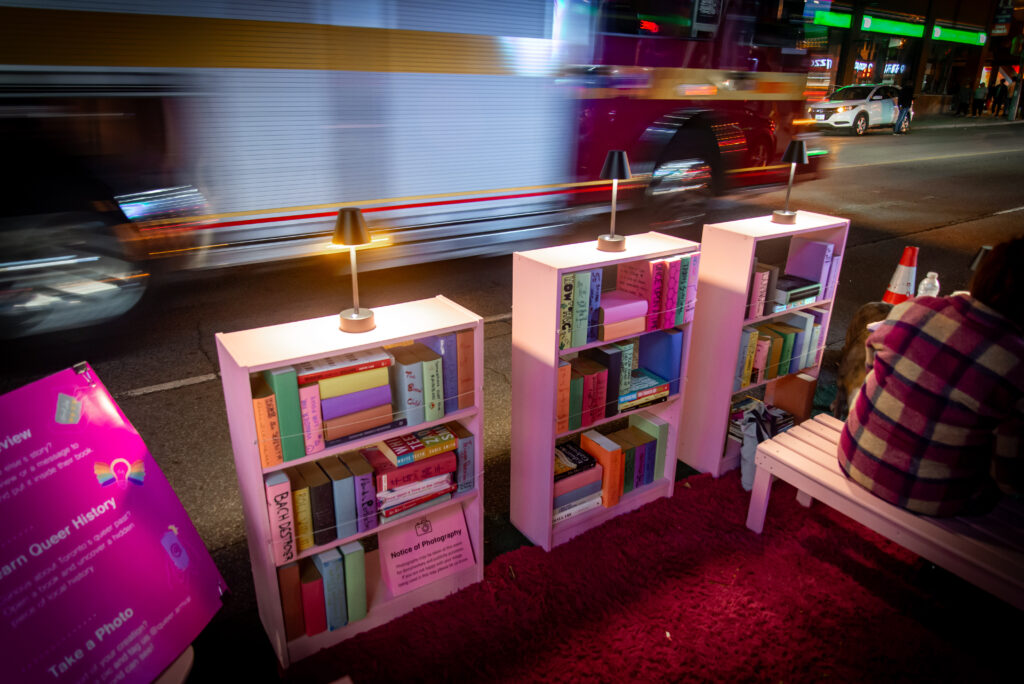
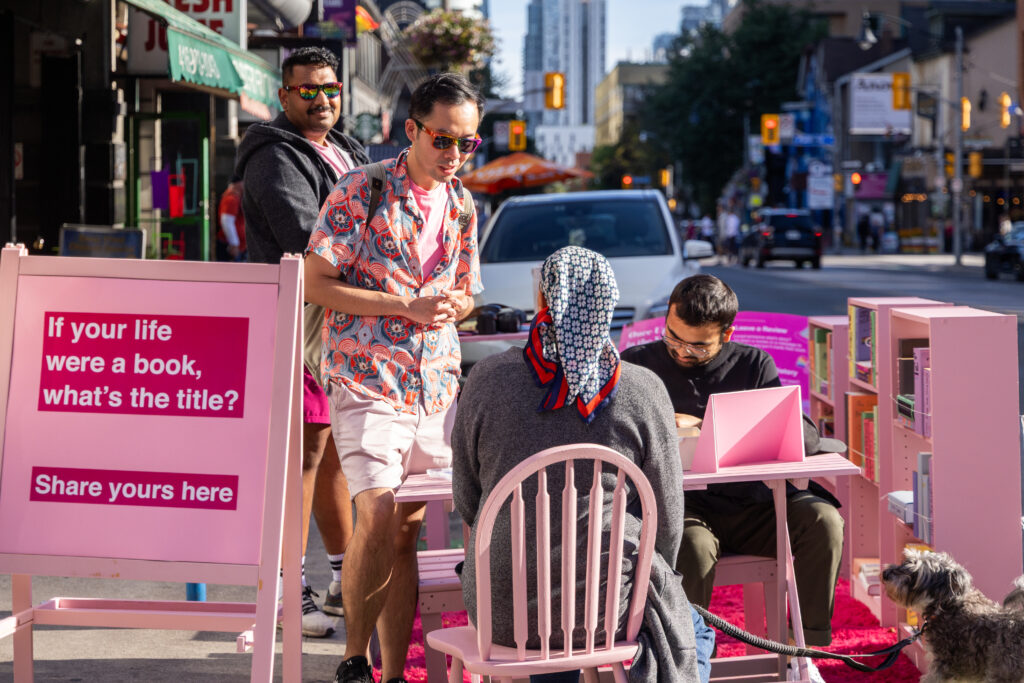
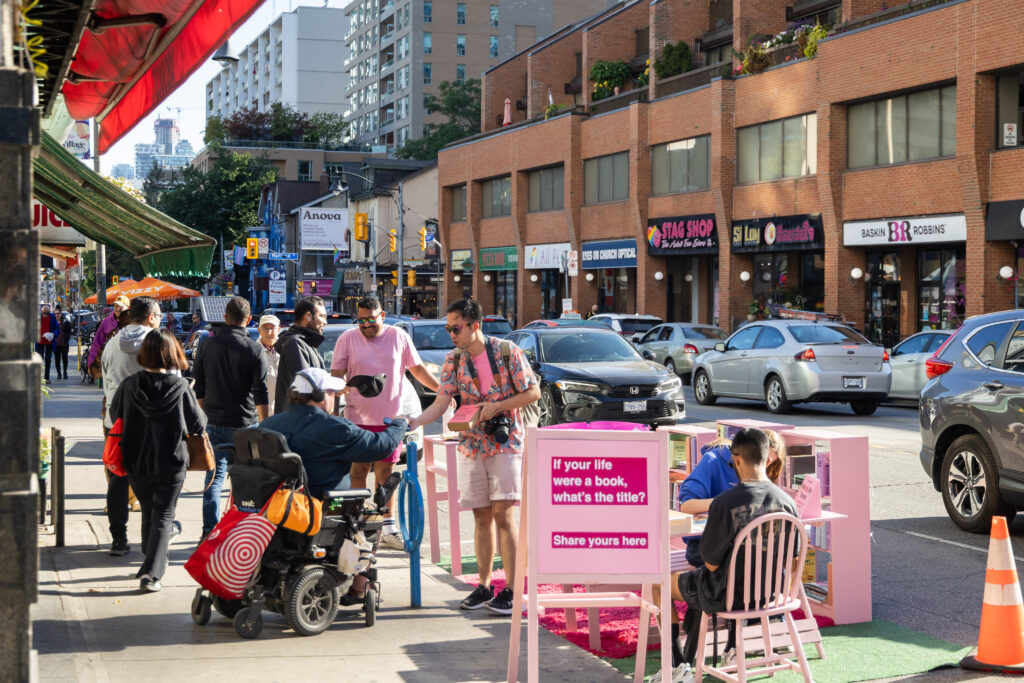
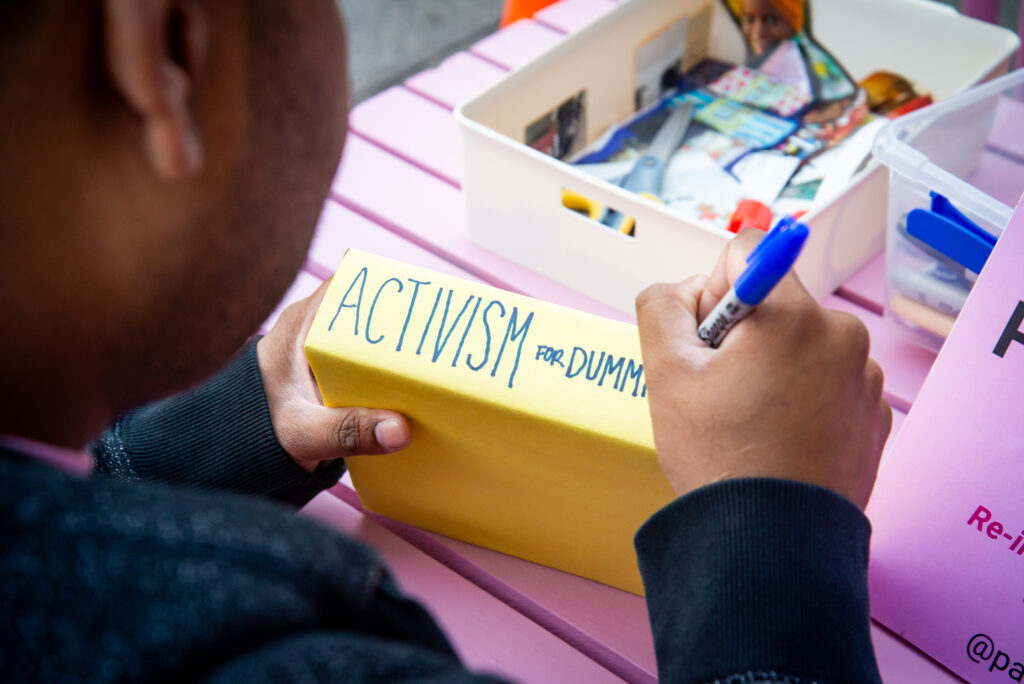
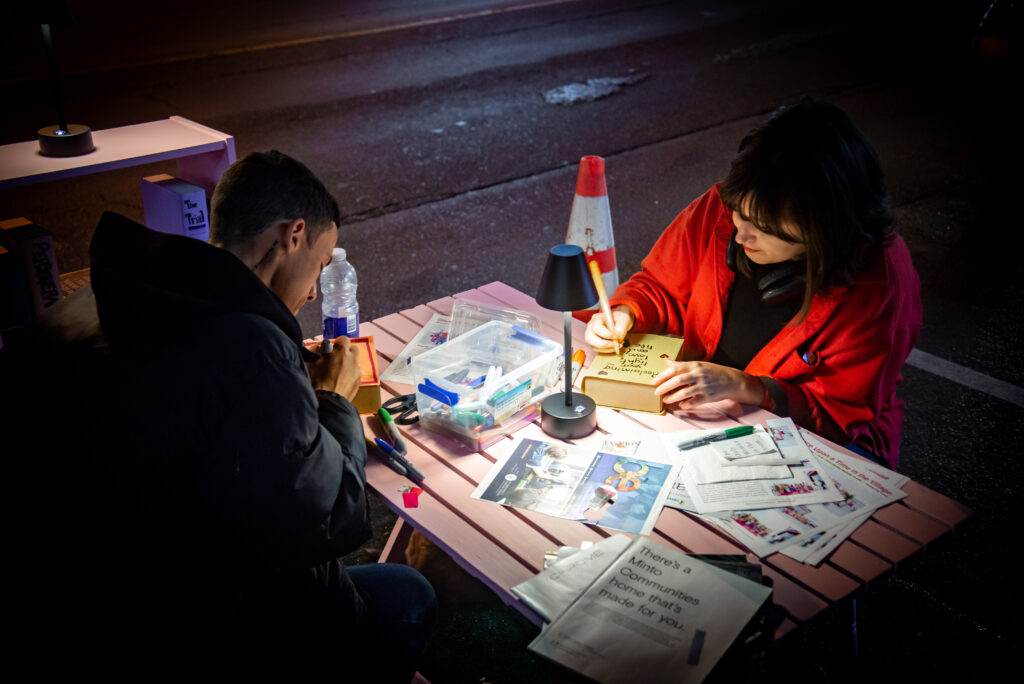
The first visitors were a couple, one of whom was an American expat. As attention turned to the big question “If your life were a book, what’s the title?”, the conversation quickly became personal, and our first two books were created. One was titled “Escaping the Rise of Fascism”, featuring a quick drawing of the U.S. and Canadian flags linked by a road and a car heading toward Canada. He shared his experiences of the current political climate in the U.S., and his plans to settle in Toronto with his long-time Canadian partner. The other book, “Popsies: The Summer of My Life and the Popsicle Cafe Dream”, featured a pineapple popsicle reflected on a summer as a young boy running a popsicle stand on his front lawn. At the time, it was going to be his dream job.
“Trigger Warning: You’ll Never Be Ready” was designed by a local server from a nearby bar who immediately jumped at the opportunity to design a cover. “I know exactly what my book title would be,” he scribbled away. He quickly shared stories from his extensive dating history, joking that he was a handful and fully aware of it.
“Be Kind to the Planet, to Others, and to Yourself” and “Tales from the Trio” were left by two lifelong friends. In a lovely twist, these were not fictional titles at all, but a spoiler of the real books they are currently writing.
Throughout the day, hundreds of people stopped by to explore, create, talk, and read the stories left behind. The installation’s location outside Glad Day’s former storefront was quickly noticed by many visitors. Some asked about the fate of Glad Day; others learnt about it for the first time. It became clear to us that many have not simply moved on. They still cared, and they were still seeking ways to find belonging and build their own queer space in the wake of Glad Day’s departure.
But this was more than just an homage to a lost queer space. This pop-up library quickly became a platform for intergenerational and cross-cultural exchange among people of diverse backgrounds and identities. New friendships formed, phone numbers and social media accounts were exchanged, amongst strangers sharing their titles, and sitting down to decorate book covers together.
“We need more of this”, said one elderly visitor who was too shy to put his story on display, but shared deeply personal reflections about the scars that remained from his coming-out journey as a young, closeted man.
Indeed, in a city that prides itself for diversity and inclusivity, we need more queer spaces and public activities like this. During hostile times, the Village was one of the very few places where queer people could safely exist. It drew generations of queers who were seeking community belonging – young people running away from familial rejection, migrant workers arriving from small towns, and many others searching for a place of acceptance. Their stories of self-discovery, bravery, and resilience have established the Village as a global queer destination that we see today. Their unwavering practice of placemaking has built the Village as a physical container of queerness and collective memories.
Neighbourhoods are changing, and the city is developing. That is an inevitable part of urban life. Today, while Toronto’s queer communities are no longer constrained by the safety net the Village once offered, many have accepted the demise of the Village and the loss of queer spaces within it. But the risk is too high: when spaces disappear, memories and stories of identity, belonging and connection are gone with them. The question, then, is not only how to honour the past, but how can we create new places of connection and belonging amid rapid urban change?
Once Upon a Time in the Village is not just a tribute to a lost place and its stories, but a new way to imagine what is possible. It embeds Conscious Design Principles as the foundation of spatial activism to create replicable models and measurable social impacts.6 The project prioritizes collaboration and citizen participation to co-design collective memories and imaginations. The site selection is context-driven, and amplifies awareness of local queer spaces. The flexible and low-cost design solutions and accessible activities allow for adaptations across various locations and social conditions. The project is intentional and conscious, but the human interactions and stories that emerge are organic and sentimental.
In Toronto, a city shaped by rapid urban transformation, many other neighbourhoods, especially ethnic and marginalized communities, share similar losses of place, memory, and belonging. Beloved community spaces and mom-and-pop businesses are replaced by big-box stores and soulless condominiums. Long-time residents are displaced from their homes. People are fighting for a place to belong in their own neighbourhoods. This project demonstrates that, regardless of spatial constraints and financial limitations, overlooked public space can be mobilized to reinforce place-based identity, and cultivate connection through collective acts of creativity and care.
In one curbside parking spot, Once Upon a Time in the Village invited people to write themselves into the past, present, and future of their individual and shared environment, together. It may be a small spatial intervention, but we queer it to the maximum in the hope for a more inclusive, community-driven future. In this sense, queer space is no longer simply a term denoting 2SLGBTQIA+ communities, but a code for non-normative spatial activism that challenges traditional urban design practice, how we build communities, and where we all belong.
References
1. Park(ing) Day. Park(ing) Day. Accessed February 24, 2026. https://www.myparkingday.org
2. Toronto Foundation. The Power Of Us: Toronto’s Vital Signs 2023 Special Report. 2023. Accessed February 24, 2026. https://torontofoundation.ca/powerofus/
3. Nash CJ. The age of the “post-mo”? Toronto’s gay Village and a new generation. Geoforum. 2013;49:243-252. doi:10.1016/j.geoforum.2012.11.023
4. Ornstein M, McCaskell T. The Evolving Demographics of Toronto’s Gay Village. In: Chambers S, FitzGerald M, Jackson E, et al., eds. Any Other Way: How Toronto Got Queer. Coach House Books; 2017:66-70.
5. Glad Day. Glad Day. Accessed February 5, 2025. https://www.gladday.ca
6. Conscious Design Principles. The Centre for Conscious Design. Accessed March 28, 2026. https://theccd.org/conscious-design-principles/