

Introduction
Vernacular urbanism is often regarded as a contested form of urban heritage: it may lack formal recognition, yet it remains fundamental to the character, identity, and genius loci of place. More importantly, it shapes how people inhabit and experience their environment, structuring everyday practices and reinforcing relationships between individuals, community, and space. In this sense, vernacular urbanism plays a crucial role in fostering both connection and belonging.¹ This study explores these interdependencies, positioning connection as the key mechanism through which spatial form translates into social attachment.
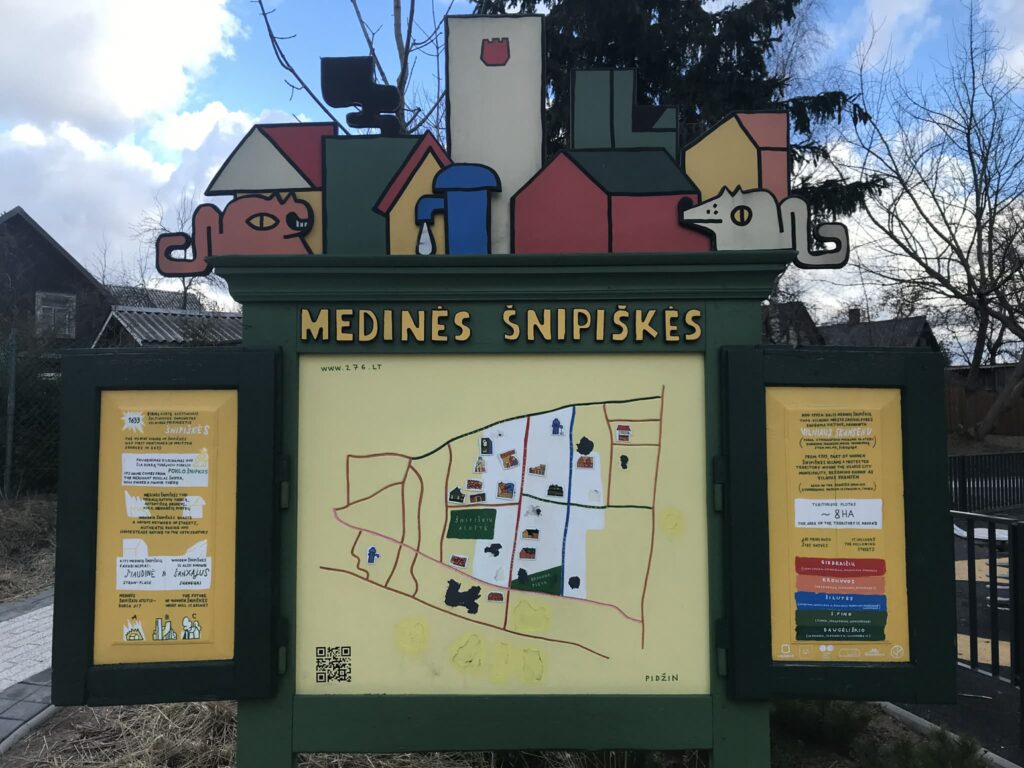
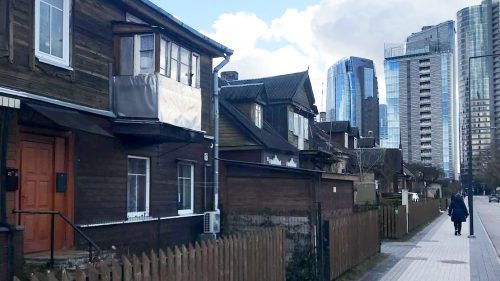
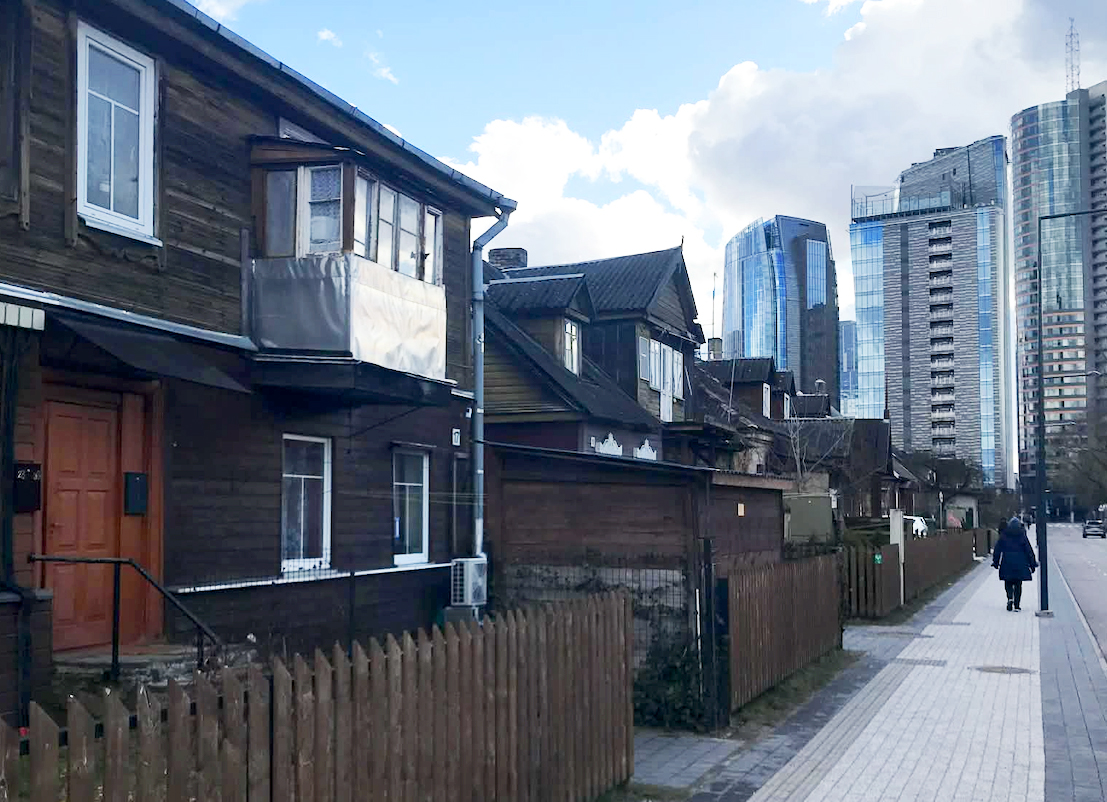
To examine this relationship in practice, the historic wooden district of Šnipiškės in Vilnius was selected as a case study. Šnipiškės can be understood as an urban village, where low-rise vernacular architecture and community-shaped spaces create conditions for everyday interaction and sustained social ties. These characteristics make it particularly suitable for investigating how inherited urban forms and structures support contemporary experiences of connection and belonging. Concurrently, the case highlights that preserving vernacular urbanism involves more than safeguarding individual buildings; it requires attention to the relational spatial structures and practices that underpin community life.
This perspective becomes especially important in the context of rapid and disruptive urban development in Šnipiškės. Such transformations not only alter the physical environment but also affect patterns of interaction, social cohesion, and residents’ attachment to place.
The research was conducted between September 2022 and March 2023 as part of the Research Council of Lithuania’s Student Research Summer Project 2023.² A follow-up phase in February-April 2026 incorporated additional fieldwork alongside updated media and visual analysis, enabling a more longitudinal understanding of the area and its evolving forms of connection and belonging.
Concepts
Vernacular urbanism can be defined as a locally grounded and continuously evolving form of urban development shaped by indigenous building practices and spatial patterns. While rooted in historical forms, it remains inherently dynamic, as existing structures are adapted and reinterpreted over time. This ongoing process allows new urban configurations to emerge while maintaining continuity with the past. Despite this, vernacular urbanism remains insufficiently recognized in many contexts, including Lithuania, where its broader spatial and social dimensions are often overlooked.
This lack of recognition has direct implications for conservation. Protection strategies tend to prioritize individual architectural objects (such as wooden buildings) rather than the wider urban fabric and the social interactions embedded within it. As a result, the relational qualities that enable connection and belonging risk being undervalued or lost. In Vilnius, this imbalance is particularly evident, as architectural preservation often takes precedence over the maintenance of lived spatial systems and urban structures.
As Richard Sennett suggests, vernacular urbanism is best understood as a process that links past and future, allowing new forms to emerge while remaining connected to existing ones.¹⁰ This emphasis on continuity highlights its capacity to sustain meaningful relationships between people and place over time. Similarly, Yuri Artibise identifies vernacular urbanism as a framework that balances old and new, responds to local conditions, and fosters belonging through shared practices.¹ These practices are not incidental; they are embedded in everyday spatial arrangements that enable interaction and reinforce social ties.
Seen through this lens, connection becomes central to understanding how vernacular urbanism operates. Communal and informal spaces (yards, paths, shared boundaries) provide the settings in which everyday encounters occur, gradually producing a sense of attachment and belonging. In Šnipiškės, these characteristics manifest in ways that closely resemble those of an urban village, where spatial proximity and participatory practices support sustained interaction.
This interpretation is reinforced by comparisons with Southeast Asian urban villages, or kampungs, found in countries such as Brunei, Malaysia, Indonesia, and Singapore.⁴ These environments are characterized by dense, informal development and strong neighborhood ties, often rooted in long-term social relationships.⁵,⁶ The comparison highlights that, across different cultural contexts, vernacular urbanism consistently supports forms of connection that underpin belonging, suggesting broader theoretical relevance.
Methodology
Building on this conceptual framework, the study adopts a multidisciplinary qualitative approach to investigate the manifestations of vernacular urbanism in Šnipiškės, and subsequently to analyse how these spatial and social configurations enable processes of connection that underpin a sense of belonging. The analysis focuses on the interplay between spatial structures, material forms, and everyday activities, treating them as interconnected components of a lived urban system.
Vernacular urbanism was assessed using criteria outlined by Scott Hawken,⁷ including community-led design and construction, reliance on local materials, process-oriented development, and a predominantly low-rise urban form (Table 1). These criteria provide a basis for identifying not only physical characteristics but also the social processes embedded within them.
Table 1. Research methodology. Table by Tautvydas Bokmota, 2023.
| Characteristic | Research Mode and Methods | Primary and Secondary Sources |
| Community designed, built, and maintained Locally sourced lightweight materials | Desk research: archival analysis, database review, document review | – Vilnius Regional State Archives (Vilnius City Council Urban Planning and Architecture Department, Urban Construction Design Institute) – Vilnius City Municipality Administration (Cultural Heritage Protection Department, City Development Department) – 20th-century plans of Vilnius, project drawings, graphic material, textual and graphic parts of historical studies (reviews), explanatory notes and acts of 20th-century projects, preliminary design works, and strategies, the Šnipiškės (Skansenas) special plan, and other planning documents – Data from the Register of Cultural Values, Wooden Architecture Database (Archimede) – Scientific articles, publications, dissertations, and other publications of scientific value |
| Process-driven, community-based approach | Field research: spatial analysis, GIS analysis, observation, photographic documentation | – Šnipiškės streets characterized by elements of a spontaneous development plan and spatial structures (Daugėliškio, Linkmenų, Lvivo, Krokuvos streets) and the surviving historical urban fabric of the suburb (Giedraičių, Krokuvos, Veprių streets) – Data from the Regional Geoinformation Environment Service (REGIA), Vilnius interSAVE database |
| Local image of low-rise traditional communities | Desk research: content analysis, visual and textual analysis using MAXQDA software | – Articles with textual and visual material published on the websites of the five largest Lithuanian news portals (Delfi.lt, TV3.lt, Lrytas.lt, 15min.lt, LRT.lt) between 2018 and 2022 |
To capture these dimensions, data collection combined archival research, observation, content analysis, and visual analysis. Archival research established historical context and helped identify spaces associated with communal use and interaction. Observation provided insight into current spatial practices and patterns of use. Content analysis of media sources revealed how the area is framed within public discourse and helped to identify dominant narratives, thematic patterns and shifts in media discourse, while visual analysis encompassed photographs, drawings, and project visualizations and helped to capture their spatial and symbolic qualities.
The two-phase research design (2022-2023 and 2026) allowed for both in-depth examination and temporal comparison, making it possible to trace how evolving urban conditions influence patterns of connection and belonging.
Results
The findings show that Šnipiškės’ spatial fabric embodies vernacular urbanism while simultaneously supporting the development of social and emotional ties. Historic street networks, plot configurations, building types, and natural features remain visible and continue to structure everyday life.³ These elements create environments that encourage interaction, shared use, and long-term attachment to place.
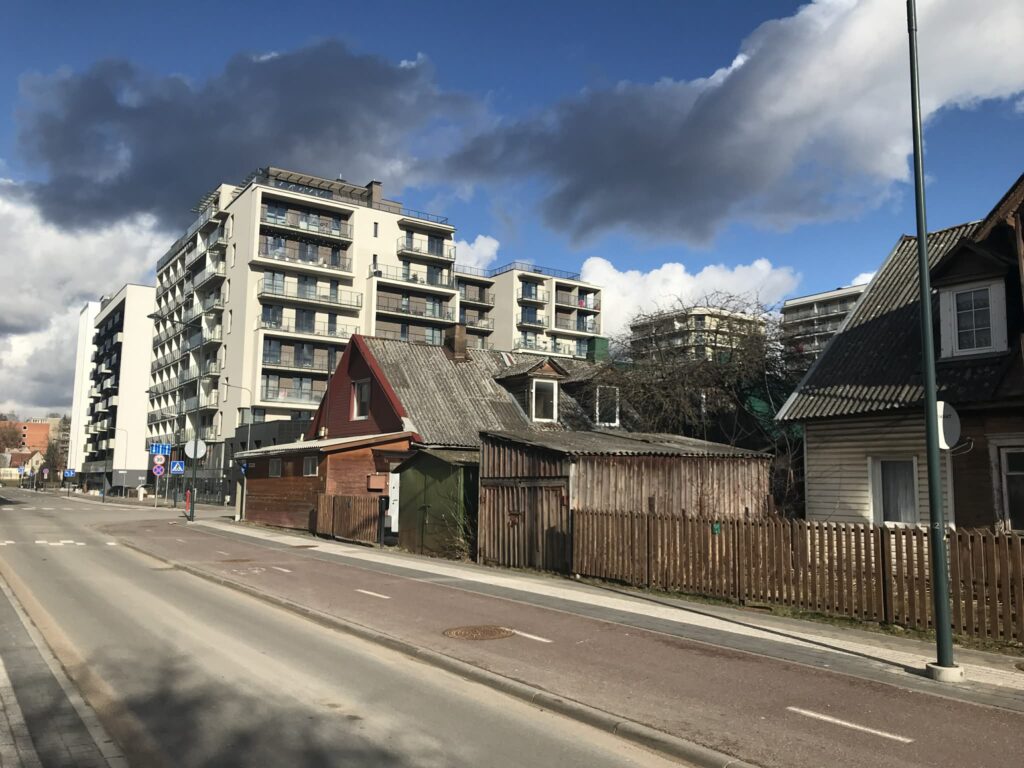
(Credits: Author).
The neighborhood’s development (from a suburban settlement to a semi-dense urban area) has preserved many of these characteristics, particularly along Daugėliškio, Krokuvos, Lvivo, and Linkmenų streets.⁸ The continued use of locally sourced wood, often combined with traditional locally extracted materials such as lime and clay, reinforces both material continuity and local identity.⁸ By the mid-20th century, wooden houses dominated the area,⁹ and a significant number remain today, particularly in the Skansenas area.⁸
At the same time, community agency is clearly expressed through informal construction and spatial adaptation. Low-rise houses, outbuildings, and garages emerge in response to everyday needs, contributing to a built environment that reflects lived experience. These interventions shape the physical landscape and enable ongoing interaction, reinforcing connection and belonging. Shared spatial practices (such as pathways, fences, collectively used areas) further illustrate how space is negotiated and maintained at the community level.
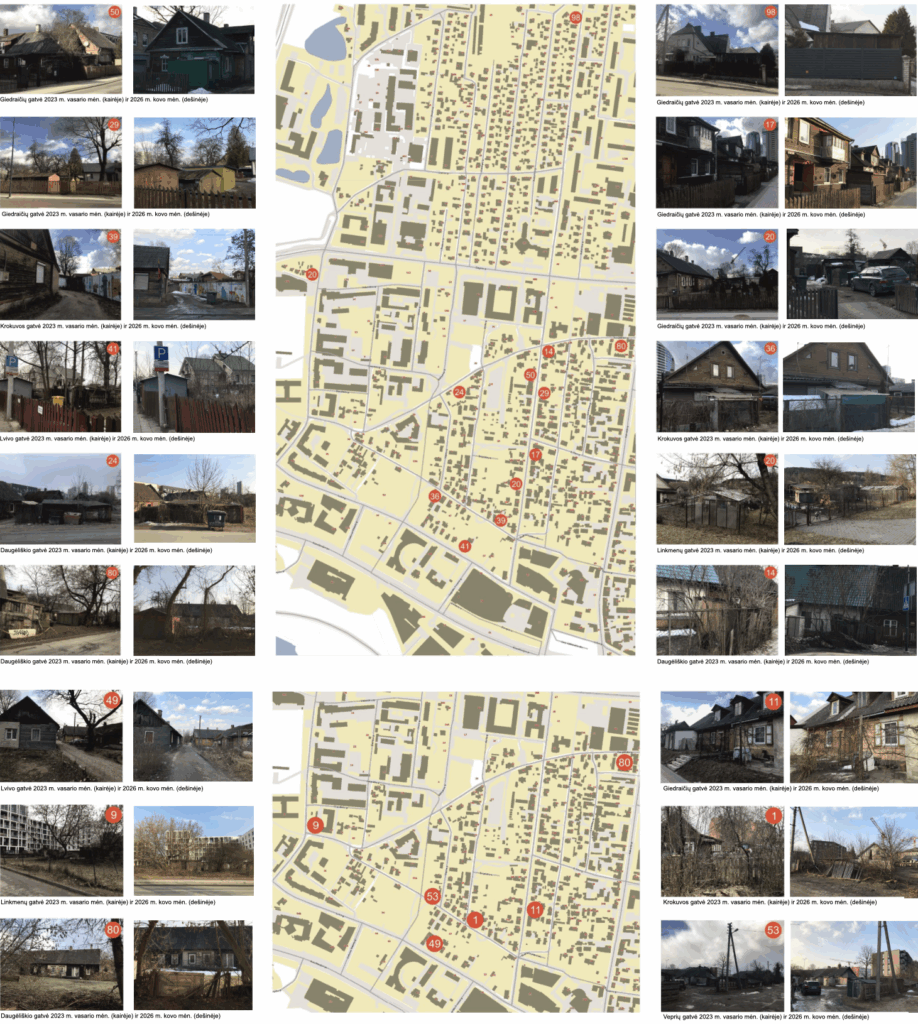
However, the follow-up research conducted in 2026 indicates that these practices are declining, alongside the demolition of previously documented structures. This suggests a weakening of the spatial conditions that support everyday interaction and, by extension, connection and belonging.
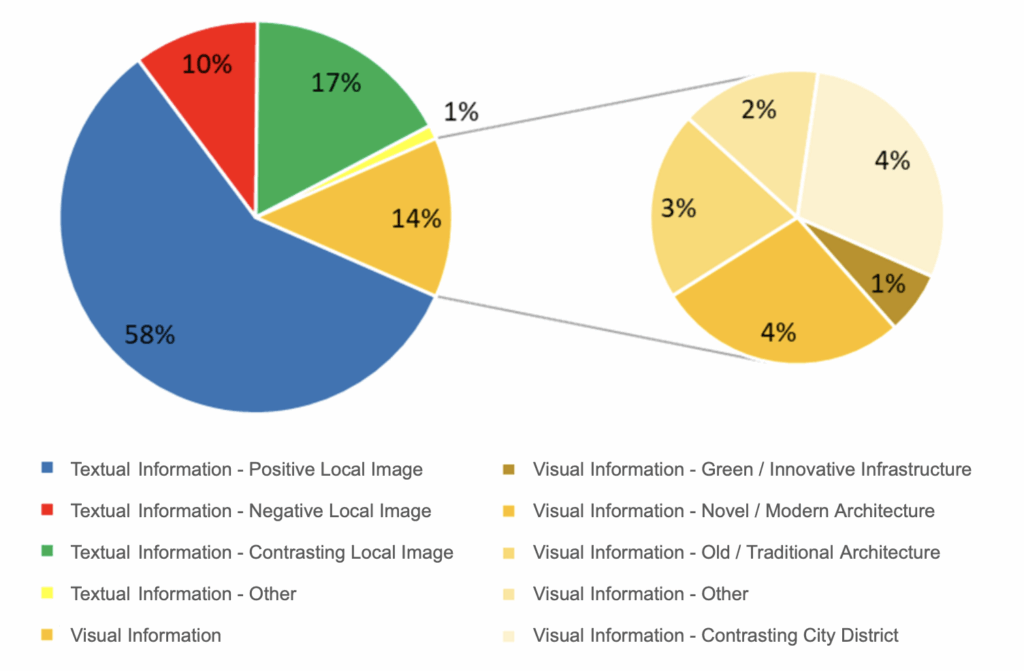
Media and visual analysis provide additional context, revealing a multi-layered public image of Šnipiškės (Figure 3). While earlier narratives emphasized renewal and heritage value, more recent representations highlight tensions between development and preservation. These shifting narratives reflect broader uncertainties about the future of the area and its identity.
Discussion
The case of Šnipiškės illustrates that vernacular urbanism functions as a relational and process-oriented system. Rather than being defined solely by physical form, it emerges through the continuous interaction between space and social practice. Informal construction, shared spaces, and negotiated boundaries are not peripheral features; they are central mechanisms through which residents shape their environment and sustain social ties.
These practices create opportunities for everyday encounters, supporting routines that reinforce collective identity. In this context, space becomes a medium of connection – one that enables individuals to engage with both their surroundings and each other. Over time, these interactions accumulate, producing a durable sense of belonging. This dynamic closely aligns with the notion of Gemeinschaft, in which social relations are grounded in proximity, shared experience, and mutual recognition, rather than formal or institutional structures.
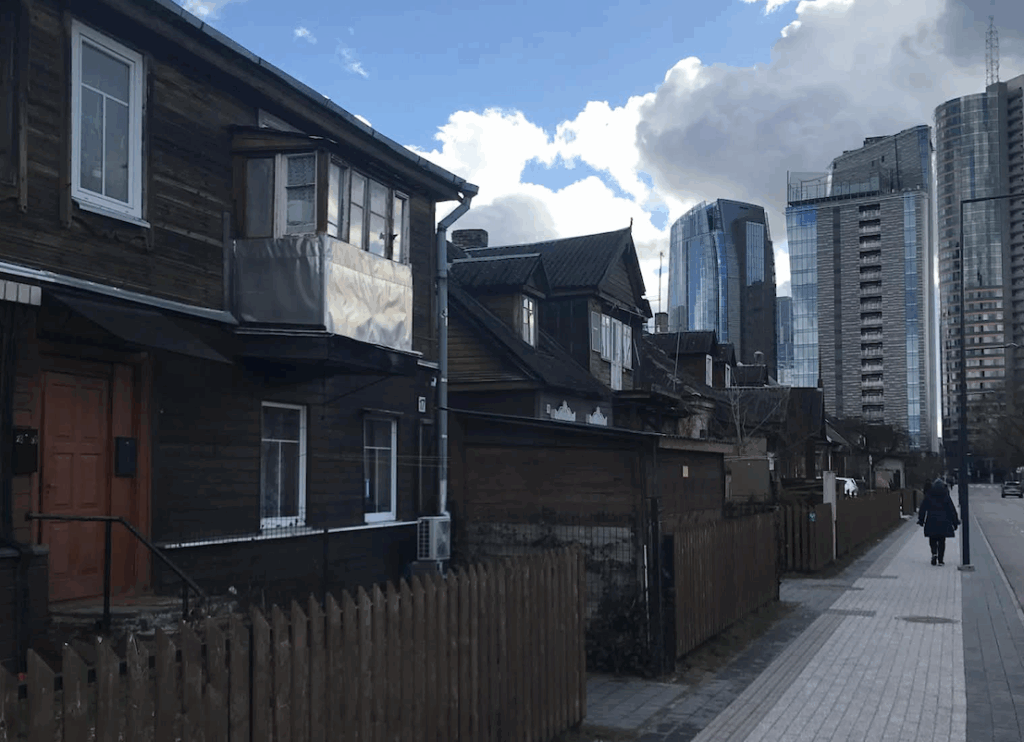
Such communal practices may also be interpreted as forms of collective expression, or even ritualized behaviors, that reflect and reproduce community cohesion. They are rooted in shared experiences and contribute to a sense of equality and mutual recognition, temporarily reducing social hierarchies and strengthening village-like sociality.
This perspective underscores that Šnipiškės should be understood not as a static heritage site but as a living urban environment. Its value lies in the ongoing interplay between historical continuity and contemporary life, mediated through everyday practices of connection.
Consequently, preserving vernacular urbanism requires more than protecting buildings or urban layouts. It demands recognition of the social processes that sustain them. Without them, the capacity of such environments to foster connection is significantly diminished.
Conclusion
The case of Šnipiškės demonstrates that vernacular urbanism is not merely a physical condition but a dynamic relationship between people and place. Low-rise wooden architecture, incremental development, and community-led spatial practices collectively sustain the area’s genius loci, showing that urban heritage is continuously produced through everyday interaction rather than preserved as a static form.
Residents’ interventions, such as informal construction, shared pathways, and negotiated boundaries, play a central role in shaping this environment. These practices enable ongoing interaction and reinforce social ties, through which connection emerges. In turn, these connections underpin a sense of belonging, linking individuals to both place and community. However, ongoing development pressures and the decline of informal practices indicate that both the spatial fabric and the social processes that sustain it are increasingly at risk.
At the same time, public representations of Šnipiškės reveal competing narratives that reflect broader tensions between preservation and transformation. While some emphasize heritage value and continuity, others highlight modernization and redevelopment, pointing to the complexity of maintaining vernacular urban environments within rapidly changing urban contexts.
Ultimately, preserving Šnipiškės as an urban village depends not only on protecting its vernacular structures but also on sustaining the participatory practices, everyday interactions, and forms of social cohesion that give them meaning. These dynamics reflect forms of social organization characteristic of Gemeinschaft, where relationships are grounded in proximity, shared experience, and mutual recognition. By valuing and supporting this urban gemeinschaft (both in its physical fabric and in its lived practices) the neighborhood can continue to function as a meaningful environment that sustains local identity, connection, and belonging.
This study contributes to the understanding of vernacular urbanism by demonstrating how spatial structures and social processes are interconnected, positioning connection as the mechanism through which belonging is produced and maintained. It highlights that the significance of vernacular environments lies not only in their material form but also in the everyday interactions they enable.
As a natural next stage, further research should focus on qualitative investigations of residents’ lived experiences, particularly their perceptions of connection and belonging. Greater attention to concepts such as sociality, village-like interaction, and communitas would help to better understand how behavioral practices shape spatial meaning. By linking spatial analysis with lived experience, such research would deepen understanding of vernacular urbanism and generate new insights into how connection and belonging are formed and sustained in contemporary urban contexts.
References
1. Artibise Y. The ABC’s of Urbanism. 2011.
2. Bokmota T. Tradicinė (liaudies) urbanistika Lietuvos urbanistinio paveldo ir istorinio urbanistinio kraštovaizdžio kontekstuose. Vilnius, Lithuania: Research Council of Lithuania’s Student Research Summer Project Report; 2023 (supervised by V. Janušauskaitė).
3. Dijokienė D. Istoriniai priemiesčiai: genezė, raida, vertė, tvarkymas (Lietuvos miestų pavyzdžiu). Vilnius, Lithuania: Doctoral Dissertation; 2002.
4. Samalavičius A.L., Gabrėnas A. The legacy of Lithuanian urban and semi-urban vernacular architecture and possibilities of its preservation. Buildings. 2022;12:2087.
5. Gans H.J.. The Urban Villagers: Group and Class in the Life of Italian-Americans. New York, NY: The Free Press of Glencoe; 1962.
6. Gregory D., Johnston R., Pratt G., Watts M.J., Whatmore S., eds. The Dictionary of Human Geography. 5th ed. Oxford, UK: Wiley-Blackwell; 2009.
7. Hawken S. The urban village and the megaproject: Linking vernacular urban heritage and human rights-based development in the emerging megacities of Southeast Asia. In: Heritage, Culture and Rights: Challenging Legal Discourses. 2018;4:91–118.
8. Jurevičienė J. Vilniaus istoriniai priemiesčiai: Autentiškumo aspektas. Vilnius, Lithuania: Doctoral Dissertation; 2005.
9. Miestų statybos projektų institutas. Šnipiškių rajonas Vilniuje, 1968-01-01 – 1968-12-31. Vilnius, Lithuania: Vilnius Regional State Archives, f. 1036, ap. 11, l. 652.
10. Sennett R. Building and Dwelling: Ethics for the City. London, UK: Penguin Books; 2018.