

Abstract
The research examines placemaking in Hyderabad’s historic Walled City as an ecological and temporal practice through which collective identity was formed. Rather than treating place as static geography or symbolic abstraction, it argues that belonging emerged from sustained interaction between people, water infrastructures, and monsoon cycles. Through the paired lens of baoli (stepwell) and bagh (garden), read alongside Dakhni literary traditions and key theories of temporality, the study shows how monsoon- dependent urbanism produced civic reciprocity and ethical relationality. The lived landscape of K.W. Bagh in Alijah Kotla is presented as embodied evidence of environmental participation — irrigation routines, seasonal adaptation, communal maintenance, through which people–place connection became durable. The erosion of such infrastructures signals not only ecological decline but a reconfiguration of civic identity. The paper contributes to placemaking debates by foregrounding ecological time rather than standardized clock-time as central to collective belonging in semi- arid urban contexts. ¹–⁸
It argues that Deccan gardens can be understood not as a static historic fabric but as an ecological-temporal system, where baoli (stepwell) and bagh (garden) structured everyday life through water availability and monsoon cycles. Within this system, belonging emerged through repeated acts of maintenance, seasonal adaptation, and shared dependence on water infrastructures. By foregrounding ecological time and lived participation, the study repositions placemaking as a process grounded in environmental reciprocity rather than symbolic representation.
Introduction
The study argues that Deccan gardens and Lost walled city of Hyderabad may be interpreted not as a static historic fabric, but as an mindful ecological–temporal system, wherein natural systems and resilient urban planning were establishing even in the baoli (stepwell) and bagh (garden) structured everyday life through cyclical water regimes, ritual practices, and adaptive landscape management. Within this framework, Hyderabad’s walled city offers a compelling example of a well-articulated medieval urban interface, where terrain, hydrology, and spatial planning were understood as interdependent systems rather than discrete elements. Established under the Qutb Shahi rulers, the city was strategically located along the Musi River and organized around the Charminar as a central node, functioning both as a symbolic and infrastructural anchor. The urban fabric evolved at the intersection of trade routes, topographical gradients, and water networks, allowing for a calibrated distribution of resources. Natural slope, catchment patterns, and underlying aquifers were systematically integrated into planning, enabling water to move, collect, and recharge through interconnected systems of tanks, baolis, canals, and garden precincts.
In this semi-arid context, the integration of fārz (customary obligations of maintenance and stewardship) and baoli-based water infrastructures facilitated a decentralized yet resilient system of water governance. These systems were not merely utilitarian but were embedded within social and cultural rhythms, ensuring regular upkeep through collective participation. The baoli functioned as both a hydrological device and a social condenser, regulating access, sustaining groundwater levels, and anchoring neighborhood life. In doing so, it enabled forms of everyday encounter—drawing water, gathering at thresholds, observing rituals—that cultivated a shared sense of belonging rooted in place. This integration made possible the proliferation of enclosed gardens (baghs) and orchard landscapes across the Deccan plateau, even within the dense urban core. Historical accounts and cartographic evidence indicate a high density of such باغات (baghāt) around Charminar and its adjoining precincts, where water availability was ensured through subterranean channels and stepwell systems. These باغات were not ornamental alone but productive landscapes—supporting fruit cultivation, microclimatic cooling, and ecological balance, while simultaneously shaping collective memory and identity.
Building upon this premise, water in the Deccan has historically functioned not merely as a resource but as an organizing principle of settlement, cosmology, and everyday practice. Across semi-arid peninsular India, survival and prosperity depended upon the careful reading of terrain, seasonal variability, and subsurface hydrology. The Deccan plateau, characterized by undulating granitic formations, shallow soils, and monsoon-dependent rainfall, necessitated a system of decentralized yet interconnected water infrastructures. Within this context, the baoli and bagh emerged not as isolated architectural typologies, but as mutually reinforcing components of a larger ecological and social system. The stepwell enabled vertical access to groundwater, while the garden translated this availability into surface productivity, shade, and microclimatic comfort. Together, they formed a coupled system of storage, recharge, use, and cultural engagement. This relationship was further embedded within ritual cycles, where water bodies were activated through festivals, daily practices, and seasonal rhythms, reinforcing not only ecological sustainability but also a continuity of community belonging and shared identity.
Existing scholarship on Deccan landscapes has largely approached gardens through aesthetic, dynastic, or stylistic lenses, emphasizing their Persian influences, geometric layouts, and symbolic meanings. Similarly, studies on stepwells have predominantly focused on their architectural typologies, construction techniques, and historical patronage. While these approaches have contributed significantly to documentation and conservation discourse, they often treat water structures and gardens as discrete entities, overlooking their role in shaping lived experiences of connection, social cohesion, and place-based identity. Recent works in cultural landscape studies and traditional ecological knowledge have begun to recognize the importance of integrating built form with environmental processes; however, there remains limited exploration of how these systems operated as dynamic, participatory infrastructures that fostered belonging in semi-arid urban contexts. In particular, the role of everyday practices, customary governance systems such as fārz, and localized knowledge in sustaining both ecological function and social connectedness remains underexamined.
This study addresses this gap by examining the baoli–bagh relationship within Hyderabad’s walled city as a representative model of ecological–temporal urbanism in the Deccan, with particular attention to how such systems cultivate connection and belonging. It posits that the efficiency and resilience of these systems were not determined solely by engineering or design, but by the integration of hydrological intelligence, spatial planning, and socio-cultural practices that enabled collective participation and identity formation. The research seeks to understand how terrain-informed planning, decentralized water networks, and community-based stewardship enabled not only the sustenance of باغات and orchard landscapes, but also enduring relationships between people and place.
The significance of this inquiry lies in its potential to reposition traditional water systems as frameworks for designing contemporary cities that foster connection, inclusion, and resilience. At a time when urban environments increasingly experience fragmentation, water stress, and ecological degradation, the Deccan model offers insights into how infrastructure can support both environmental sustainability and social cohesion. By analyzing the reciprocal relationship between baolis and baghs, the study contributes to broader discussions on placemaking, collective identity, and participatory urbanism. The paper is structured to first establish the historical and environmental context of the Deccan plateau, followed by an analysis of Hyderabad’s hydrological planning systems, and finally a focused examination of the baoli–bagh interface as a model of culturally embedded, community-oriented infrastructure.
People–Place: Belonging as Ecological Practice
Placemaking is often discussed as the production of meaning within physical environments—through design, memory, narrative, and symbols. Yet in water-stressed terrains, meaning is not produced by representation alone. It is produced through repeated participation in the ecological systems that make settlement possible. In semi-arid regions, the primary ecological condition is water, and the primary social condition is how water is shared.
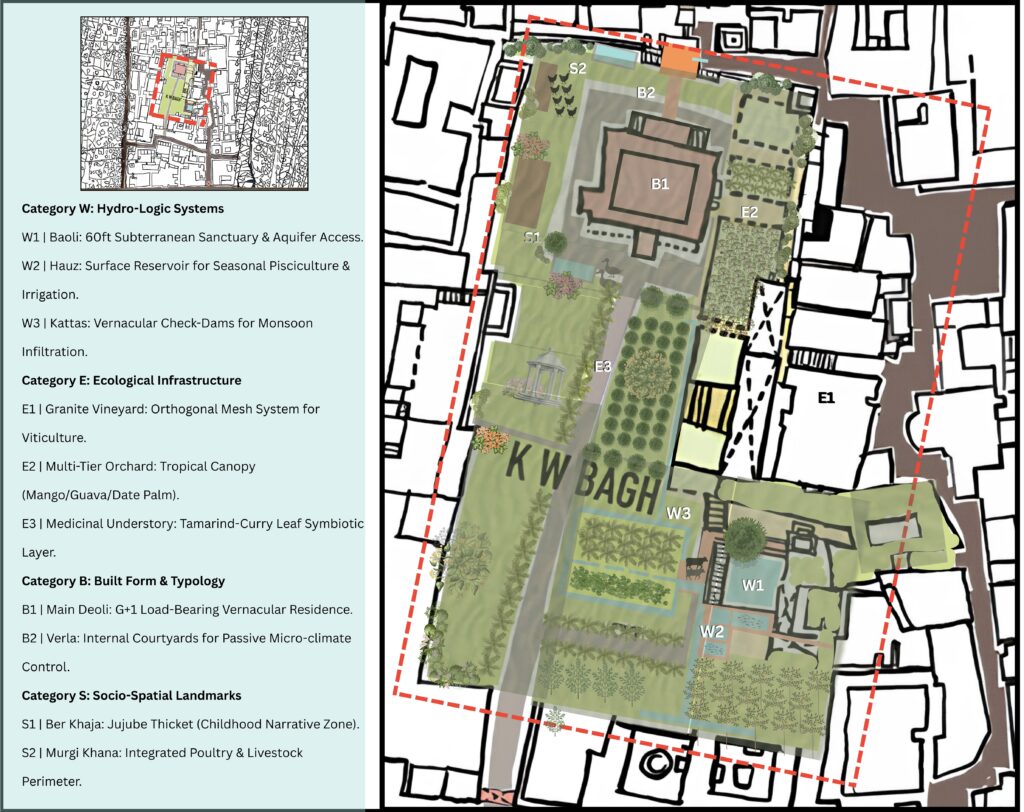
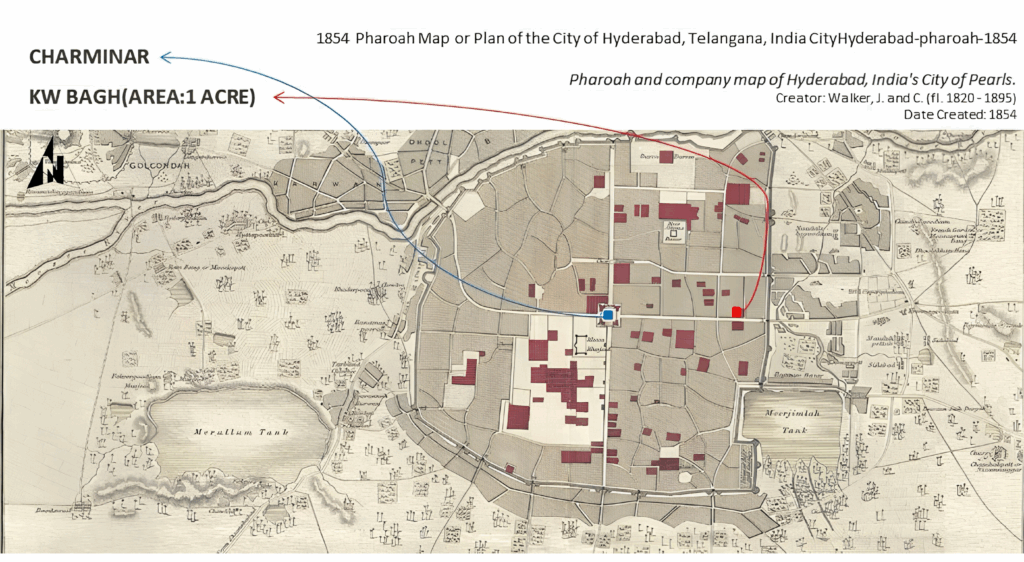
The Walled City of Hyderabad was not only a fortified urban core. It was a lived hydrological arrangement where baolis, tanks, channels, gardens, shaded courts, and orchards formed a civic ecology. Deccan histories show that the region’s political consolidation and architectural cultures were inseparable from water management— through tanks, gardens, and waterworks linked to settlement stability, legitimacy, and public welfare. ⁹–¹⁴ The city’s built forms taught residents how to inhabit heat, scarcity, and seasonal variability: where to pause, when to store, what to repair, and how to coordinate. The spatial organization and historical layout of this ecological-temporal system are preserved in the reconstructed site plan of K.W. Bagh, as illustrated in Figure 1. The precise geographical context of the stepwell within the garden is further detailed in the location map shown in Figure 2.
Theoretical accounts of place help clarify why such repetition matters. Heidegger describes dwelling as a relational gathering, where being is shaped by how life is held together in everyday practice.¹ Casey emphasizes that places are not inert containers; they are constituted through embodied orientation and the layering of memory over repeated encounter.² Tuan’s “topophilia” similarly frames attachment as an affective bond formed through familiarity, use, and lived environmental experience.³ These formulations become sharper in the Deccan context when “environment” is not background but constraint: without groundwater access and climatic buffering, belonging is fragile.
Within this ecology, the baoli functioned as a civic threshold. Its presence required care—clearing silt, protecting edges, regulating use, repairing stone, managing access. Water drawing was visible; reliance was shared; restraint was learned. The bagh extended this relational field horizontally, distributing shade, food, and microclimatic comfort across domestic and neighborhood scales. Together, baoli and bagh made the city’s dependence perceptible and therefore ethically available. Place was not only where one lived; it was what one maintained.
In this sense, placemaking in Hyderabad’s older quarters can be understood as a form of ecological practice: belonging emerged not from labels, but from recurring participation in water’s seasonal life.
Methodology
This study adopts a qualitative and interpretive approach to examine placemaking in Hyderabad’s historic Walled City. The analysis draws on a combination of historical literature, Dakhni literary texts, and environmental-historical interpretation to understand the relationship between water infrastructures, seasonal cycles, and collective identity. The baoli (stepwell) and bagh (garden) are read together as interconnected ecological systems that structured spatial and temporal practices. Lived evidence from K.W. Bagh is incorporated as a situated case to illustrate how everyday routines—such as irrigation, maintenance, and seasonal adaptation—produced forms of ecological participation. The methodological aim is not to reconstruct a complete historical record, but to interpret how belonging emerged through sustained interaction between people, water, and monsoon-driven environments.
Plural Temporalities and Urban Identity
If water structured spatial belonging, monsoon structured temporal belonging.
Modern urbanism tends to treat time as homogeneous and universal. Elias shows how standardized time operates as a social medium of coordination—an agreement through which collective life is synchronized. ⁴ Hartog argues that modernity produces a “regime of historicity” where the present becomes accelerated and time is imagined as linear progression. ⁵ This regime is intensified through institutions of synchronization: industrial work rhythms, school schedules, administrative calendars, and infrastructural standardization. The result is a dominant assumption that time is one—uniform and forward-moving.
Yet scholarship on South Asian temporalities challenges this assumption. Kaul argues that colonial modernity did not simply introduce new clocks; it marginalized alternative temporal regimes embedded in precolonial knowledge systems. ⁶–⁸ Such regimes were not marginal curiosities. They were functional ways of organizing life through recurrence, ethical duration, and cosmological scale. Linear “developmental” chronology displaced cyclical ecological recurrence and reduced time to measurement, often excluding vernacular modes of knowing that were neither unscientific nor merely “mythic.” ⁶–⁸
In the Deccan, ecological time is not an abstract philosophy; it is operational. Monsoon recurrence defines agricultural cycles, food practices, repair schedules, and ritual calendars. Dakhni poetry captures this not as ornament but as environmental literacy. Muhammad Quli Qutb Shah repeatedly evokes Barsaat as the moment when the plateau’s dryness turns toward vitality. ¹⁵ The imagery—parched land responding to rain—names a lived dependence: when rains arrive, the city’s thermal texture changes, vegetation responds, water thresholds fill, and civic routines shift.
Baoli waterlines fluctuate across seasons. Bagh flowering and fruiting sequences become a calendar learned through the body. Seasonal literacy—knowing when to clean channels, strengthen earthen checks, anticipate pests, prepare storage, adjust diet—becomes a civic competence. Monsoon time is thus not “premodern recurrence.” It is coordination: an ecological-temporal system integrating environment and community.
Placemaking in Hyderabad therefore involved temporal literacy. Belonging was not only where one was, but when one acted: before the rains, after the first showers, during sustained wetness, during dry return. Identity formed through synchronized ecological attention.
Water as Ethical Infrastructure
If ecological time organizes coordination, water infrastructures organize ethics.
Water systems in the Walled City were not neutral technologies. They structured how people related—through visibility of dependence, shared thresholds, and routine maintenance. This is where Dakhni Sufi writing becomes analytically relevant: it does not treat water as scenery; it treats water as a medium through which the self is disciplined and the world is re-learned.
Mulla Wajhi’s Sabras frames the well not as engineering alone but as an arena of interior work. ¹⁶ The point is not a literal motion downward; it is a reorientation of consciousness. The seeker’s encounter with water becomes a workshop of refinement—where ego loosens, perception steadies, and the search for clarity requires humility rather than conquest.¹⁶ The Aab-e-Hayat is not a trophy but a condition approached through adab—ethical comportment, restraint, and readiness.
This Sufi interior register matters because it parallels what infrastructure demands in civic terms. A baoli teaches patience: water is not instantly produced, it is awaited. It teaches restraint: excess drawing affects others. It teaches shared responsibility: neglect becomes collective risk. Even where metaphysical language is not spoken explicitly, the ethical pattern is learned in practice.
The The bagh similarly institutionalizes reciprocity. Orchard care and irrigation schedules require coordination. Channels must be cleared. Shade must be maintained through pruning and watering. The garden is not a private aesthetic; it is a living agreement between labour, season, and comfort.
In Deccan ritual life, water charity further expresses this ethic. Marsiya traditions localized Karbala’s thirst within a drought-prone landscape, reinforcing ‘sabeel’ practices—public distribution of water as civic virtue. These acts are not merely devotional: they materialize an ethics of care under scarcity, keeping water visible as shared responsibility.
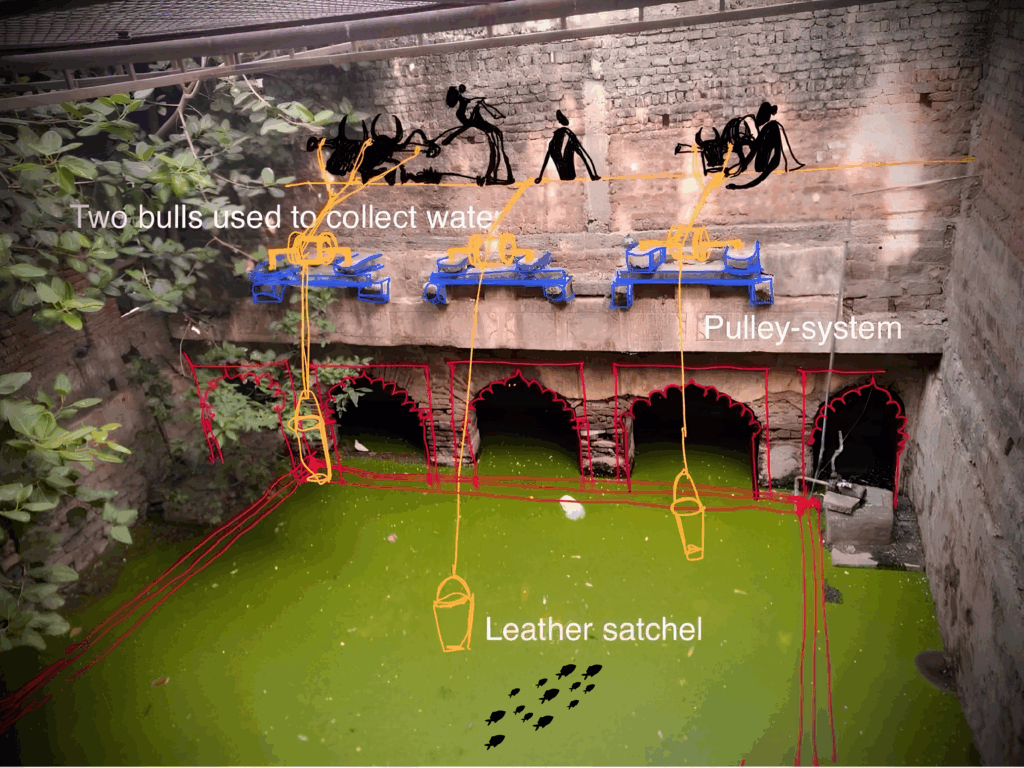
Thus, reciprocity is not abstract morality. It is infrastructural discipline. Where modern systems hide extraction through private borewells and centralized supply, reciprocity becomes harder to sustain because dependence becomes less visible. The mechanical reciprocity of the stepwell was facilitated by an intelligent pulley system, which is depicted in Figure 3. Furthermore, the architectural complexity and depth of the subterranean structure are visible in the plan of the baoli in Figure 4. If spatial arrangements structured forms of belonging, temporal rhythms determined how these relationships were sustained across seasons.
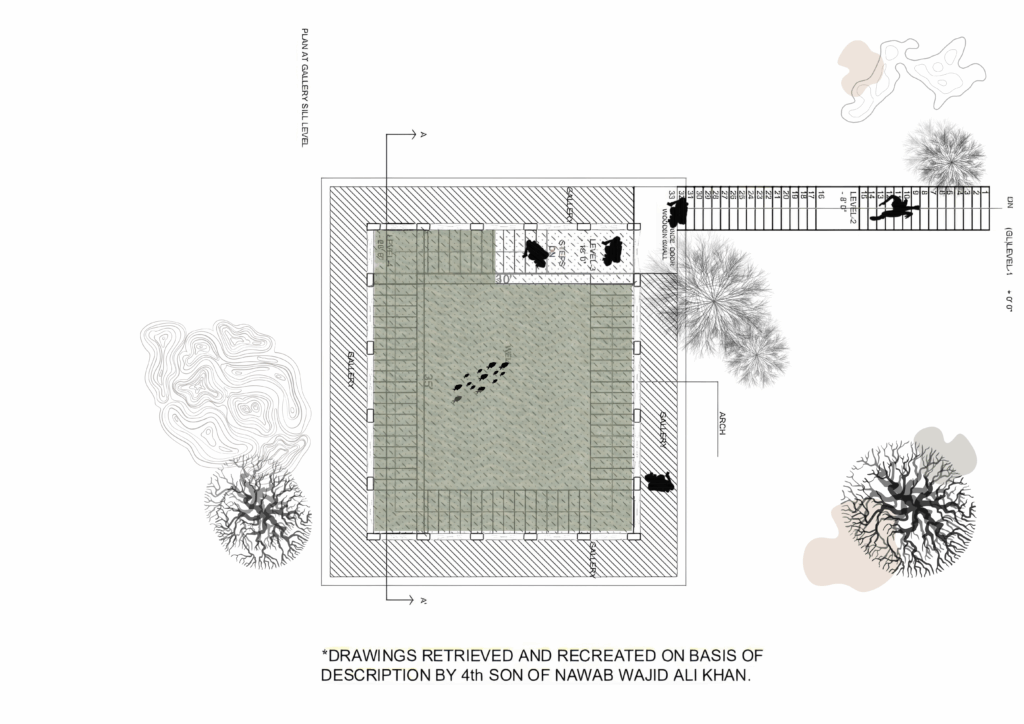
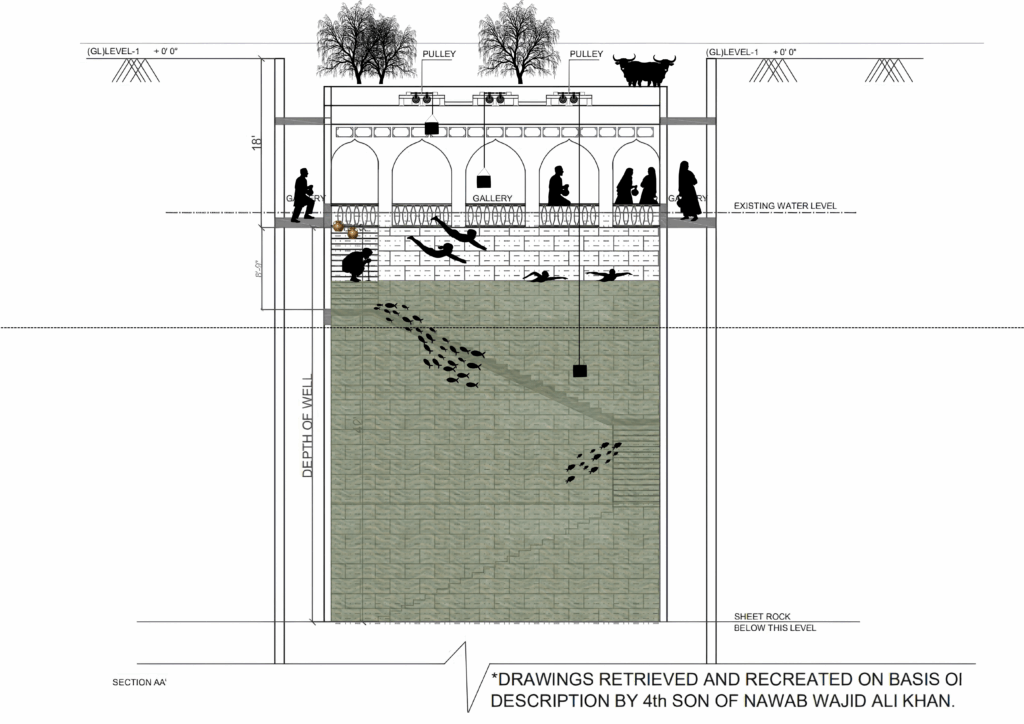
Figure 5: Section through baoli. This architectural section provides a vertical perspective of the baoli, illustrating the descent to the water table and the multi-tiered structure that served as a thermal refuge.
(Drawings retrieved and recreated based on the descriptions provided by Engr Ameer Ali Khan [Shazaad Mama], 4th son of Nawab Wajid Ali Khan)
K.W. Bagh: Lived Evidence of Ecological Reciprocity
Theoretical arguments gain clarity when anchored in lived evidence. Kaiser Wajid (K.W.) Bagh, located in Alijah Kotla within Hyderabad’s old city, exemplified integrated ecological design into the late twentieth century. This case is presented here as a lived system rather than a heritage object: a place where climate, water, architecture, labour, play, and seasonal timing formed a continuous relational field.
In the summers of the 1980s, K.W. Bagh operated as a self-sustaining climatic ensemble. Granite columns structured vineyard corridors where grapevines filtered light before it reached the ground. This was not decorative excess but thermal moderation: filtered light reduced surface heat gain while permitting airflow. Tamarind canopies produced dense shade, cooling gathering zones through evapotranspiration. Curry leaf plantations thrived under irrigation routines calibrated to gravity gradients rather than mechanical pumping.
The orchard—guava, mango, chiku, date palms, amla—functioned as a seasonal calendar. Ripening cycles structured anticipation and memory. Time was learned biologically: the guava’s early sweetness, mango’s delayed abundance, dates ripening under heat, amla’s medicinal durability. This is not nostalgia; it is a pedagogy of season. Children learned “when” through fruit and shade rather than clocks.
Ecological literacy at K.W. Bagh was practiced as attentive sensing. Residents did not require formal meteorological forecasts to register seasonal turning. Soil moisture, leaf texture, insect sound, wind density, and air scent signaled change. Monsoon arrival was sensed in atmospheric thickness and wind direction before rainfall. Such reading is not romantic; it is a pragmatic competence in monsoon-driven landscapes.
Temporary kattas slowed monsoon runoff, increasing infiltration and soil recharge. Water was allowed to pause rather than escape—an ethic of holding rather than rushing. Gravity-fed systems distributed stored water into hauz tanks, balancing irrigation and evaporation. Fish cultivated in these tanks were consumed during Mrig, reflecting seasonal knowledge embedded in diet. Food was not separated from climate; it responded to it.
The baoli within the estate—approximately sixty feet deep—was integrated into everyday rhythm. It functioned simultaneously as water source, thermal refuge, and gathering site. In peak heat, swimming was embodied adaptation rather than leisure detached from ecology. Rest in shaded chambers recalibrated bodily equilibrium.
Shifting light across stone surfaces trained attention to diurnal movement. These experiences created a bodily literacy of environmental modulation: temperature, humidity, shade, sound, and stillness became ways of knowing. The architectural and hydraulic memory of K.W. Bagh has been preserved largely through the oral histories and technical recollections of the family. The intricate details of the baoli’s subterranean galleries and the mechanical precision of its leather-satchel pulley system were vividly mapped through the descriptions of Engr Ameer Ali Khan (affectionately known as Shazaad Mama), the fourth son of Nawab Wajid Ali Khan. His engineering perspective ensured that the baoli is remembered today not just as a nostalgic childhood retreat, but as a masterpiece of vernacular hydro-social engineering.
The Deodi residence, constructed as a G+1 load-bearing structure with internal courtyards, sustained cross-ventilation and daylight regulation without heavy mechanical dependence. Courtyards functioned as pressure-release zones for hot air. Kitchens opened into working yards, enabling continuous circulation between domestic labour and orchard care. Guava trees supported swings, integrating play into productive landscape. Harvesting ber fruit required negotiation with thorned branches, embedding tactile memory in everyday terrain. Minor scratches became ordinary marks of participation, not dramatic rites.
Table 1. Ecological Reciprocity in K.W. Bagh
| Family and Memory (Spatial elements) | Ecological Role | Social Role | Temporal Architecture |
| Baoli | Groundwater storage and cooling | Shared access, gathering space | Seasonal water fluctuation |
| Bagh (Orchard) | Microclimate regulation, food system | Collective use, shade, memory | Crop and fruiting cycles |
| Kattas | Slowing runoff, aiding recharge | Maintenance activity | Monsoon-dependent operation |
| Hauz Tanks | Water storage and redistribution | Irrigation support | Dry season usage |
| Courtyards | Ventilation and thermal regulation | Domestic interaction | Diurnal temperature variation |
The visual documentation of K.W. Bagh reinforces its interpretation as a coherent ecological system rather than a set of discrete architectural elements. The spatial relationships between the baoli, orchard, hauz tanks, and domestic structures illustrate how water management, microclimatic adaptation, and everyday practices were integrated. The plans and sections indicate a system structured through gravity, seasonal variation, and spatial continuity, where architecture and landscape functioned as a unified environmental framework.
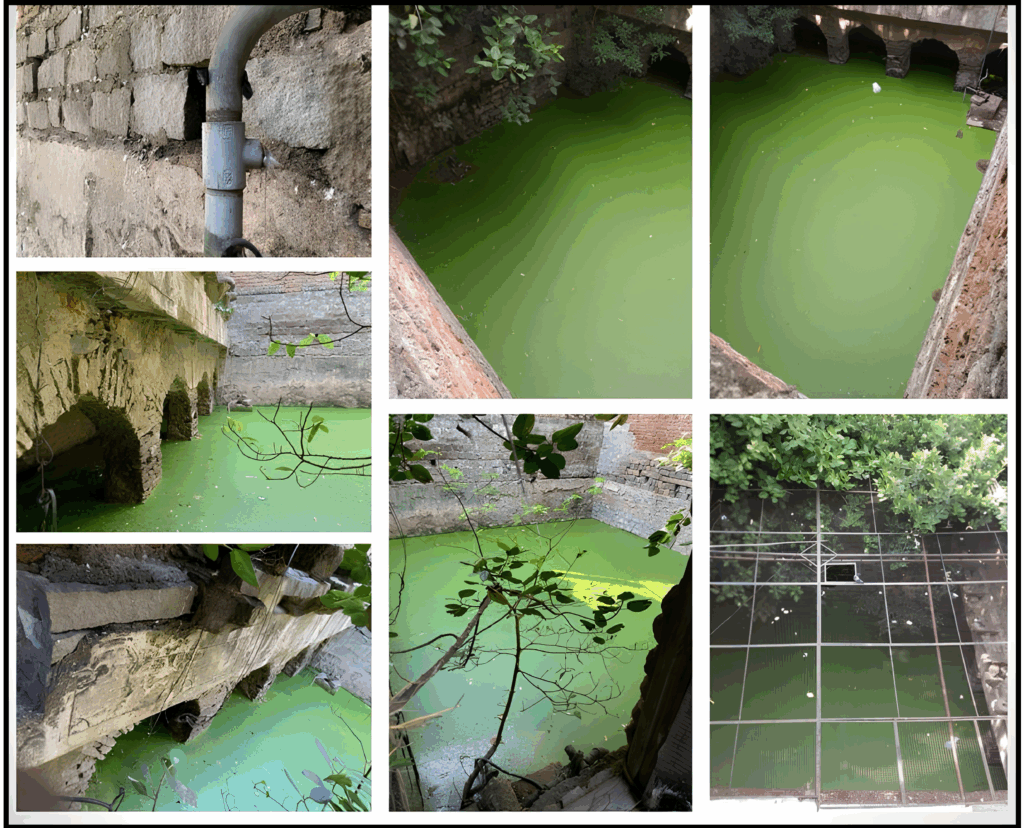
Most importantly, K.W. Bagh functioned as a network rather than a set of isolated features. Baoli water supported irrigation; orchard canopy stabilized microclimate; the house amplified airflow; kattas supported recharge; hauz tanks balanced distribution. Climate, architecture, labour, play, and water governance formed a continuous relational system.
Placemaking here was not a theoretical abstraction but embodied repetition. Identity emerged from participation in maintenance—watering, harvesting, repairing, resting, pruning, slowing runoff, sharing shade. The estate was not museum nostalgia; it was operational ecological coherence.
Flood Memory and Ethical Recalibration
If monsoon recurrence structures expectation, flood constitutes rupture. The Musi flood of 1908 reshaped Hyderabad’s civic landscape and remains a key moment in the city’s environmental memory. Amjad Hyderabadi’s poetic reflections render water as both sustainer and force, undoing complacent ideas of stability. ¹⁷ Water that nurtures can also erase.
Flood is not only a hydrological event; it is a temporal interruption. It collapses assumed continuity and exposes infrastructural fragility. In such moments, the city is forced into recalibration — material, administrative, and ethical. After 1908, Hyderabad’s drainage and embankment interventions grew more prominent, marking how catastrophe reorganizes planning horizons.
Flood memory also becomes a civic disposition. It introduces humility: water cannot be fully domesticated. It reinforces reciprocity: the environment is not merely a resource; it is a relationship with limits. The land retains flood memory through altered banks, sediment traces, and infrastructure redesign (material archives of rupture).
This matters for placemaking because collective identity absorbs catastrophe into caution. The city learns not only to celebrate rain, but to respect its excess.
Indigenous Ecology and Devotional Continuity
Deccan placemaking is also rooted in ecological particularity—species, soil, and seasonal ritual. Kakatiya-era literary traditions document reverence for wild native blooms rather than imported floriculture. ¹⁸ Bathukamma continues this devotion by gathering seasonal flowers from local terrain, turning floral selection into ecological recognition.
The Deccan literary shift toward indigenous flora signals epistemic autonomy. Qutb Shah’s monsoon vocabulary replaces imported rose symbolism with plateau specificity.¹² The region’s lexicon of belonging is not written in abstract nationalisms, but in the vernacular of the soil. The scent of rain-soaked earth, the seasonal arrival of local birds, the dense shade of mango groves — these are not merely environmental features; they are kin. For the author, this lexicon is an ancestral inheritance. My identity is inextricably bound to the shaded microclimate of K.W. Bagh, a landscape that taught me how to read the world. To belong here is to participate in a hydro-social cycle where the human and the geological are in constant, reciprocal dialogue. This deeply situated, localized epistemology proves that the only true gateway to understanding the universal human condition is through the specific earth we stand upon.
K.W. Bagh sustained this ancestral continuity not through the ornamental imports favored by colonial imaginations, but through a profound ecological fit. It was a landscape of climate-suitable orchards where every tamarind and curry leaf tree acted as a temporal marker. The interdependent roles of these natural elements and our social practices—the rituals of sweeping, harvesting, and retreating—are summarized in Table 1, which outlines the temporal maintenance of the baoli and bagh. This was a living calendar. The seasonal fluctuation of groundwater levels, which governed our communal rhythms and is graphically represented in Figure 5, was not a metric to be managed, but a pulse to be listened to. The plants thrived, and we thrived with them, because we adhered to the plateau’s inherent logic.
Yet, this lived epistemology stands in stark opposition to contemporary, capitalist approaches to heritage. Today, the revival of stepwells is frequently co-opted for expensive profit, sanitized under the guise of “adaptive reuse.” Developers treat the baoli like a severed artifact—pried from the ecological ring of the Deccan, polished for the gaze of social media, and displayed in an extractive exhibition. An act of epistemic violence. It is the architectural equivalent of taxidermy: the physical body of the stepwell is perfectly preserved, but its socio-cultural breath has been hollowed out.
Under the banner of regional conservation—often driven by shifting political will—these sacred thresholds are increasingly co-opted by startups and non-professional conservation firms. They are repurposed into exclusive venues for high-fashion photoshoots, musical advertising, and corporate marketing. They parade the masonry for global consumption, yet fundamentally erase the people who actually lived, swam, and sought spiritual retreat within these baghs. Why repurpose a space for commerce when its ontological purpose was communion? They restore the stone but pave over the soul. To a community that knows the aquifer as a living elder holding their shared history, these commercial restorations are not resurrections; they are simply beautifully decorated ghosts.
Epistemic Violence, Historical Discipline, and What Counts as Evidence
Modern historiography often privileges documentary verification, linear chronology, and methods that treat metaphysical registers as secondary or non-evidentiary. Kaul’s critique is relevant because it identifies how colonial modernity’s temporal regime shaped what could be recognized as knowledge.¹³–¹⁵ Banerjee similarly traces how colonial time-politics reorganized historical writing and the status of “premodern” worlds.¹⁹ The critique is not that empirical history is unnecessary; it is that a narrow regime of evidence can erase lived systems where ecology, ritual, and ethics co- produce space.
Recent debates within theory and history further underscore how disciplinary method can become a gatekeeping mechanism.²⁰ Comparative work on premodern South Asian historicity shows that multiple modes of representing the past existed—didactic, ethical, poetic, and performative—often sidelined by modern disciplinary expectations.²¹
This matters directly for water infrastructures. If baolis are studied only as hydraulic artifacts, analysis becomes incomplete. Water systems in Hyderabad were simultaneously technical and ethical, material and literary, civic and interior. Dakhni texts do not merely “decorate” infrastructure; they provide a record of how water structured inner life, civic obligation, and cultural time.
To analyze placemaking in the Walled City, evidentiary frameworks must expand. Lived memory (such as K.W. Bagh’s ecological routines), ritual calendars, labour rhythms, and literary consciousness must be treated as legitimate sources—when carefully contextualized—rather than dismissed as non-empirical.
The historical patterns discussed above provide a basis for understanding the transformation of water relations in contemporary urban contexts.
Reciprocity Versus Extraction
Postcolonial urbanization introduced vertical expansion and centralized water supply, often accompanied by the privatization of aquifers through borewells, the neglect or infill of tanks, and the erosion of shared water thresholds. These changes altered not only hydrology but civic ethics. When water becomes invisible infrastructure (piped, commodified, individualized), reciprocity weakens because dependence is no longer publicly encountered.
The baoli and the bagh illustrate an alternative civic model grounded in visible dependence and shared maintenance. The argument here is not for romantic restoration. It is for relational intelligence in contemporary planning: decentralized recharge, visible storage, seasonal maintenance protocols, community stewardship mechanisms, and design that keeps water perceptible as shared life rather than hidden commodity.
Placemaking, under this view, cannot be reduced to streetscape beautification or symbolic branding. In semi-arid cities, placemaking must be rebuilt as ecological participation, because belonging is stabilized by what communities repeatedly hold together.
In this context, the relevance of historical water systems lies not in their replication but in the principles they embody. Decentralized recharge, visible water storage, and shared maintenance practices offer alternative models to centralized and extractive systems. Reintegrating such principles into contemporary planning can restore awareness of ecological limits while strengthening community participation. Placemaking in semi-arid cities must therefore move beyond surface-level interventions toward systems that re-establish the relationship between water, time, and collective responsibility.
Conclusion
Hyderabad’s Walled City can be read as an ecological-temporal practice rather than a static heritage precinct. The baoli and bagh were not background features; they were ethical infrastructures binding community to aquifer and monsoon. Dakhni literary traditions illuminate how this binding extended beyond utility into interior discipline: the baoli appears as a workshop of the soul—not through romantic excess, but through a rigorous ethic of humility, restraint, and relational dependence. ¹⁵,¹⁶
Modern temporal regimes introduced uniformity and accelerated presentism. ⁴,⁵ Deccan practice sustained plurality: monsoon time as recurrence, maintenance as civic rhythm, rupture (flood) as moral recalibration.¹⁷ The lived ecology of K.W. Bagh demonstrates that such integration persisted into recent memory as operational practice.
The land keeps the score—not as metaphorical flourish, but as material record. It registers reciprocity and rupture alike. Placemaking today requires reading that record: not to replicate premodern forms uncritically, but to restore ecological time, visible reciprocity, and shared stewardship as foundations of belonging in semi-arid urban life.
References
1. Heidegger M. Being and Time. Translated by Macquarrie J, Robinson E. New York, NY: Harper & Row; 1962.
2. Casey ES. Getting Back into Place: Toward a Renewed Understanding of the Place-World. Bloomington, IN: Indiana University Press; 1993.
3. Tuan YF. Topophilia: A Study of Environmental Perception, Attitudes, and Values. Englewood Cliffs, NJ: Prentice-Hall; 1974.
4. Sherwani HK. History of the Qutb Shahi Dynasty. Hyderabad, India: Munshiram Manoharlal; 1974.
5. Michell G, Zebrowski M. Architecture and Art of the Deccan Sultanates. Cambridge, UK: Cambridge University Press; 1999.
6. Nayeem MA. The Heritage of the Qutb Shahis of Golconda and Hyderabad. Hyderabad, India: Hyderabad Publishers; 2004.
7. Eaton RM. A Social History of the Deccan, 1300–1761: Eight Indian Lives. Cambridge, UK: Cambridge University Press; 2005.
8. Yazdani G. The Early History of the Deccan. Oxford, UK: Oxford University Press; 1960.
9. Alam M, Subrahmanyam S. Writing the Mughal World: Studies on Culture and Politics. New York, NY: Columbia University Press; 2012.
10. Elias N. Time: An Essay. Translated by Jephcott E. Oxford, UK: Blackwell; 1992.
11. Hartog F. Regimes of Historicity: Presentism and Experiences of Time. Translated by Brown S. New York, NY: Columbia University Press; 2015.
12. Muhammad Quli Qutb Shah. Kulliyat-e-Muhammad Quli Qutb Shah. Edited by Abdul Haq. Delhi, India: Anjuman Taraqqi-e-Urdu; 1940.
13. Kaul S. Seeing the past: Text and questions of history in Kalhana’s Rajatarangini. History and Theory. 2014;53(2):194-211.
14. Kaul S. The Making of Early Kashmir: Landscape and Identity in the Rajatarangini. New Delhi, India: Oxford University Press; 2018.
15. Kaul S. Historical methods. In: Jain P, ed. Encyclopaedia of Indian Religions: Hinduism and Tribal Religions. Dordrecht, Netherlands: Springer; 2018.
16. Wajhi M. Sabras. Edited by Naseeruddin Hashmi. Hyderabad, India: Dairat-ul- Maarif; 1935.
17. Hyderabadi A. Ruba’iyat-e-Amjad. Hyderabad, India: Idara-e-Adabiyat-e-Urdu; 1960.
18. Palkuriki Somanatha. Basava Purana. Hyderabad, India: Telugu University; 2003.
19. Banerjee P. Politics of Time: “Primitives” and History-Writing in a Colonial Society. New Delhi, India: Oxford University Press; 2006.
20. Kleinberg E, Scott JW, Wilder G. Theses on theory and history. TheoryRevolt. 2018.
21. Narayana Rao V, Shulman D, Subrahmanyam S. Textures of Time: Writing History in South India 1600–1800. New Delhi, India: Permanent Black; 2001.