

Introduction: Belonging in Urban Regeneration
Urban regeneration is not only spatial but relational: it reshapes how people connect to places and to one another in an era of fragmented public life.
Urban fragmentation manifests in the thinning of shared everyday life: fewer informal encounters, fewer overlapping routines, and a diminished sense that public spaces are collectively held. Jane Jacobs argued that urban vitality emerges from continuous mutual presence and small-scale social practices rather than from isolated physical interventions.1 Ray Oldenburg similarly emphasised the civic role of “third places” as informal environments where sociability and recognition are sustained.2 When regeneration produces spaces that feel interchangeable or scripted, it risks what Edward Relph described as placelessness: the erosion of lived meaning that anchors identity in urban life. 3
Within this context, connection refers to relational ties mediated by place, while belonging describes the lived experience of being “of” a place — recognising oneself in it and being recognised by others. Nira Yuval-Davis frames belonging as an affective attachment that becomes visible when it is negotiated through social and political boundaries.4 In urban design, belonging therefore exceeds questions of access or aesthetics; it emerges through everyday practices, recognition, and participation.
Place attachment provides a conceptual bridge between subjective experience and collective outcomes. Altman and Low define it as a multidimensional bond—affective, cognitive, and behavioural—between individuals or groups and their socio-physical environments.5 Manzo and Devine-Wright show how such attachments evolve over time and are reshaped by processes of change, including regeneration.6 In this article, collective identity refers to a shared “we” anchored in place, expressed through narratives, memories, and common practices. Shared responsibility denotes the translation of belonging into care: maintaining, protecting, and investing in a place over time. These dimensions are critical, as stewardship determines long-term success.
Participatory design and co-production offer pathways through which attachment becomes collective capacity. Ostrom conceptualises co-production as the joint creation of public goods across institutional boundaries.7 Bovaird and Loeffler argue that co-production generates public value when communities act as partners rather than consultees.8 Empirical studies reinforce this process-oriented view: Falanga demonstrates how internally driven regeneration can strengthen residents’ perceived agency in shaping place trajectories;9 Wu and colleagues highlight the importance of continuous stakeholder engagement for sustainable neighbourhood rehabilitation10; and Li et al. reveal both the potential and tensions of institutional co-production at neighbourhood scale.11 Together, this literature suggests that belonging is not a by-product of design quality alone, but an outcome of shared authorship and sustained engagement.
Against this backdrop, this article examines Teleki Square in Budapest as a qualitative case of participatory transformation and community formation. The square’s community park emerged through an open, ten-week workshop process in which residents collectively shaped design decisions.12 Embedded within the socially oriented urban regeneration programme,13 the project foregrounded participation as a core principle rather than a procedural formality.
The argument advanced here is that participatory design fosters a sense of belonging through shared authorship. When residents co-define problems, negotiate trade-offs, and shape material interventions, they develop not only a redesigned square but a collective identity and a sense of “our place.” Over time, this belonging becomes visible in maintenance practices and community care, supporting the square’s continued vitality beyond project completion. This relationship is summarised in Figure 1.

Methodological Note
This article is based on a qualitative case study of Teleki Square in Budapest. The analysis combines historical review, on-site observation conducted in 2022, and a semi-structured interview with landscape architect Dominika Tihanyi14, who led the participatory design process. The interview provides insight into the decision-making process, community dynamics, and the project’s long-term social effects.
Teleki Square Before Transformation: A Space Without Collective Anchoring
Teleki Square, located in Budapest’s 8th district, an area marked by long-term socio-economic challenges, has undergone multiple transformations reflecting broader urban change. In the late 19th and early 20th centuries, the square functioned as a vibrant marketplace serving artisans, working-class residents, Jewish communities, and Roma musicians. Its proximity to a railway station positioned it as an entry point for migrants arriving in the capital, contributing to intense density and commercial vitality.15_16
This early phase was defined by sustained use. The marketplace structured everyday routines and mutual visibility. The square served as a social anchor within the district, where its presence and exchange generated informal yet durable attachments.
The relocation of the market in the late 1950s marked a decisive rupture. With the loss of its primary function, Teleki Square gradually declined. Benkő and Germán describe it as a “neglected, functionless and stigmatised urban void,” characterised by deteriorating physical conditions and social marginalisation.15 Faurest similarly notes that the square “lost its raison d’être” and only partially fulfilled the role of an urban park.17
Although some accounts recall a temporary revival in the 1960s and 1970s—when residents regularly used chess tables and benches18—this period did not reverse the longer trajectory of decline. By the 1980s, the area was widely associated with high crime rates, prostitution, population turnover, and deteriorating public space quality.18 Over time, stigma became embedded in the identity of the square itself.
By the early 2000s, Teleki Square was frequently described as an uncontrolled and avoided space, associated with homelessness, drug use, and neglect.15,17 What matters for belonging is not only material deterioration but the erosion of everyday use. Without sustained occupation, the square ceased to function as a shared setting of routines and recognition. It remained physically present, yet socially unanchored.
The inclusion of Teleki Square within a broader regeneration programme in 2004 marked an institutional acknowledgement that spatial decline was intertwined with broader social fragmentation.13 Unlike purely physical redevelopment schemes, the programme aimed to address social, economic, and architectural dimensions simultaneously.13 The renewal of the square, completed in 2014, therefore confronted not only infrastructural decay but the long-standing absence of collective anchoring.
Belonging presupposes repeated use and negotiated coexistence. Teleki Square’s decades of functional loss and stigma created a relational vacuum in which attachment could not easily form. Understanding this condition is essential to evaluating the subsequent participatory process. The transformation did not occur at a neutral site; it engaged a space marked by discontinuity, mistrust, and disrupted routines. The significance of the project lies in its attempt to re-establish Teleki Square not merely as a redesigned park, but as a socially embedded place that can sustain a sense of belonging.
Participatory Design as Social Infrastructure
If Teleki Square previously lacked collective anchoring, the participatory process initiated a relational reconstruction. The transformation did not begin with form-making but with a redistribution of authorship. Although an initial plan was prepared for funding purposes, it was set aside once workshops began:
“We drew something before… but that was put away, and we started completely from zero.”14
Rather than commenting on a completed proposal, residents co-constructed the concept. Over approximately ten weeks, workshops operated as a collaborative studio involving around twenty residents and four designers. As Dominika Tihanyi recalls, it was “like in university… 25 people working together”.14
The process was discussion-based and iterative. Drawing and dialogue unfolded simultaneously; with each session, decisions were layered onto the plan. Participants physically indicated spatial preferences, even “standing where the bench should be”.14
“It wasn’t about fighting… it was thinking together on how their future could be better.”14
Crucially, participants did not argue solely on the basis of individual interest. According to Tihanyi, the Teleki group “could think as a community… not only about themselves but about everybody who would use the park”.14
The participatory process thus functioned as social infrastructure, establishing trust through repeated encounters and shared decisions. Tihanyi explicitly contrasts this with other projects where distrust dominated: “In Teleki, there was trust in both directions”.14
Belonging thus began before construction. The workshops produced relational bonds that later stabilised the physical transformation. The process, from initial workshops to long-term use and maintenance, can be understood as a continuous sequence linking participation to stewardship (Figure 2).

1. Starting From Zero: Shared Authorship
Beginning “from zero,” the agency was redistributed. Residents presented historical knowledge, debated spatial organisation, and shaped the conceptual framework. Designers repeatedly returned “to the zero point where we decided what the concept should be”.14
This reflexive structure mattered. Decisions were evaluated against collectively defined principles rather than individual preferences. The plan that emerged was not merely spatial but normative: it encoded shared agreements about use, coexistence, and future maintenance.
The process rehearsed the very forms of interaction the park would later host. Designing together became an act of collective identity formation.
2. The Fence: Territoriality and Symbolic Boundaries
The debate over the fence reveals how material elements can crystallise collective meaning. Residents insisted the park be enclosed and locked at night; for them, this was “not a question”.14 Given the square’s history of neglect, the fence represented rupture with the past.
Yet its meaning exceeded control. Residents rejected a cheap solution and demanded an elegant, dignified structure:
“It shouldn’t be cheap… it should show respect… It’s like the park’s backbone.”14
The fence thus functioned as a symbolic boundary in Lamont’s sense: a material marker distinguishing valued space from prior marginalisation. At the same time, it enacted territoriality as described by Altman, defining legitimate users and patterns of responsibility.
Tihanyi later acknowledged that residents were right: “Even from this point of view… it was a good decision”.14
However, strong ownership carried ambivalence. Residents began to perceive the park “as their own garden”.14 While this fostered care and vigilance, it also risked over-regulation. A caretaker, imagined as a friendly presence, sometimes acted more as a guard; informal enforcement occasionally produced tension.
Belonging, therefore, is not boundary-free. It generates responsibility but also requires careful calibration of openness and control.
3. Zoning the Park: A Choreography of Coexistence
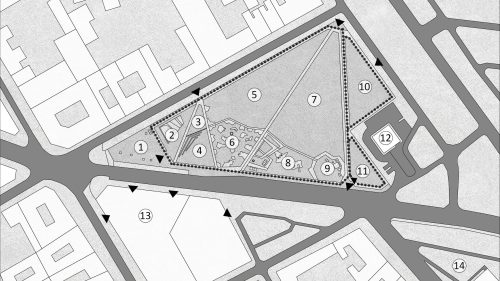
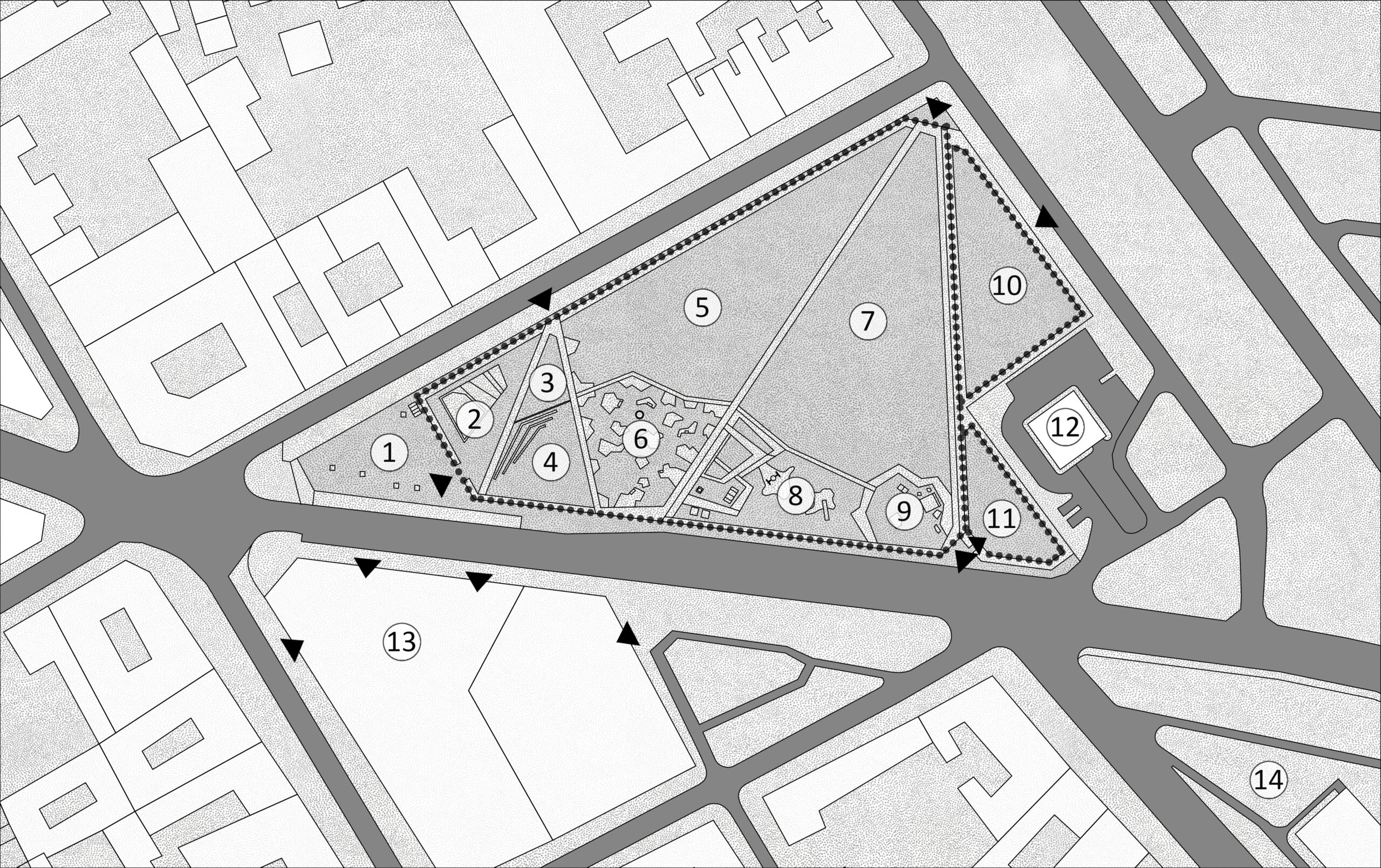
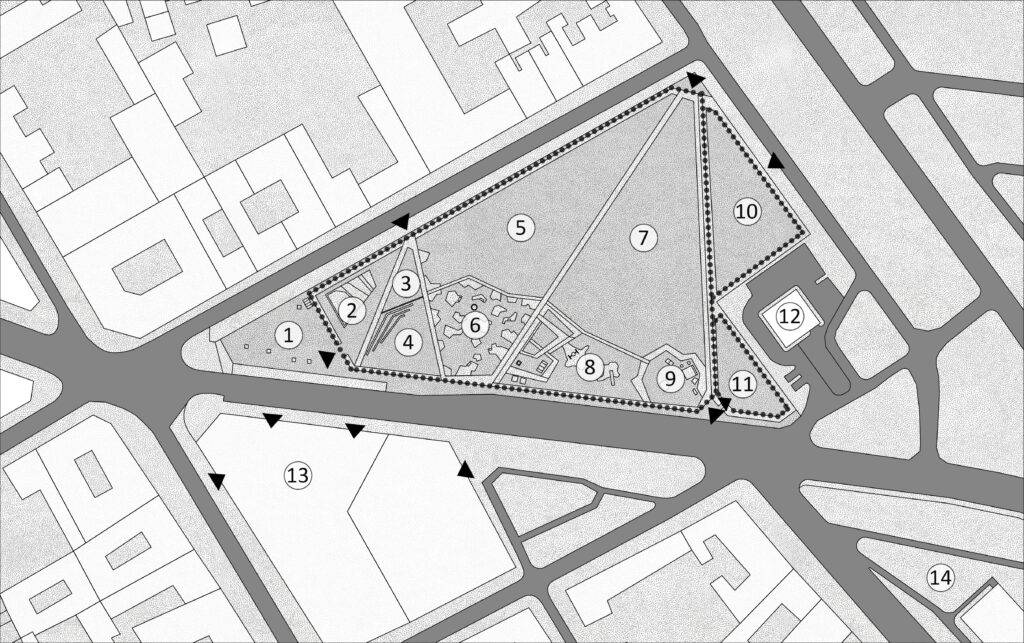
The spatial organisation of Teleki Square reflects negotiated pluralism rather than fragmentation. The park integrates an entrance square and event space, an information area, a children’s play garden, a teenage corner, shaded seating with chess tables, and separate dog areas.14 Figure 3 shows the plan of Teleki Square with separate areas marked on it.
These zones emerged through deliberation across age groups. Residents explicitly considered multiple users rather than advocating solely for themselves. Budget constraints limited the spectacle’s scope and prevented overdesign. As Tihanyi notes, having less money may have been beneficial: “You didn’t have enough money to overdo it”.14
The result is a restrained spatial framework that supports simultaneous occupation. Rather than imposing uniformity, the layout choreographs coexistence. Belonging here is plural: structured through differentiation yet anchored in shared authorship.
Across collaborative authorship, symbolic boundary-making, and negotiated zoning, participatory design operated as social infrastructure. The built park materialised prior to relational work. Trust, identity, and responsibility were forged during the process and later stabilised in spatial form.
From Participation to Ownership
If participatory design generated shared authorship, its longer-term effect was collective ownership. After construction, a core group of participants formed a local association, extending the design process into everyday governance.14 The park became a platform for events and informal gatherings, sustaining social bonds.
Ownership was most visible in maintenance practices. Residents monitored the park’s condition, cleaned up litter, and contacted the municipality when repairs were needed. As Tihanyi explains, they functioned as “the eyes” of the park.14 Belonging translated into stewardship. The square was no longer an anonymous public space; it was perceived as “their own garden”.14
This dynamic reflects the behavioural dimension of place attachment described by Altman and Low: attachment becomes legible through care and protection.5 Yet strong ownership also revealed ambivalence. The sense of “our place” sometimes approached over-territoriality. Informal rule enforcement and the presence of a caretaker risked shifting the atmosphere from hospitality to regulation.14
Territoriality, as Altman suggests, stabilises norms but can also narrow openness. In Teleki Square, the mechanisms that enabled responsibility could also generate friction. Belonging produced care, but care could also manifest as control.
A further challenge concerns continuity. The association’s core members are ageing, and renewal has been limited.¹⁴ This raises a structural question: can belonging sustain itself without ongoing relational investment? Community energy requires reproduction; otherwise, stewardship weakens over time.
Collaboration with the municipality further exposed the negotiated nature of ownership. Debates over the public toilet and the deterioration of elements such as the wooden stage required mediation and compromise.14 Communication remained essential to maintaining trust.
Teleki Square demonstrates a paradox: belonging generates responsibility, which must remain calibrated to avoid closure. Participatory regeneration can initiate ownership, yet its long-term vitality depends on balancing territorial care with openness.
Maintenance as an Indicator of Belonging
More than a decade after its completion, Teleki Square remains well-maintained and in active use. This durability is not self-evident, as many regeneration projects deteriorate once funding cycles close. Teleki Square presents a different trajectory.
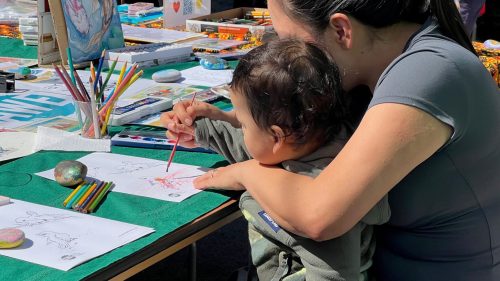
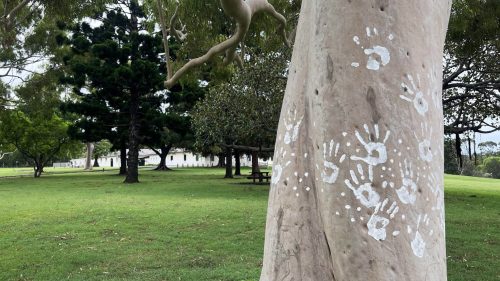
Repeated visits to the square between 2022 and 2026 indicate continued everyday use and visible care. Plantings are largely intact, the space remains clean, and people of different ages occupy the park throughout the day. The square does not appear abandoned or loosely managed; rather, it shows signs of ongoing attention (Figure. 4, 5, 6).
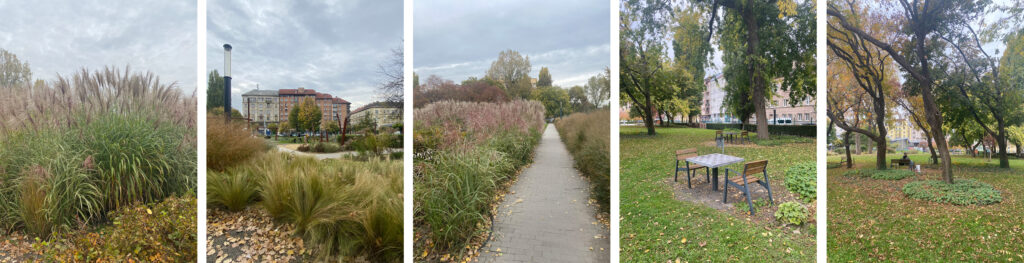
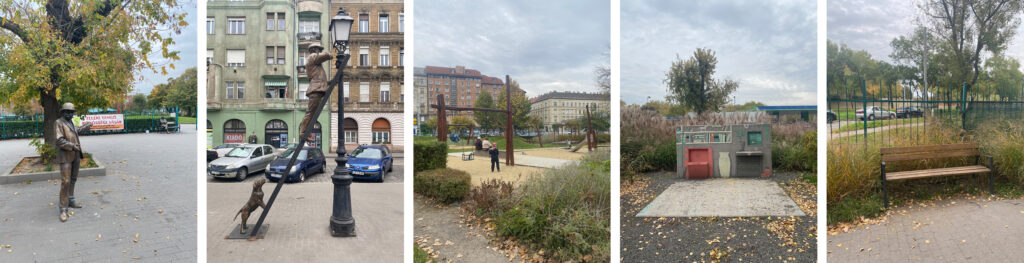
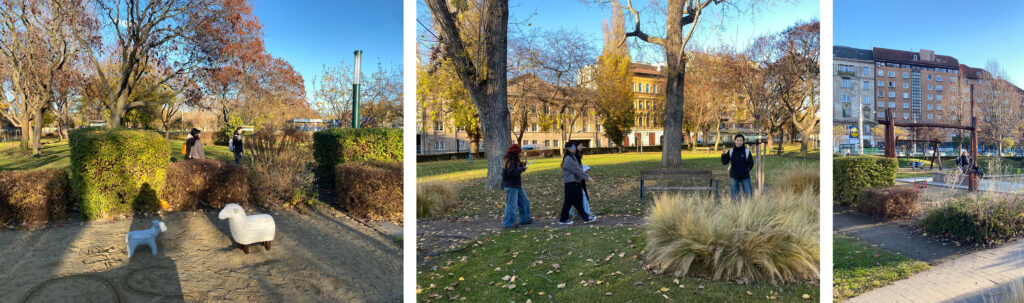
This continuity is particularly notable given material changes over time. The original wooden stage has been removed due to deterioration.14 Parts of the play area were modified by the municipality without consulting the designers.14 Debates have emerged over the installation of a public toilet, generating tension between residents and local authorities.14The park has therefore evolved, and not always according to its original design logic.
Yet these changes have not led to decline. The absence of the stage did not trigger neglect. Alterations did not dissolve use. Instead, residents continue to monitor conditions, contact the municipality when problems arise, and defend the space’s character.14 Maintenance here is not merely technical upkeep; it is behavioural evidence of attachment.
Belonging becomes legible in small acts: correcting littering, organising activities, negotiating improvements. Pride in the park is expressed through continued engagement rather than spectacle. The square’s relative stability after more than a decade suggests that stewardship has become embedded in everyday routines.
Importantly, belonging does not eliminate disagreement. The toilet debate illustrates that visions of care may diverge.14 However, the capacity to negotiate such tensions without collapsing collective involvement indicates that the relational infrastructure established during the participatory process remains operative.
Teleki Square thus supports the article’s central claim: participatory design does not simply produce a physical environment; it generates social bonds that sustain it. Long-term maintenance is not only a matter of material durability, but of cultivated belonging.
Discussion: Designing Conditions for Belonging
The case of Teleki Square suggests that belonging cannot be installed through spatial intervention alone. It emerges through co-production. The park’s relative stability after more than a decade indicates that what sustains public space is not only design quality, but shared authorship.
First, belonging is not designed in the conventional sense; it is collectively produced. The participatory workshops did more than generate spatial proposals. They created a framework of mutual recognition, shared decision-making, and negotiated responsibility. The built park materialised these prior relational investments. Without this process, the same configuration would not have generated comparable attachment.
Second, the case reinforces the primacy of process over object. While material form matters, the durability of Teleki Square cannot be explained by aesthetics or layout alone. The design process functioned as social infrastructure: it rehearsed coexistence, established trust, and produced collective identity before construction began. The physical environment stabilised bonds that were already in formation.
Third, material decisions can operate as symbolic anchors. The fence debate demonstrates how built elements may condense meanings of dignity, rupture with stigma, and collective recognition. What began as a practical disagreement evolved into a shared statement about value and respect. Such elements do not merely regulate space; they communicate identity.
Fourth, trust appears as a precondition for productive participation. In contrast to other projects marked by suspicion, Teleki Square benefited from mutual trust between designers and residents.¹⁴ This trust allowed disagreement without fragmentation and enabled residents to assume responsibility without perceiving design as imposed. Where distrust dominates, participation risks becoming defensive rather than generative.
At the same time, the case reveals important tensions and limits of participation. While shared authorship fosters attachment and responsibility, it may also generate forms of over-territoriality. As reflected in the interview material, residents began to perceive the park as “their own garden,” which strengthened care but could also “feel a little bit like privatising a park”.
Concerns about safety further intensified this dynamic. Efforts to ensure visibility and control, such as modifying planting to eliminate hidden areas, demonstrate how the pursuit of safety may lead to increased regulation and reduced spatial openness. This points to a broader tension between freedom and control in public space: while parks are often understood as spaces of openness and informal use, participatory processes may also produce new forms of behavioural regulation.
Participation also operates within temporal and institutional limits. The community group that emerged through the design process has faced challenges in renewal over time, raising questions about the long-term sustainability of collective stewardship. At the same time, later modifications implemented without consultation illustrate that co-production remains negotiated within uneven power structures rather than fully shared governance (Figure. 7).
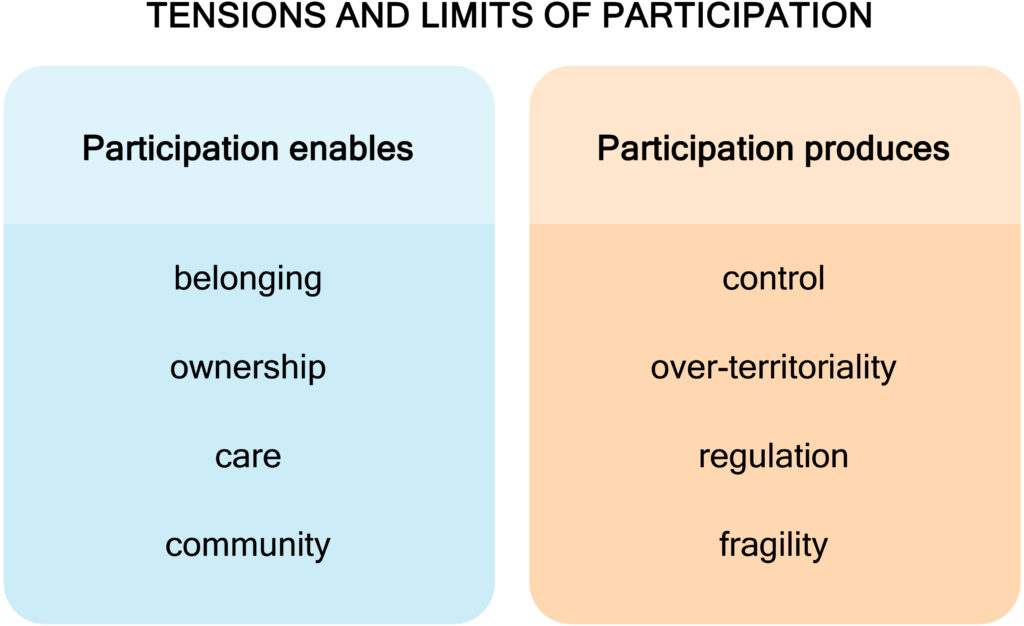
Finally, community energy must be sustained. Belonging is not self-perpetuating. The ageing of the association’s core members illustrates the fragility of collective stewardship. Without renewal, attachment may weaken. Participatory regeneration, therefore, requires long-term communicative structures that support adaptation and generational transition.
In broader urban regeneration contexts, Teleki Square offers a modest but significant lesson. Public space resilience is not solely a function of funding, surveillance, or technical maintenance. It depends on whether residents recognise themselves in the space and in one another. Designing conditions for belonging means designing processes that enable shared authorship, symbolic recognition, and ongoing negotiation.
Belonging, in this sense, is less a product than a practice—one that must be continually enacted to sustain urban life.
Conclusion: From Space to Social Infrastructure
Teleki Square demonstrates that physical redesign alone does not create a sense of belonging. The transformation of the square was not simply a matter of replacing a neglected space with a functional park. It was a relational process that reconfigured how residents connected to one another and to the place itself.
Participation created the conditions for these connections to emerge. By starting “from zero,” redistributing authorship, and engaging residents in sustained dialogue, the design process generated trust and collective identity before construction began. The built form did not produce belonging; it stabilised bonds that had already been formed.
Material decisions, such as the fence and the park’s spatial zoning, became meaningful because they were collectively negotiated. They condensed shared memory, aspiration, and dignity into physical form. In this way, architecture operated not only as a spatial arrangement but as a carrier of symbolic and relational meaning.
More than a decade later, the continued maintenance and everyday use of Teleki Square indicate that belonging has translated into stewardship. Despite material alterations, institutional tensions, and the natural ageing of community members, the park remains socially anchored. Belonging has manifested as vigilance, pride, and ongoing engagement.
The case suggests that designing for connection and belonging requires shifting the focus from objects to processes. Urban regeneration succeeds when it cultivates social infrastructure alongside spatial intervention. Public spaces endure not only because they are well-designed, but also because people recognise themselves in them—and assume responsibility for their future.
Teleki Square offers a modest but compelling example: when participation generates relational bonds, built form can sustain them. Belonging, once co-produced, becomes a durable resource for urban life.
References
1 Jacobs J. The Death and Life of Great American Cities. New York, NY: Random House; 1961.
2 Oldenburg R. The Great Good Place: Cafes, Coffee Shops, Community Centers, Beauty Parlors, General Stores, Bars, Hangouts, and How They Get You Through the Day. New York, NY: Paragon House; 1989.
3 Relph E. Place and Placelessness. London, UK: Pion; 1976.
4 Yuval-Davis N. The Politics of Belonging: Intersectional Contestations. London, UK: SAGE Publications; 2011.
5 Altman I, Low SM, eds. Place Attachment. New York, NY: Plenum Press; 1992. doi:10.1007/978-1-4684-8753-4.
6 Manzo LC, Devine-Wright P, eds. Place Attachment: Advances in Theory, Methods and Applications. 2nd ed. London, UK: Routledge; 2021.
7 Ostrom E. Crossing the great divide: coproduction, synergy, and development. World Dev. 1996;24(6):1073–1087.
8 Bovaird T, Loeffler E. From engagement to co-production: the contribution of users and communities to outcomes and public value. Voluntas. 2012;23(4):1119–1138. doi:10.1007/s11266-012-9309-6.
9 Falanga R. Understanding place attachment through the lens of urban regeneration: insights from Lisbon. Cities. 2022;122:103590. doi:10.1016/j.cities.2022.103590.
10 Wu H, Wang Y, Zhuang T, Li K, Hu W. What makes co-production work in sustainable neighborhood rehabilitation in China? A stakeholder structure perspective. Cities. 2024;150:105068. doi:10.1016/j.cities.2024.105068.
11 Li F, Lynam A, Huang H, Wei J. Institutional co-production at neighbourhood scale: cases of urban renewal for Shanghai’s ageing population. Habitat Int. 2024;144:103000. doi:10.1016/j.habitatint.2023.103000.
12 Újirány Tájépítész Kft. Közösségi tervezés: Teleki tér, közösségi park. Accessed February 11, 2026.
13 Balázs RD. Pebble in the pond: the socio-spatial production of gentrification in the Magdolna Quarter and its participatory landscape design project in Teleki Square. Socio.hu. Special issue; 2020.
14 Tihanyi D. Semi-structured interview by author. Budapest, Hungary. 2023. Unpublished.
15 Benkő M, Germán T. Crime prevention aspects of public space renewal in Budapest. J Place Manag Dev. 2016;9(2):191–209. doi:10.1108/JPMD-09-2015-0034.
16 Somogyi K. Teleki. Miénk itt a tér. Budapest. 2014;37(10):2–5.
17 Faurest K, Alföldi G. Remaking the agora: Teleki Square, Budapest, Hungary. Topos. 2015;(91):44–49.
18 Fehér K, Keller J, Virág T. The rediscovery of our own space: community building in Teleki Square. In: Keller J, Keresztély K, Virág T, eds. Our Neighbourhoods’ Heroes: Stories on Citizen Participation in Local Development in European Cities. Berlin: Comparative Research Network; 2017:93–100.