

Proximity, Autonomy & Belonging
Who feels connection and belonging in everyday workplaces and who carries the cost of adaptation?
Workplaces are shaped by spatial and cultural norms: temperature settings, lighting, acoustics, layouts, schedules, dress codes, and unspoken expectations about commitment and capability. Together, these conditions are often organized around assumptions of stability — both organizational and bodily.
When environments align with bodily rhythms, belonging can feel natural and connection effortless. When they do not, adaptation becomes a quiet, ongoing effort. Autonomy narrows, and individuals absorb the work of managing misalignment alongside their primary tasks.
These dynamics are often recognized intuitively, even without formal language. Puberty, for example, is widely remembered as a period of heightened emotional variability, physical unpredictability, and difficulty with regulation. This turbulence reflects a body in transition rather than diminished resilience. Many of these shifts are shaped by interacting hormonal and neurobiological processes that regulate sleep, stress, mood, metabolism, and cognition.
Across the life course, women experience several hormonal transitions, including menstruation, pregnancy, postpartum, recovery, perimenopause, and menopause. Like puberty, these phases involve shifts in physiological regulation, though they are less consistently recognized.
These transitions are common, though highly variable in timing, intensity, and lived experience.1,2 Their effects are not limited to individual experience, but can shape interaction, participation, and expectations within shared environments. They alter how bodies experience space, including how quickly heat becomes overwhelming,3 how much light exposure shapes sleep and alertness,4 and how easily cognitive performance,5 and attention6 are disturbed or sustained. Despite this, workplace environments are typically organized around assumptions of consistency, rarely adjusting to these shifts.
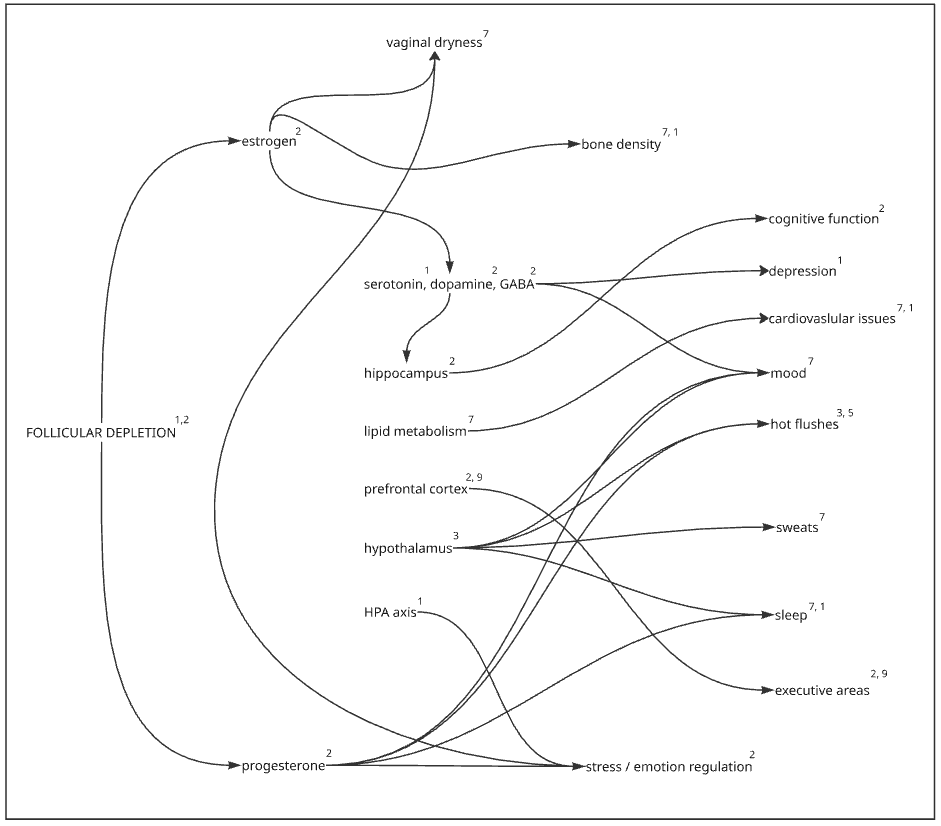
Menopause marks the point at which menstruation and reproductive capacity permanently end, a natural stage of life most women move through during their working years.1 The transition leading up to this point, known as perimenopause, typically lasts several years.1,2 During this phase, the body gradually produces less estrogen and progesterone — the primary sex hormones that regulate sleep,1 stress,2 metabolism,7 mood,8 and cognition9,10 throughout a woman’s adult life. Rather than declining steadily, levels fluctuate significantly and unpredictably before eventually settling at levels much lower than during the menstrual cycle.1,7,8 The impacts can manifest visibly in daily life: hot flushes, disrupted sleep, changes in mood or attention, increased anxiety and clinically significant depression.1 Figure 1 maps these hormonal changes and their associated bodily and symptomatic experiences.
What is sometimes dismissed as diminished resilience may instead reflect physiological regulation in motion. In what follows, menopause is used in a broader sense to refer to the menopausal transition, including perimenopause.
Proximity to lived experience, to colleagues, to cultural narratives shapes how these transitions are understood. For some, menopause is a reality. For others, it remains distant, abstracted, minimized, or reduced to stereotype. That distance influences how visible shifts in regulation are interpreted within shared environments.
Belonging is Spatial, Not Just Cultural
In an open-plan office, a hot flush may intensify under fixed temperatures and bright lighting. After a disrupted night’s sleep, sustained concentration during a presentation may require disproportionate effort. In hot-desking environments, the absence of personal territory can heighten anxiety around managing personal needs discreetly. Emotional variability may be privately monitored to avoid being misread.
The strain becomes not only sensory or physical but relational, requiring judgment about whether to request adjustment, tolerate discomfort, or mask it. Where colleagues or leaders have proximity to similar experiences, expressed needs may be met with recognition rather than suspicion. Where that proximity is absent, the labour of interpretation falls on the individual.
Over time, sustained self-monitoring may reshape connection itself. Connection to one’s body may become adversarial rather than supported. Connection to colleagues may become cautious rather than open. Connection to place may weaken when environments feel like something to endure, instead of inhabit.
Menopause as Lens: From Accommodation to Embedded Autonomy
When menopause is approached in design and policy as a discrete condition the risk is that the solution becomes framed as a niche, exceptional and medicalized, rather than structural change. Yet this framing obscures a more important insight: menopause does not introduce new needs so much as reveals long-standing blind spots in how workplaces are organized.
When workplaces assume bodily consistency — stable temperature tolerance, predictable energy levels, sustained concentration, they inevitably privilege some bodies and brains while rendering others out of sync. Menopause brings these assumptions into focus, not because it is unusual, but because it makes misalignment hard to ignore.
The problem is not the condition itself. It is that environments are designed as though various conditions didn’t exist.
For this reason, menopause is most illuminating when understood as a lens rather than a label. As a label, it isolates: it narrows attention to a defined group and invites prescriptive accommodation. As a lens, it widens the frame, situating menopause within a continuum of bodily transitions across women’s lives — menstruation, pregnancy, postpartum, perimenopause, menopause, each involving hormonal fluctuation, shifting capacities, and evolving relationships to space (as illustrated in figure 2).
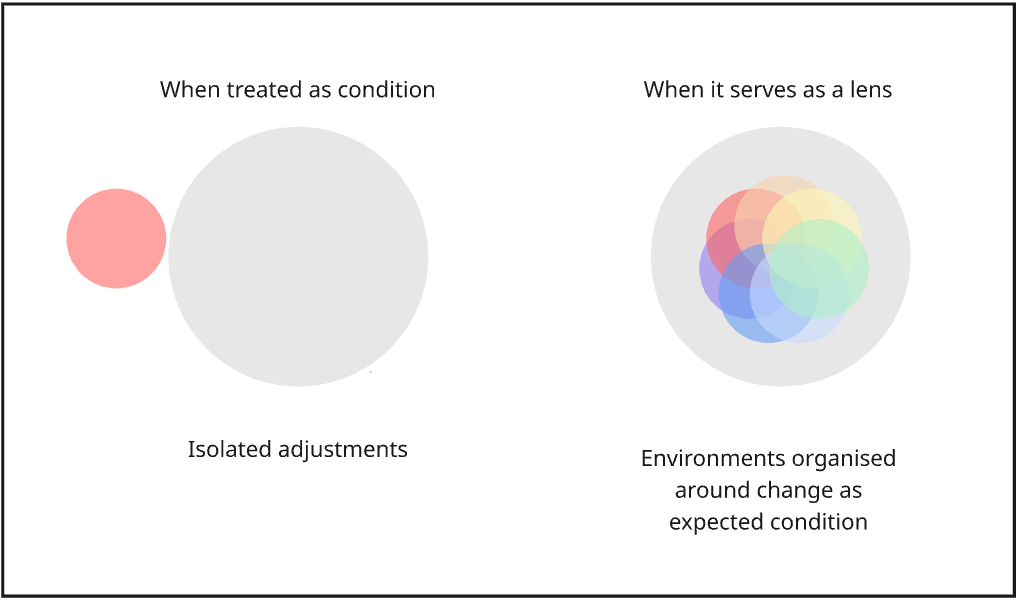
A lens-based approach does not abandon specificity. Menopause is named, but not reduced. When treated only as a condition to accommodate, responses tend toward isolated adjustments aimed at a defined group. When treated as a lens, it invites a more expansive question: How might workplaces be organized for non-static bodies from the outset?
Imagine a day when you haven’t slept well and feel tired. It doesn’t immediately mean you want to be put in a room for “tired people who didn’t sleep well.” You can still want to belong, to be included, to be able to operate at your own pace with more flexibility and choice. In a lens-based framing, the issue is less about designing for a condition and more about organizing environments around change as an expected condition of working life.
Wellbeing as a Shared System of Influence
Workplaces are not neutral backdrops. They are systems that shape how energy, attention, and restoration circulate.
A workday spent managing heat, fatigue, or cognitive fog rarely announces itself. It appears instead in small, cumulative decisions: choosing seats strategically to manage visibility and interaction, monitoring tone to avoid misinterpretation, suppressing discomfort to maintain composure. Energy is expended not only on tasks but on regulating one’s body within fixed conditions.
When the laptop closes, that effort of private self-regulation does not disappear. A person’s life is multidimensional and multiscalar, as illustrated in Figures 3 and 4. Effort travels outward — into caregiving, partnerships, friendships, and community life. Recovery is deferred. Patience shortens. Capacity narrows. What feels momentary becomes cumulative.
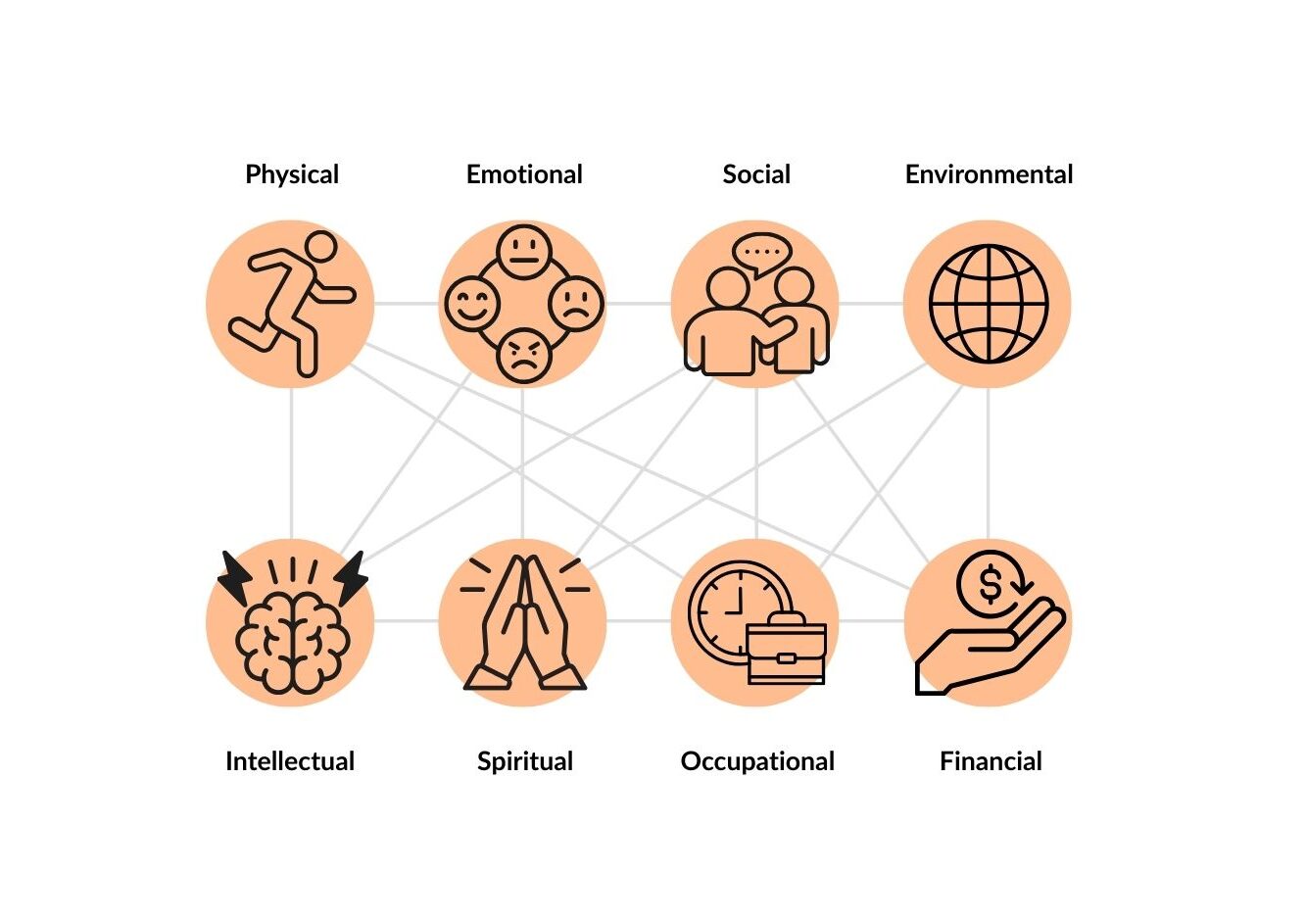
Over time, environments that demand private self-regulation do more than affect individual wellbeing — they may reshape collective wellbeing like public health accumulations. Individual experiences may influence further downstream (Figure 4), impacting things like retention, leadership continuity, household stability, and participation in civic life, shaping not only comfort but accumulated knowledge and institutional memory.
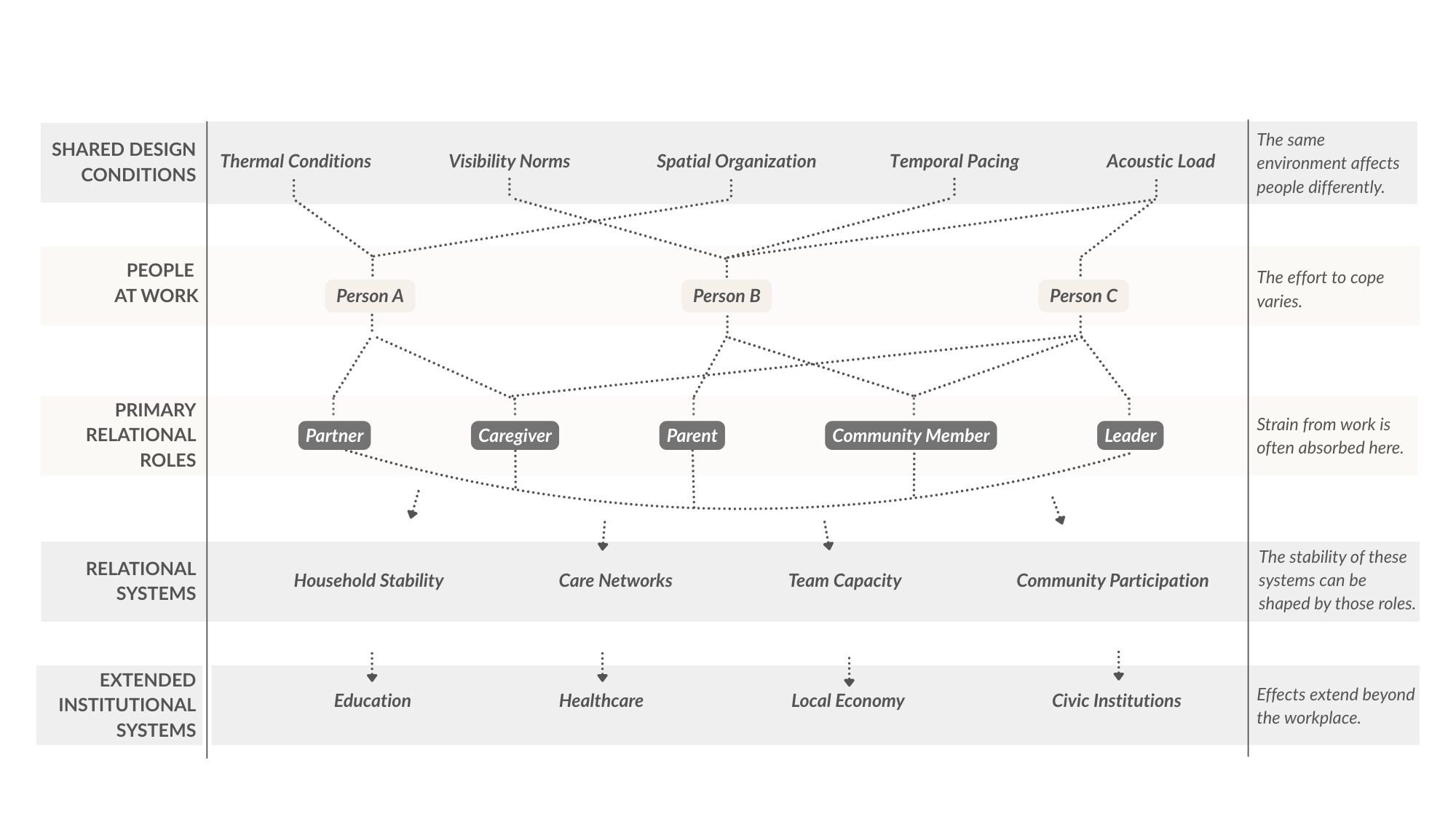
Yet organizational responses often focus downstream: resilience workshops, stress-management tactics, performance metrics, individualized wellbeing programs. Wellbeing becomes something optimized at the personal level, addressing symptoms while leaving the structural distribution of strain unexamined.
A systems approach shifts the emphasis from optimization to distribution. It asks how spatial, cultural, and operational systems allocate regulatory effort across bodies. If regulation must happen privately, strain remains individualized. If environments absorb thermal, cognitive and emotional fluctuation, then effort becomes shared.
The question shifts from how to optimize individuals to how to redesign systems.
In this framing, wellbeing is a shared system of influence, shaped by design decisions, reinforced by norms, and distributed unevenly unless consciously reorganized.
Design decisions materially shape this distribution of effort. A façade decision influences thermal regulation. A circulation strategy shapes daily movement and interactions. Layout and forms serve as stress or restoration cues. Environmental rigidity intensifies temporal strain, while cultural norms shape whether spatial flexibility can be used without consequence.
These systems are inherited. The same space will hold different bodies, different life stages, different needs and often for decades. Environments designed around a fixed occupant will always ask some people to absorb the cost of that assumption. Those designed with flexibility, variability, and choice distribute that cost differently — not because they anticipated every change, but because they were never premised on constancy to begin with.
This is the logic of universal design: the design of environments that can be accessed, understood, and used by all people, regardless of age, size, ability, or life stage. It is not an accommodation for the few, but instead a fundamental condition of good design.14
Designing for Universal Belonging Across Time
Worldwide, half of the 657 million women aged 45–59 contribute to the labour force during their menopausal years — often when they are well-established in their workplaces and roles.15 This is not a niche experience. It is a structural one, distributed across every sector: office, healthcare, education, production floor. Research suggests an association between less flexible physical working conditions and greater disruption from symptoms16, making the design of the built environment not incidental to this conversation, but central to it.
Understanding mechanisms of menopause (as outlined earlier in Figure 1) allows architecture to support belonging across spatial, environmental, temporal, and cultural systems. Each provides opportunities for intervention. Influence exists at every scale — from façade strategy to policy to daily use. The following design questions explore these domains:
Spatial
Can a building hold fluctuation without demanding withdrawal?
Rather than separating intensity and retreat into fixed opposites, spatial design can introduce gradations. Figure 5 illustrates this at the World of Volvo in Gothenburg, Sweden.
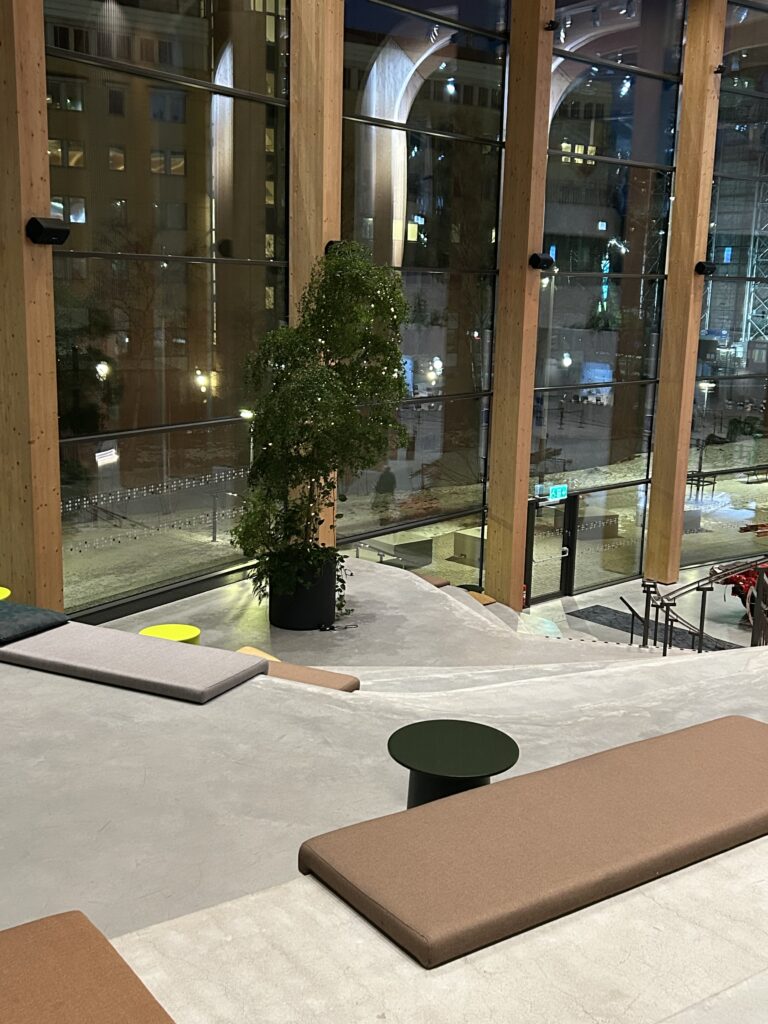
World of Volvo in Gothenburg, Sweden
Architect: Henning Larsen, Image: Lukasz Krupinski
At World of Volvo, the choice between concrete and cushions, window and shade, makes adjusting for temperature and comfort quietly available to everyone. Such graduations can take many forms: circulation can allow alternative routes through high- and low-exposure zones, e.g., a quiet restorative corridor by the window and a path via common lounge leading to a workplace. Partial retreat can be embedded within shared environments — present, unmarked, e.g., “second row” seating in meeting rooms, sitting nooks in gathering zones. Furniture systems can allow posture, orientation, and engagement to shift fluidly, e.g., varied seating heights, floor-level options, balance and movement elements, sit-stand desks. Spatial depth can permit degrees of participation and stimulation rather than binary presence, e.g., transition zones between work and public spaces, from solitary to gradually more social. Spatial legibility and daily functionality can be threaded throughout unexpected and activating cues, e.g. biophilic elements including art, plants, activity opportunities, unexpected views. The novelty is not in adding a quiet room. It is in designing environments where modulation is structurally embedded, so that regulation does not require explanation.
Environmental
Is comfort treated as uniform or metabolic? As illustrated in Figure 6, even within a single office environment, design can create conditions that differ meaningfully in light and privacy — without marking those who need them as separate.
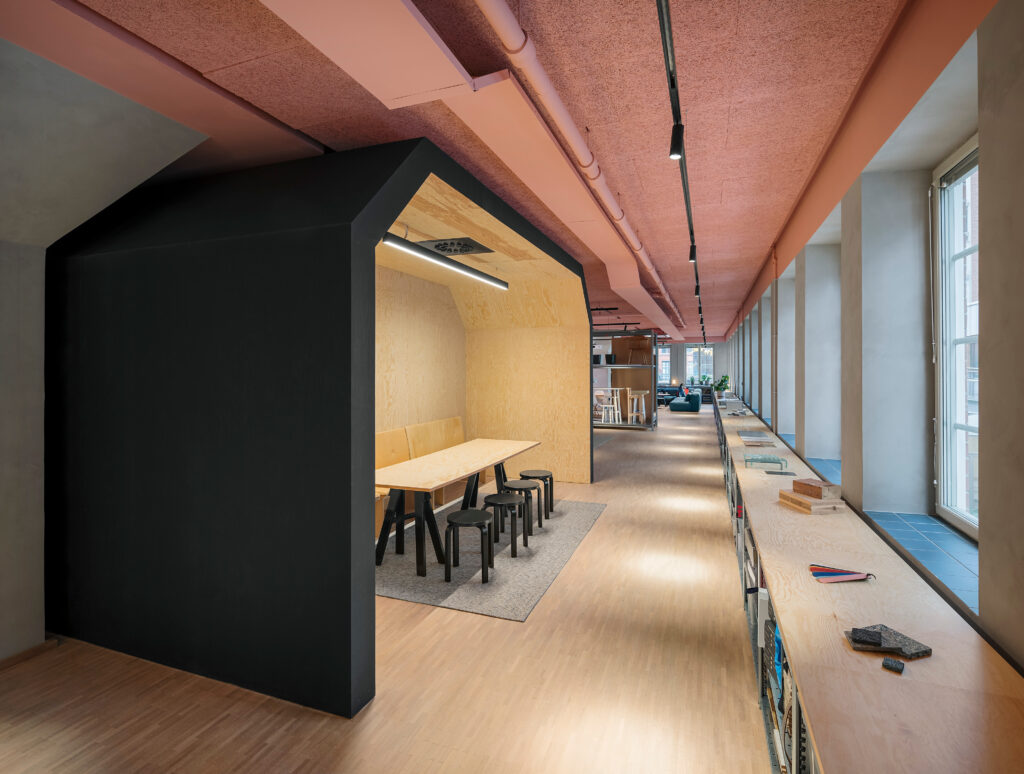
Tengbom Stockholm, Sweden
Architect: Tengbom, Image: Felix Gerlach
Instead of assuming a single optimal temperature, light or sensory stimulation level, architecture can design for range. Passive thermal diversity can be modulated through section, materiality, and façade strategy. Floorplates can be organized around microclimates rather than centralized neutrality. Lighting can shift gradually across zones and support circadian rhythm. Sensory input can vary to support cognitive recovery rather than constant under- or overstimulation. Environmental variability thus becomes an asset, as opposed to being a problem.
Temporal
Does the building assume a stable body across decades?
Menopause often coincides with senior roles and accumulated expertise. Yet many workplaces are designed around early-career bodies — uninterrupted, endlessly energetic.
Structural planning should anticipate adaptation across life stages, not just immediate occupancy (conscious temporal consideration). Architecture can intersect with organizational rhythms: Layouts can make movement intuitive and habitual — from informal circulation to structured activity (interesting and sensory pleasant paths with activity affordances). Visible restorative thresholds can make pause practical, not symbolic (comfortable seating, quiet areas, sensory retreat). Amenities and active design features that support long-term strength, balance, and resilience — from a gym to spaces for rest and recovery — can all be planned across workplaces and transition spaces. Design for fluctuation is design for longevity.
Cultural
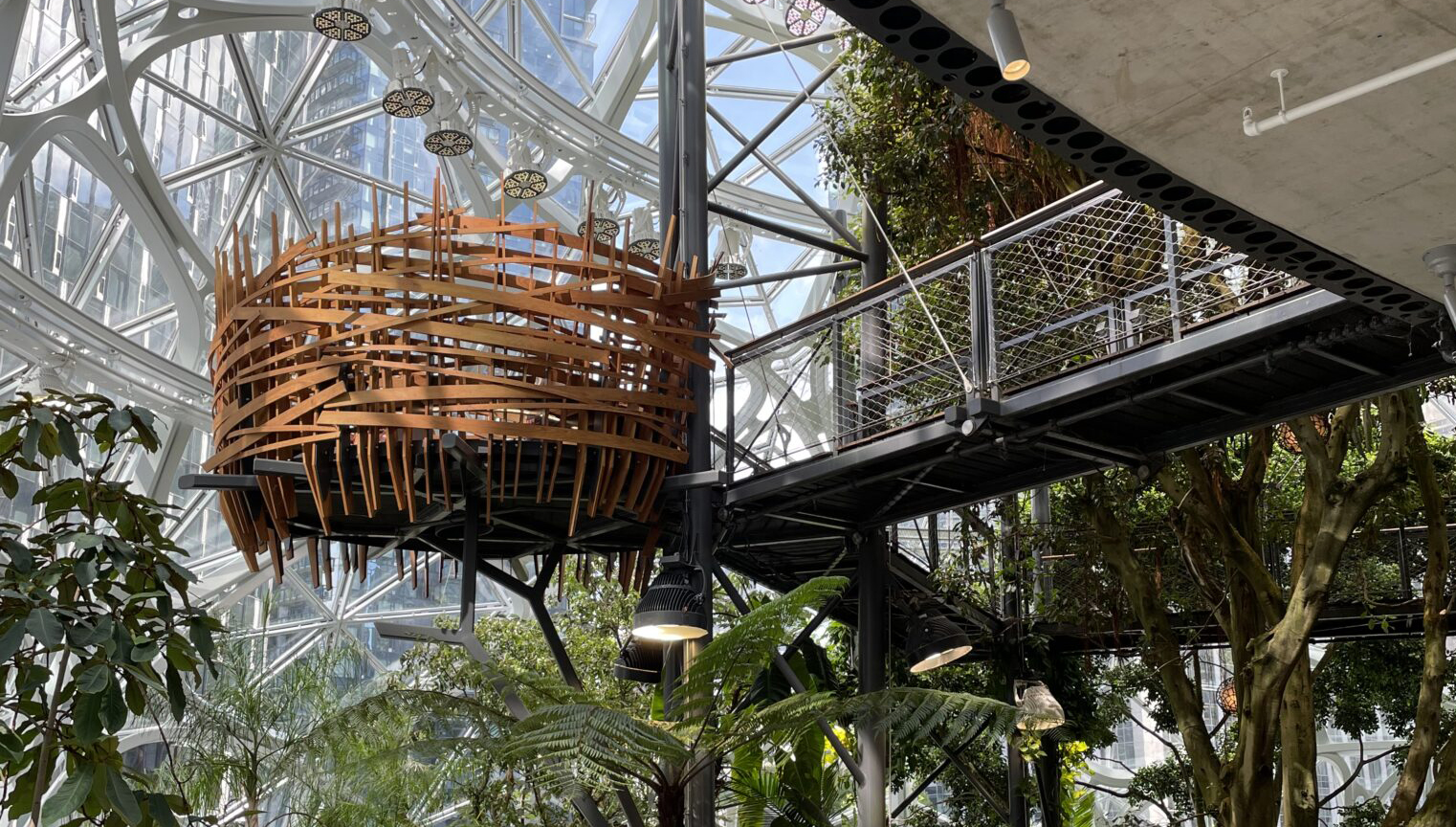
What does the environment quietly reward? Open-plan visibility can signal constant performance, centralized control can signal uniform tolerance, hidden retreat can signal deviation. Architecture communicates what is normal. As shown in Figure 7, when restoration is woven into the everyday fabric of a building, it stops signalling deviation and becomes simply part of how the space works.
By embedding variation and possibility for adjustment — in temperature, exposure, movement, posture, social engagement — into the everyday fabric of space, design shifts regulation from exception to norm. Culture is reinforced through spatial cues long before policy intervenes.
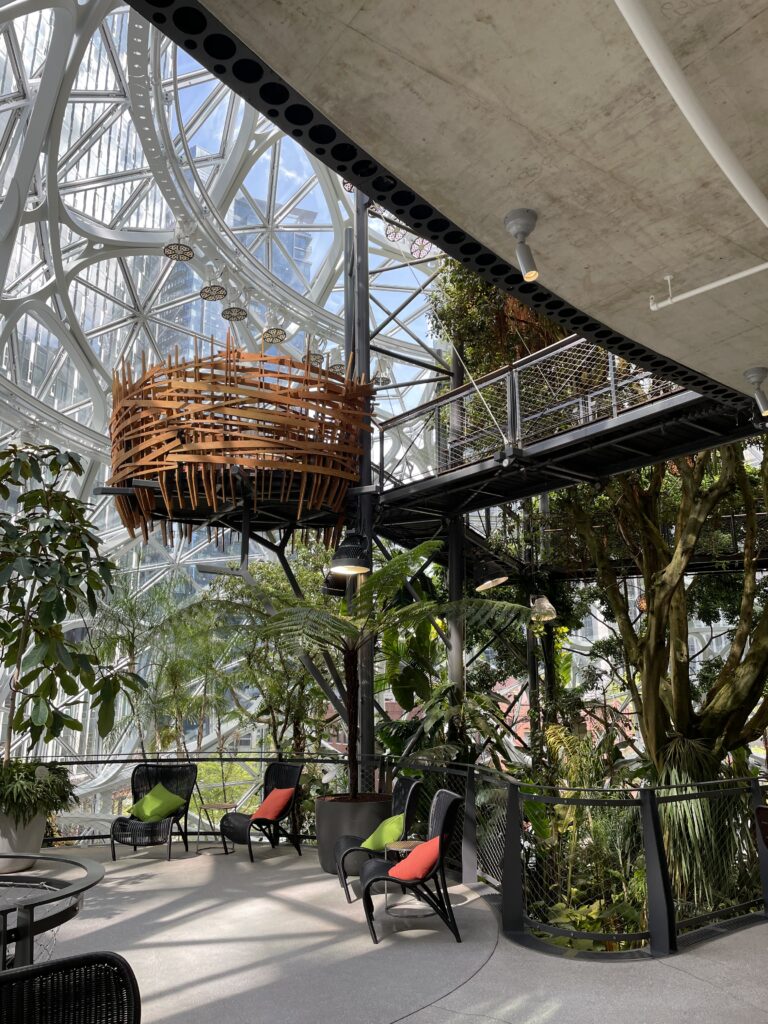
The Spheres, Seattle, Washington, USA
Architect: NBBJ, Image: Lukasz Krupinski
Design for Belonging — Through Range and Adaptation
Wellbeing operates as a system of influence and architecture sits within its core.
Designing for universal belonging and connection is not about accommodating deviation. It is about recognizing variation as inherent to working life. When environments assume constancy, some bodies absorb the cost. When they embed range, regulation becomes shared.
Through the lens of menopause, this perspective sharpens, revealing where architecture assumes bodily constancy and where it might instead support metabolic change across time.
The standard office is only one site of this question. In hospitals, production floors, schools, transport, many workplaces depend on operational rigidity to function — fixed stations, prescribed routes, continuous visibility, safety-critical protocol. In these environments, individual regulation cannot be a matter of personal choice.
When spaces are designed with built-in flexibility, rather than relying on individual accommodations, people can access support without having to disclose personal needs. The nurse does not have to explain why she needs a moment away from the ward. The production worker does not have to request a different station. The teacher does not have to account for why she needs the room slightly cooler. Belonging does not ask for justification.
The question is not whether flexibility exists, but where it can be located. In a hospital, this may occur in the spaces between: a corridor niche, a handover area, or a staff threshold that allows a brief moment of restoration without stepping away from care. On a production floor, where pace and position are often fixed, it may be limited to transitions between stations or small adjustments to sensory conditions where the work allows. In a school, where sightlines to pupils are needed across classrooms, corridors, and schoolyards, retreat may be designed into the fabric of each without interrupting visual contact.
The specific form varies by context. The underlying condition does not: where bodies cannot adapt freely, environments determine whether people can belong or must simply endure.
This article does not propose a finished framework. It offers a lens and an invitation. The design principles explored here through menopause are intended as a starting point: for addressing menopausal considerations more deliberately across built environments, and for asking which other human experiences — hormonal, neurological, chronic, episodic — have long shaped how people inhabit space without ever shaping how space was designed. The question is not whether these needs exist. It is whether design is ready to hold them.
Belonging and connection endure when environments can hold variation without penalty — across bodies, across roles, and across time.
References
- Peacock K, Carlson K, Ketvertis KM. Menopause. StatPearls. StatPearls Publishing. Updated December 21, 2023. Accessed January 6, 2026. https://www.ncbi.nlm.nih.gov/books/NBK507826/
- Lang X-L, Huang C-C, Cui H-Y, Zhong H-X, Shen M-Y, Zhao F. From physiology to psychology: an integrative review of menopausal syndrome. World J Psychiatry. 2025;15(11):108713. doi:10.5498/wjp.v15.i11.108713
- Charkoudian N, Stachenfeld NS. Hormonal influences on thermoregulation in women. Compr Physiol. 2016;6(2):685-703. doi:10.1002/cphy.c150015
- Kothe G, Landry GJ, Dumont M. The circadian variation of sleep and alertness of postmenopausal women. Sleep. 2022;45(12):zsac272. doi:10.1093/sleep/zsac272
- Solís-Ortiz S, Corsi-Cabrera M. Sustained attention is favored by progesterone during early luteal phase and visuo-spatial memory by estrogens during ovulatory phase in young women. Neuropsychologia. 2008;46(10):2561-2569. doi:10.1016/j.neuropsychologia.2008.03.016
- Pletzer B, Kerschbaum H, Klimesch W, et al. Menstrual cycle-dependent neural plasticity in the adult human brain is hormone, task, and region specific. Brain Struct Funct. 2010;214(4):361-372. doi:10.1007/s00429-010-0252-6
- Patel P, Patil S, Kaur N. Estrogen and metabolism: navigating hormonal transitions from perimenopause to postmenopause. J Midlife Health. 2025;16(3):247-256. doi:10.4103/jmh.jmh_75_25
- Low Progesterone. Cleveland Clinic. Accessed February 23, 2026. https://my.clevelandclinic.org/health/diseases/24613-low-progesterone
- Maki PM, Thurston RC. Menopause and brain health: hormonal changes are only part of the story. Front Neurol. 2020;11:562275. doi:10.3389/fneur.2020.562275
- Henderson VW. Cognitive changes after menopause: influence of estrogen. Climacteric. 2019;22(4):326-332. doi:10.1080/13697137.2019.1583846
- Jarden A, Roache A. What Is Wellbeing? Int J Environ Res Public Health. 2023;20(6):5006. doi:10.3390/ijerph20065006
- Stoewen DL. Dimensions of wellness: Change your habits, change your life. Can Vet J. 2017;58(8):861-862.
- Clark College. The 8 Dimensions of Wellbeing. Clark College website. Accessed February 10, 2026. https://www.clark.edu/tlc/healthy-penguin/wellness-dimensions.php
- Centre for Excellence in Universal Design. About Universal Design. National Disability Authority. Accessed March 27, 2026. https://universaldesign.ie/about-universal-design
- Rees M, Bitzer J, Cano A, et al. Global consensus recommendations on menopause in the workplace: A European Menopause and Andropause Society (EMAS) position statement. Maturitas. 2021;151:55-62. doi:10.1016/j.maturitas.2021.06.006
- D’Angelo S, Bevilacqua G, Hammond J, Zaballa E, Dennison EM, Walker-Bone K. Impact of menopausal symptoms on work: findings from women in the Health and Employment after Fifty (HEAF) Study. Int J Environ Res Public Health. 2023;20(1):295. doi:10.3390/ijerph20010295