

Introduction
Participatory urban design can be defined as a key architectural ‘process of investigating, understanding, reflecting upon, establishing, developing, and supporting mutual learning between multiple participants in collective “reflection-in-action”.1 The interdependency between the built environment and the stakeholders involved such as designers and residents manoeuvres the contextual knowledge of design. Thus, perpetually being a transactional process, participatory urban design aims to transform urban spaces into a communal experience. Therefore, it can be claimed that a profound level of social impact will be created through inclusivity of demographics and creating user-responsive designs. It can be argued that the fulcrum of this design experience stems from prerequisites such as fostering power dynamics, mutual learning, situation-based actions and alternative visions of tool applications.1
Right to the City – Henri Lefebvre
A sociological book written by Henri Lefebvre in the 1960s to being reinstated by David Harvey in the succeeding decades, the written work of Right to the City essentially encapsulates the possible challenges that may occur in developing urban planning policies and creating an inclusive approach when it comes to participatory urban design within cities. Some key factors such as socio-economic, environmental and political turbulences that have occurred within certain demographics are also highlighted. Hence, the government and a few United Nations agencies have associated to design collaborative initiatives that neutralise the rights. Some key aspects that have been globalised through this book includes democracy, social justice, sustainability and equity.2 Deconstructing it further, this can be corroborated as a collective authority being provided to the citizens of the cities and prioritising marginalised communities and providing them voices that eventually benefit the welfare of the participatory process and urban community. The concept essentially labelled ‘World Charter for the Right to the City’ primarily outlines principles: complete exercise of citizenship, democratic management and social function of urban area and city.3 Based on this study, it can be corroborated that it radically supports libertarians to exist within the participatory urban design process that may exert the power in deciding urban strategies for the cities. Nevertheless, the study also proclaims that all delegated parties ‘must not oppress or exclude’.2 Instead, civic engagement must harmoniously coexist with the local legislations that establish the rights of all demographics that reside city-wide.
Ladder of Citizen Participation – Sherry Arnstein
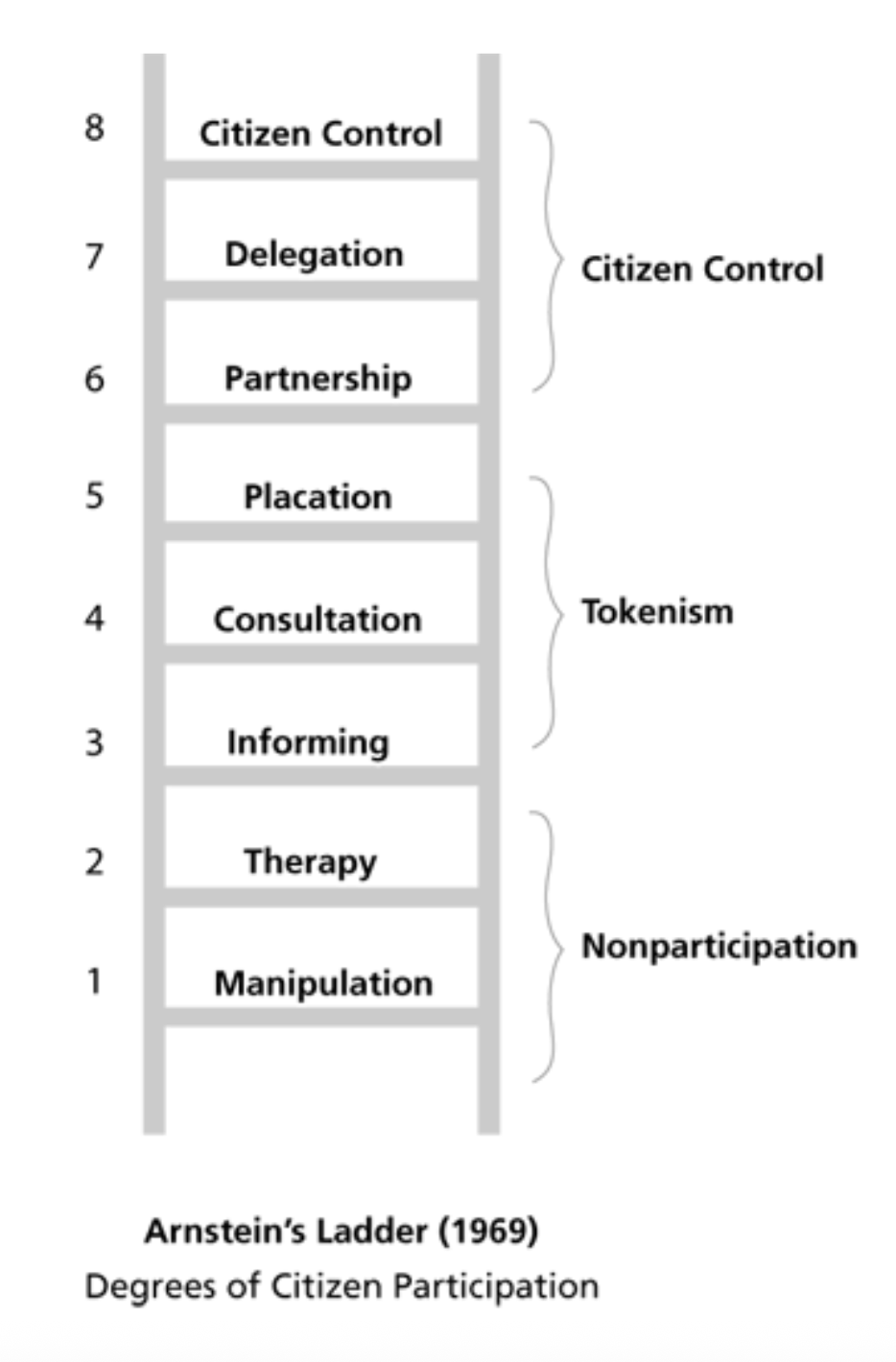
Delving into the power dynamics in the participatory process, in 1969 the renowned political theorist Sherry Arnstein, wrote about the hierarchy and the degree of participation involved in the planning process,4 it specifically highlights the degree of power allocated to individuals and authorities throughout the participatory urban design decision-making process, as aforementioned in Figure 1. It can be claimed that till date, fluctuations in discussions due to external factors such as a country’s economy, technological advancements, socio-political and cultural shifts have kept this ladder relevant in terms of dynamics fluctuating within the ladder rungs.
Intervention of Digital Tools and Urban Design
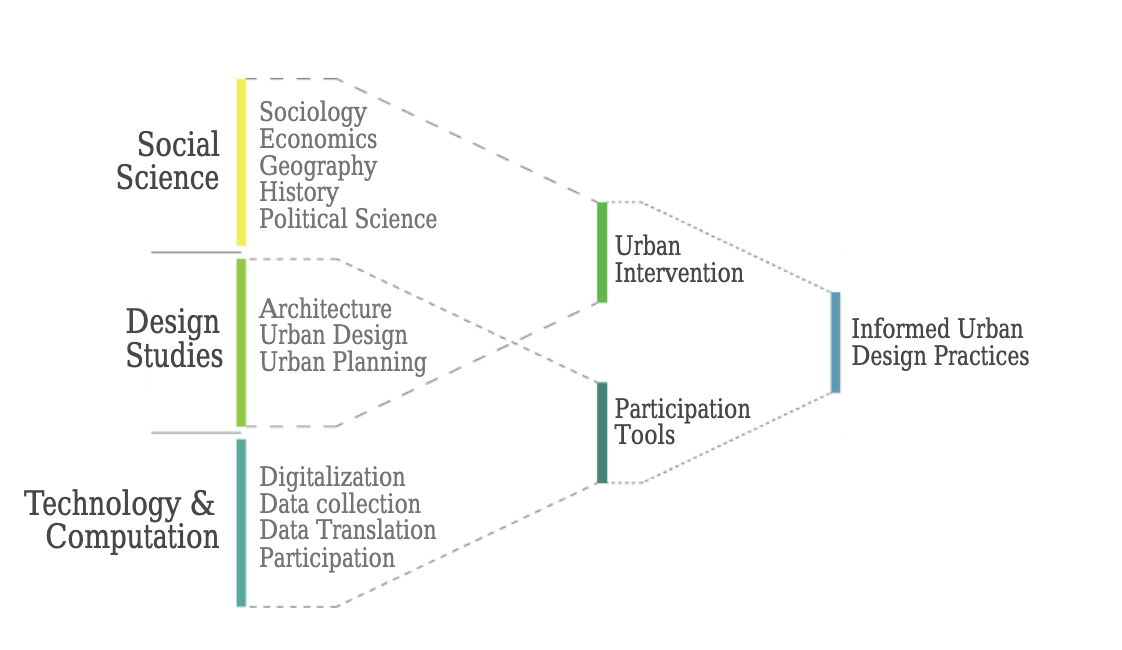
Figure 2 highlights the combination of urban interventions and participation tools that decisively end up being an informed design practice. Factors such as understanding the psychogeography of the city or desired urban scale are amalgamated with sub-contexts. For instance, economic strategies and cultural movements that quintessentially acknowledge the communities’ expectations and prerequisites in an urban context. Adapting to perpetual urban settings like ‘Technology & Computation’5 is also a pivotal focus with the iterative design process.
ICT Synchronisation with Urban Planning
As established, urban planning can be endeavoured a perpetual evolution since cities have existed. Initially, city planning circulated around elements such as buildings and fortification. However, the socio-political and economic movements that have been taking place since 1900s became a fulcrum towards distinct changes that confronts the quintessential norms of urban planning. Thus, cities can be argued a living organism with diversified interests and issues.
Denting towards the evolution of ICT from 1960s, digital tools such as Geographical Information System (GIS) have been used proficiently as a participatory urban design tool. Recognising the potential of ICT implementation in the urban planning process, cities began to utilise through traffic management systems and data collection. This led to the initiation of computerised traffic signal system, optimising traffic flow and increasing pedestrian safety.
Therefore, the unprecedented growth of ICT and digital tool implementation in urban planning has been engulfed within the urban morphology. More so, it has been discussed ubiquitously among various relevant stakeholders like governments, residents and urban planners to implement rapid and user-inclusive resolutions within the city. Specifically, during the unforeseen circumstance of COVID-19, obliged urban planning organisations to temporarily rely on digital participation methods of public in co-creating urban spaces. Additionally, the platform continues to provide an opportunity to address complex issues such as interpersonal dynamics of socio-cultural diasporas that coexist within society.
Subsequently, the functioning of societal beliefs and user functionality with regards to urban planning therefore led to the emergence of ‘Cyberspace’. A virtual environment, where physical environment and the surge of socio-economic trends converge into this platform to showcase the interactions within city.3
PPGIS – Truly an Inclusive Participation?
As aforementioned, public participation over the last decade has undeniably integrated with urban planning practices. Moreover, it is encompassed within planning legislations in various coalitions such as European Union. One of the urban planning studies, that was conducted by Nurminen6 , comprised of 10 interviews mostly from different municipalities in Finland. According to the residents’ point of view, public participatory services enable them to have a say and reinstate tacit knowledge in their living environment. Despite certain obstruction faced till date by quintessential participatory planning practices, one of the state-of-the-art digital innovations ‘Public Participation GIS (PPGIS)’ is ubiquitously applied among various countries. Subsequently, it has been a visual testament to solidify equal participation between various demographic groups. These interviews were conducted with urban planners that utilised ‘Maptionnaire®’ application.6 A funded company based in Helsinki, Finland, this application is widely used due to its convenience and interactive community engagement platform. Through customised maps of geographical locations, it allows users to create surveys and collect information through specific pointers on the map with their queries.
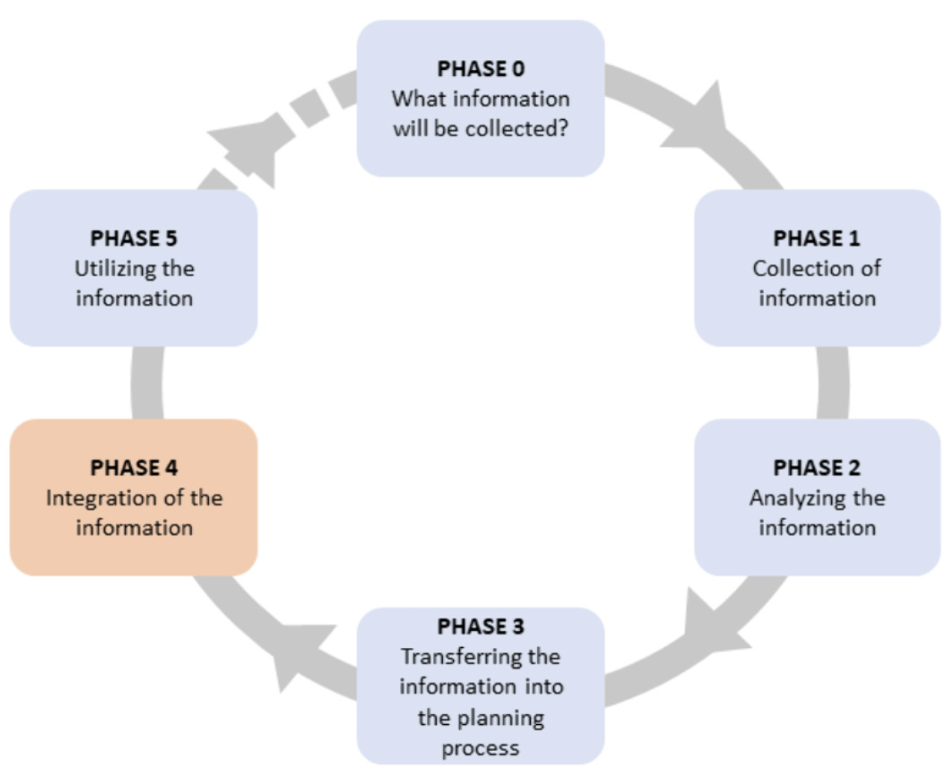
Furthermore, in this study by Nurminen6, the effectiveness of the tool and how were the results perceived among the residents were analysed. Based on the interview responses, a prototype of flow of action within the participatory urban design process was created. This was to examine any possible hindrances along the way that dissuade the purpose of public participatory information.
PPGIS and Right to the City: Mutually Exclusive?
PPGIS, although proclaimed to be an inclusive approach, it may be endeavoured that a section of demographics may still not be exposed to digital literacy at its fullest due to situations such as ease of access to digital devices and comprehending cognitive mapping information. For instance, the elderly. Subsequently, it can possibly create a cultural conflict of digressing from disseminating true knowledge. Moreso, adapting to contemporary trends in the market is also a challenge, hence marginalising a certain community during the participation process.
Delving from a different perspective, it can be perceived that applying this methodology to Less Economically Developed Countries (LEDCs) is not necessarily a viable option. Scrutinising on the Global South as opposed to a European country, mentioned in the preceding study, it can be claimed that the lack of infrastructure for conducting digital learning workshops or the monetary income of residents can therefore imply the existence of social class division and lack of feasibility of an inclusive participatory design approach.
Looking from the participatory phases’ point of view, the possible drawback at the initial stage includes the prolonged time that may occur in fulfilling the required needs between the company and the participatory community. Moreover, programming and attaining a high-end graphical experience for the users can result in a trade-off of budgetary conflict between the delegated parties. This can therefore hinder to progressing forward with the phases.
With regards to the phases, it can be argued that key considerations to be taken while creating an inclusive public approach. For instance, questionnaires have to be dealt with meticulously to ensure it does not violate the privacy of residents. Maptionnaire® documents the psychogeography patterns of residents like user movement within a city and experiential interconnectivity of spaces and users. These subjective opinions voiced by participants can impose a conflict of interests within the urban planners and residents. Consequently, the lack of data privacy may result in trust being lost among residents in providing the necessary information for future participatory urban design surveys. Furthermore, it plummets the opportunity of an inclusive approach being signified to a mere constitutional decision.
Additionally, encapsulating all the communicated knowledge while transferring into visual report could perhaps impose the manipulation or discrepancies of data. As aforementioned in the case study of Maptionnaire®, as the crowdsourced data and qualitative responses during the participatory design process can be large in numbers, there is a possibility of anomalies that can skew the desired result by the residents. Therefore, exploitation of data can occur at this stage of proceeding with the majority and disregarding a section of responses, which may cause marginalisation within the community.
Subsequently, external influences such as planning policies that may digress from the actual feedback provided by the residents could exert a conflict of interest between the delegates and public participation. Quintessentially, the participatory process represents the power dynamics between the planners and residents to be imbalanced. This is because it follows the bureaucratic approach rather than delegating power to authorities. In addition, having multiple stakeholders involved with the decision-making process ultimately can be considered futile from the citizen’s perspective due to the lack of inclusivity in the participation process.
Digital Democracy by UN-Habitat?
In addition to the preceding claim, the United Nations Human Settlements Programme (UN-Habitat) intends towards creating sustainable urban developments through digital tools. Scrutinising into various demographics, it aims to eradicate global poverty and inadequate shelter provision. The Urban Planning and Design Branch has worked intricately in developing records, objectives and projects around the world, directed towards the implementation of the agency´s ‘Global Programme on Public Space’. This primarily encapsulates three areas: 1. Partnerships for public space; 2. Citywide strategies and pilot demonstration projects; 3. Knowledge management. Subsequently, one of UN-Habitat’s key philosophy states that ‘a good city should foster social cohesion and build social capital, engaging the community in design, management and maintenance of public space’.1
Several policies within UN-Habitat also claims that participatory urban design are supported by sustainable and inclusive planning and technical assistance in calculating the urbanization strategies. Due to the rapid rise in participatory design process, it can be argued that various toolkits have been implemented such as assessment, policy and participatory planning. Essentially, these toolkits adhere towards optimising the participatory activity of citizens and effective evaluation to implementation at an urban scale.1 Observing from a macro scale, the UN-Habitat has a distinct focus on delivering the 2030 Sustainable Development Agenda Goal 11, ‘to make cities and human settlements inclusive, safe, resilient and sustainable.’ 7
Youth Digital Pathway (UN-Habitat)
It can be substantiated that ethically inculcating technological practices have become an integral part within urban design. Hence, leveraging the participation of youth in the sustainable development process is encouraged. Therefore, in celebration of International Youth Day 2024, under the theme of ‘From Clicks to Progress: Youth Digital Pathways for Sustainable Development’ several youth initiatives within UN-Habitat have been a pivotal prototype of how digital tools can empower participatory urban development. It can be endeavoured that the crux of the theme encapsulates youth, sustainability and technology.8 Subsequently, this platform exclusively provides an opportunity for the younger generation to reshape the urban setting, particularly in marginalised communities.8 This can potentially imply the positive design drivers created within communities and impacts such as enhanced educational awareness, encouraging youth entrepreneurship and promoting community advocacy. The key programs launched through this initiative are Young Gamechangers Initiative (YGI), Her City Toolbox and Block by Block. These programs essentially highlight the innovative and futuristic approach of applying digital technologies to inclusive urban design developments.
Weightage of Power Dynamics?
Following the aforementioned study, it can certainly be substantiated that the Youth Digital Pathways according to Arnstein’s ladder, falls under the sixth category ‘Partnership’ however bordering the seventh rung ‘Delegated Power’. This is because the programs leverage digital platforms to be utilised to its maximum potential alongside increasing civic engagement through getting various demographics and marginalised communities involved in the participation process. For instance, women being given opportunity to voice out their societal concerns and create hospitable designs for themselves through ‘Her City’. As mentioned in the Right to the City, civic engagement must seamlessly contribute with the local legislations that exert the human rights of all demographics that reside city-wide. More so, infrastructural provision for organising digital literacy workshops and pitching the urban initiatives to various delegates from local governments to United Nations, this provides an opportunity for everyone to negotiate their ideas on a public forum regarding inclusive urban design. Furthermore, the financial, political and technical support provided by authorities and companies can be deemed with the genuine intent of positive change in the urban landscape.
Nevertheless, it can be argued that certain limitation still prevails the process of intertwining technology with participatory urban design. Due to certain socio-cultural and political conflicts, it may be implied that certain countries do not encourage the public participation to its fullest with urban planning. Thus, the influence of societal hierarchy would still be prioritised over participation for the community welfare. In addition, certain resource constraints alongside the demographic population might be negatively correlated such as budgets, technology or infrastructure that may cause a hinderance in providing a voice to everyone.
Initiatives Evaluation: Technological Inclusivity or Power Digression?
Analysing the feasibility of digital tools at various geographical scenarios embedded with Arnstein’s Ladder of Participation, it can definitely be claimed that Youth Digital Pathway has a higher weightage in terms of considering social, environmental and psychological aspects of the urban space design and its user feasibility.
Beginning with socio-economic analysis, although the target participation of public differs between the two platforms based on Global North and Global South, Youth Digital Pathway can be deemed to be a more inclusive approach with integrating technology with participatory urban design seamlessly. In terms of simplifying the visual representation and user experience with or without prior knowledge, less likelihood of data bias or manipulation as opposed to Maptionnaire® implementation in Finland with the lack of comprehending the true knowledge behind the PPGIS. Global North essentially dominates the market in terms of acquiring adequate financial resources for any idea implementation as supposed to Global South that faces urban poverty and lower income demographics. Less Economically Developed Countries (LEDCs) encounter systemic inequality in terms of societal hierarchy being prevalent in most regions that essentially hamper access to various demographics rights. Eventually, the access to basic necessities becomes scarce such as educational and social rights. Nevertheless, based on the precedent studies, Youth Digital Pathway implementation in Global South has managed to accommodate the basic rights through rigorous workshops and bridging the linguistic and social barriers between technology and public participation.
Delving into the environmental aspect, the precedent studies of Youth Digital Pathway alongside UN-Habitat explicitly exert their main design philosophy to adhere to the Sustainable Development Goals (SDG) in designing climate resilient public spaces. Subsequently, specific training workshops are provided to the target public changemakers that would essentially penetrate through altering urban policy reform due to the hand-in-hand approach with the government authorities. Global North platform, on the other hand, can be endeavoured to have disregarded this aspect to be scrutinised closely while designing due to the surplus quantitative data and qualitative responses from the public participation or have not had the opportunity to break through the bureaucratic hierarchy in achieving for the urban community. Hence, the dichotomy between public inclusivity and power dynamics is established in this scenario through the environmental lens and the futility of the participation process to a major extent.
Scrutinising from a psychological aspect, it can be claimed that Youth Digital Pathways can be considered a more hospitable approach benefitting the community welfare due to the initiation of its programme to niche demographics. For instance, a Block-by-Block initiative fostered a successful participatory process with the intention of translating inclusive urban designs from vision to reality. According to UN-Habitat 7, in the UAE a public park implementation took place working alongside the youth community aged 8-14 of Sharjah, UAE.9 As quoted by UNICEF, a ‘Child Friendly City (CFC)’ is essentially a space wherein the local government is committed to adhering child rights.10 Thus, with UNICEF’s financial aid, UN- Habitat worked alongside the Sharjah Baby Friendly Office and Urban Planning Council that significantly focused on 4 key aspects: Data and Evidence, Children Community Participation, System Strengthening and Strategic Project 9. Alternatively, a separate workshop was conducted to brief the other stakeholders involved such as government, urban planners and other local authorities. All the delegated parties therefore agreed on collaborating with children by organising a Block-by-Block workshop in the city. As stated by Dr. Hessa Ghazal from the Sharjah Baby Friendly Office, “Our role is to ensure that children are given these opportunities to achieve their dreams and aspirations, and to have a say in changing not only the future, but their present reality as well.” 9 In terms of an inclusive design approach, the study establishes that the youth decided to create a universal design that span across the ability to disability. For instance, improving signage by incorporating sign language in the public park design proposal allowed the participatory process to be considered futuristic.9
References
1. Caroca Fernandez A, Rigon A. Participatory Design and Urban Infrastructure – An Overview. (DeCID Thematic Brief #4). University College London; 2020.
2. Lefebvre H, et al. Understanding and Implementing the Right to the City: Building Just, Democratic and Sustainable Cities. Global Platform for the Right to the City. https://www.hlrn.org/img/documents/guiderighttothecity.pdf
3. Das A. Urban planning in the ICT age: the chronicle of evolution. SSRN Electron J. 2020. doi:10.2139/ssrn.3674642
4. Arnstein’s ladder of citizen participation. https://citizenshandbook.org/arnsteinsladder.html
5. Ataman C, Tuncer B. Urban Interventions and Participation Tools in Urban Design Processes: A Systematic Review and Thematic Analysis (1995 – 2021). Sustainable Cities and Society. 2021;76:103462. doi:10.1016/j.scs.2021.103462
6. Nurminen V, et al. How has digital participatory mapping influenced urban planning: views from nine planning cases from Finland. Comput Environ Urban Syst. 2024;112:102152. doi:10.1016/j.compenvurbsys.2024.102152
7. UN-Habitat. The Block by Block Playbook: Using Minecraft as a Participatory Design Tool in Urban Design and Governance. https://unhabitat.org/sites/default/files/2021/09/1-bbb_playbook_publication_final.pdf
8. Tsaplina O. Digital tools for participatory urban planning led by youth. UN-Habitat Youth. Published 2024. https://www.unhabitatyouth.org/en/digital-tools-for-participatory-urban-planning-led-by-youth/
9. Building a Child-Friendly city in Sharjah — block by block. Block by Block. https://www.blockbyblock.org/projects/sharjah
10. UNICEF. Child Friendly Cities Initiative. Child Friendly Cities Initiative. https://www.childfriendlycities.org/