Assistant Professor school of creative Arts architecture programme , University of Hertfordshire hosted by GAF
PhD Holder, Faculty of Engineering, Ain Shams University — Department of Urban Design and Planning
Faculty of Engineering Ain Shams University, El Sarayat St.، ABBASSEYA، El Weili, Egypt
Raneem Anwar is a neurolandscaper and urban researcher whose work bridges landscape architecture, environmental psychology, neuroscience, and artificial intelligence to explore how the built environment can support human well-being, cognitive balance, and healthier relationships between people and place.
Holding a PhD in Architecture, her research focuses on neurolandscape and evidence-based design, investigating how spatial configuration, environmental qualities, and perceptual characteristics of outdoor spaces influence human cognitive and psychological responses. Her doctoral research developed a neuroscience-informed approach to understanding restorative outdoor environments, using EEG-based environmental perception studies alongside spatial and environmental analysis.
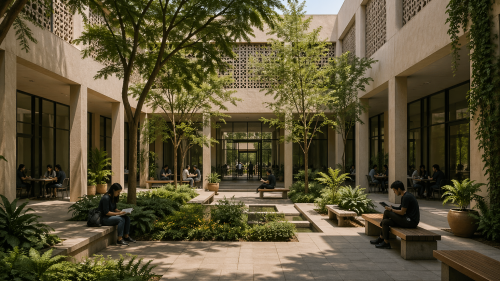
Her work explores the potential of neuroscience and environmental evidence to inform the design of conscious, restorative, and healing environments, with particular interest in educational campuses, urban public spaces, and landscapes that support attention, stress reduction, awareness, engagement, and social interaction. She advocates for a holistic understanding of landscape experience, moving beyond vegetation quantity alone to consider the wider spatial, visual, sensory, and morphological qualities of environments.
Raneem’s current research extends this work toward the intersection of neurolandscape, artificial intelligence, and evidence-based design, exploring how emerging computational and AI-assisted approaches can support the evaluation and creation of environments that respond to human cognitive and emotional needs. Her broader interests include restorative environments, neuroaesthetics, healing landscapes, climate-responsive urban design, and the relationship between human well-being and ecological health.
Through research, teaching, and interdisciplinary collaborations, she works toward a more human-centered and evidence-informed approach to designing environments for life, aligned with the Centre for Conscious Design’s vision of creating places that support well-being, ecological awareness, and meaningful human–environment relationships.

To provide the best experiences, we use technologies like cookies to store and/or access device information. Not consenting or withdrawing consent, may adversely affect certain features and functions.