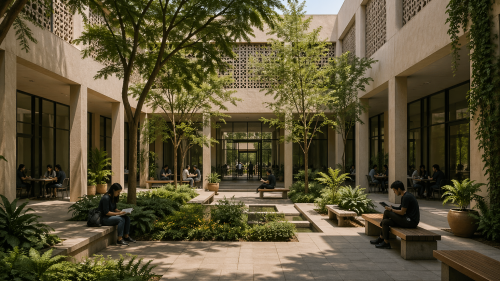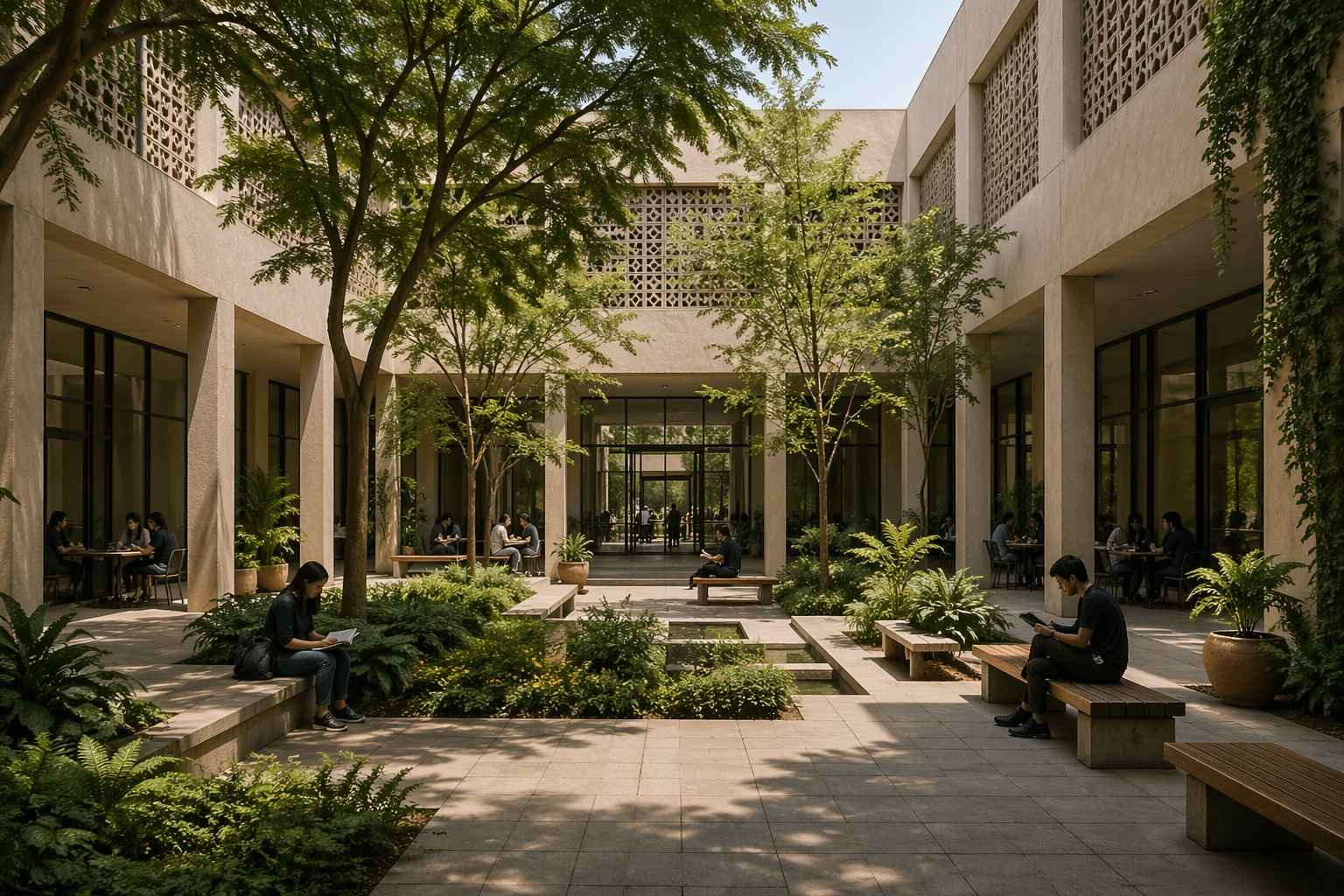

Architecture is not understood as a passive background to human life in the evolving field of conscious design. Instead it is increasingly seen as an active player in the construction of cognition, emotion and well-being. Recent neurophysiological research (“Brainwave Dynamics: Neurophysiological Responses to Enclosed Courtyards for Mental Wellbeing in Educational Contexts”) by Raneem Anwar, Samah Elkhateeb, Samy Afifi and Karim Bayoumi provides compelling evidence of this relationship—showing how spatial design directly affects brain activity in students.
The core of the research is a simple, yet powerful question: can the space itself restore attention, reduce mental fatigue and improve learning readiness?
Listening to the Brain in Space
In this study, EEG (electroencephalography) was used to measure the brain wave activity of students while they were in an enclosed courtyard at Ain Shams University. Rather than surveys or subjective impressions, the researchers recorded real-time neurophysiological responses—tracking Alpha, Theta, Beta and Gamma waves as students quietly absorbed their surroundings.
What came out of it was a strong signal: the built environment is not neutral. It’s neurologically active.
Courtyards as Restorative System for Cognitive
One of the more important findings was an increase in activity of Theta brain waves. Theta waves are linked to deep relaxation, internal reflection and a decrease in cognitive load. Design-wise it meant that the courtyard served as a restorative cognitive environment that let the brain temporarily disconnect from academic stress and arrive at a recovery state.
Concurrently, Alpha waves declined, indicating a transition from passive rest toward increased sensory engagement and awareness of the environment. The two effects together—relaxation and mild stimulation—suggest that well-designed courtyards might promote a balanced neurological state, neither overstimulating nor understimulating, but optimally engaging.
What Brain Science Says About Learning Environments
Participants showed differential patterns of neural activity depending on individual sensitivity and spatial perception. Some had strong relaxation responses, while others showed improved attention and cognitive engagement.
This variability is important, as it suggests there is no one “ideal” learning environment, but instead a collection of spatial conditions that can tune cognitive states in different ways.
In other words, architecture is not just experienced, it is processed.
Toward a Neuroresponsive Architecture of Education
The consequences for design are far-reaching. We can no longer design educational environments based on efficiency, capacity or aesthetics. They also have to be designed for neurophysiological effect.
The study reveals that well-designed courtyards can be used for:
- Cognitive reset intervals between episodes of academic stress
- Attention rebalancing rooms that bring back capacity to focus
- Transitional spaces between stimulation and reflection
- Designing for States of Mind, Not Just Behaviors
Perhaps the most important shift being proposed by this research is conceptual: from designing for behaviour to designing for brain states.
While traditional architecture asks “How do people move through space?” conscious design begins to ask:
- What is the effect of the space environment on neural recovery?
- How does enclosure affect attention?
- How vegetation change cognitive rhythm?
Those questions are now not abstract, but measurable.
Conclusion: The Courtyard as a Cognitive Tool
This study re-conceives the courtyard not as a decorative or social feature, but as a neurocognitive instrument embedded in the educational landscape. Its geometry, vegetation, and sensory properties actively modulate the brain wave activity associated with learning, calmness and attention.
In the language of intentional design, we might say:
Learning does not end in the courtyard, it’s where the brain resets itself to learn better.
As neuroscience increasingly intersects with architecture, studies like this one push us toward a future in which educational spaces are designed not just for bodies and activities, but for states of mind themselves.