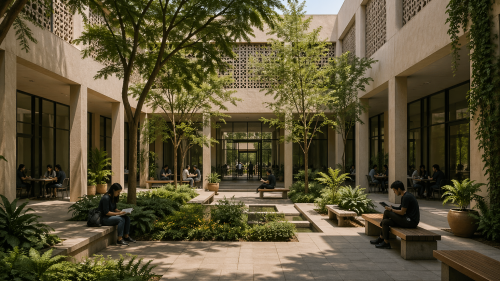
At our last Cave gathering, we explored a theme that sits at the core of both architecture and human life: meaning—and how it connects to our sense of purpose.
Meaning and purpose in life are not just a “nice to have.” They are essential human needs. Each of us, in our own way, is searching for what makes life worth living. This led us to ask: Can architecture and design invite us into this search? Can the spaces we live, work, and gather in help us begin answering it—not in theory, but through real, lived experience?
Meaningful Lives
We reflected on how profoundly we’ve all been influenced by the spaces in our lives. The places we cherish most—those we return to again and again—are often spaces designed with intention, spaces that help us connect with something greater: with each other, with art, with nature, with calmness, beauty, or culture. In moments of challenge or uncertainty, these spaces become even more essential.
It’s no surprise, then, that burnout often stems from a lack of meaning. Not only in our work, but in our environments too. If the spaces we inhabit feel careless or unintentional, they can leave us feeling disconnected and drained.

On the flip side, designing with purpose tends to create spaces that give back meaning. Like a fish eating its own tail, there’s a circular beauty to this: when a designer works with a sense of purpose, that energy is often felt by the people who later experience the space. As designers, this invites us to ask ourselves: What makes our work worth working for? And for those who will use the spaces we create: What do they live, work, and search for?
Many of our answers circled around ideas of ritual, connection and nature. Since purpose shifts over time—our goals change, our needs evolve—spaces that are flexible, layered, and open to reinterpretation can remain purposeful for longer.
Symbolic Meaning
We also touched on how meaning persists symbolically, even through disruption or change. We heard the story of how, after an earthquake devastated Italian villages, communities came together to rebuild their clock towers—or campaniles—using the debris of the fallen buildings. These reconstructed towers weren’t just functional; they were powerful symbols of shared memory and resilience, recreating a sense of belonging after loss.
This led us to wonder: How do we investigate meaning in design, when so much of it is invisible or felt rather than seen? Perhaps the answer lies in listening to enough subjective voices—when collected together, they start to form something objective.
Meaning, Purpose, and Place Attachment
We closed by looking at the layered relationship between meaning, purpose, and place attachment in the built environment.
We reflected on the idea that meaning is the broad umbrella: every design element, no matter how small or large, communicates something. Whether a space is calm and minimal or vibrant and full of life, walking into it is an encounter with a personal meaning. It’s a co-creation between the physical elements of the place and the memories, emotions, and mental concepts the observer brings.

Then, a space becomes imbued with purpose when its meaning aligns or resonates with someone’s personal goals or sense of purpose. For example a community garden that doubles as a collaborative art project may resonate with those who find purpose in creativity and connection. A secluded ocean viewpoint may hold meaning for someone whose interests are rooted in solitude and reflection.
And lastly there’s place attachment: the emotional bond we form with spaces over time, through a continuity of experience. When we live in, return to, or intentionally engage with a place, it becomes important in our lives.
We loved how the concepts fit into each other: Meaning is the largest Russian doll—all places have meaning because they communicate something. Within that, some spaces align with a personal sense of purpose, becoming meaningful to individuals whose life values resonate with what the space offers. And within that, a smaller set becomes the places we attach to, because we’ve built ongoing, lived relationships with them over time.
We look forward to continuing our exploration of purpose and meaning in design, and how to translate these ideas into built projects. In the meantime, to dive into other related concepts, join us at the next Cave!