


Abstract
In light of the current pandemic, and the subsequent social distancing measures it imposed, this research aims to contribute to the literature of digital public participation methods for urban planning. It will specifically investigate the correlation between the technical knowledge required by digital public participation tools and levels of engagement, and the consequences of digital public participation to underserved populations. The requirements for digital knowledge and the levels of engagement will be used as axes of a matrix, in which the digital engagement tools will be plotted. The comparison of these variables will lead to the conclusion that the higher is the level of engagement, the higher is the requirement of digital knowledge, and therefore, the less accessible the method is for underserved communities. The research will finalize with some suggestions on how to overcome these challenges, which include the mitigation of digital literacy gaps through education, and the use of the current tools in more creative ways, prioritizing the low-tech ones, to enhance inclusivity and equity to urban planning projects and plans.
Introduction
Cities are congregations of different communities – uniform groups of people linked by social ties and shared perspectives, engaged in joint action1, and above all, with different cultures, ways of life, ambitions, and interests. As such, cities are comparable to battlefields, where competing communities struggle to materialize their ambitions2. Throughout the years, urban planning scholars and practitioners have explored ways to overcome these conflicts and increase equity and justice in the urban planning practice. They acknowledged the inclusion of different voices as pillars of democratic cities.
The first attempts to engage with the community for urban planning arose in the 1960s when, due to extensive urban growth, political actions demanded structural changes and the reduction of racism and inequalities. These movements resulted in landmarked studies from Jane Jacobs, Sherril Arnstein, and Paul Davidoff. These three influential urban planners set the frame of how public participation can ensure more equitable urban developments and produce better cities3. As a consequence, since the 1960s, several approaches to participatory urban planning have been developed.
Public participation for urban planning is defined as a set of methods to directly or indirectly facilitate and support community participation in decision-making processes concerning urban planning projects4. Through public participation, different stakeholders’ groups can interact with government agencies, political decision-makers, and urban planning organizations to acknowledge, develop, create, and implement urban planning projects, policies, and programs. Public participation in urban planning can range from traditional public hearings, comment procedures, and reviews, to the use of more creative methods, such as collective mapping activities, art- based activities, tactical urbanism, and others.
Digital methods were slowly gaining space in the spectrum of public participation for urban planning in the last years. Digital methods for public participation are defined as a “specific type of civic technology explicitly built for participatory, engagement and collaboration purposes.”5 As such, they have been present in the urban planning field since the 1990s, when the development of public participation geographic information systems (PPGIS) and participatory geographic information system (PGIS) took place. These technologies enabled the development of participatory digital mapping.6
In the last five years, the use of digital engagement technologies has significantly increased in the urban planning field due to technology evolutions.7 However, the coronavirus pandemic accelerated this process. The social distancing imposed by COVID-19 created many effects in public participation for urban planning, without giving time for public and private sectors to adapt to the new reality. As a result, many practices ended up not exploring the full potential of digital public participation and perpetuating unequal practices, where only a part of community members can or are willing to participate in urban planning decisions.
This research promotes a further understanding of digital engagement tools and methodologies that can be used for urban planning practice. This investigation will explore the evolution of digital engagement tools and investigate two fundamental concepts for digital engagement: digital knowledge, and level of engagement. The level of engagement and the technological knowledge requirements for the digital public participation tools will be used to classify the existing tools.
The research will be concluded by investigating the challenges and opportunities currently posed by the existing methods of digital engagement, and with conclusions and recommendations to foster equity in digital public participation for urban planning.
The results of this research can be used to inform urban planners and public agents, who are usually the decision-makers of urban projects, about the existing digital public participation tools and the outcomes of their choices. Ultimately, the research will help promote more inclusive and equitable digital public participation strategies and methods for urban planning projects.
Methodology
This research is based on a bibliographical analysis of digital public participation methods. It is also based on an analysis of international public participation methods for urban planning practices which happened in the first semester of the pandemic, both in the public and private sectors.
The first phase of this research was initiated in March 2020 when, due to the coronavirus pandemic, many firms specialized in public participation for urban planning interrupted their activities. That resulted in numerous lay-offs and furloughs in these companies and interruption or postponement of several public urban planning projects that required public engagement. Because of the impacts of the crisis, the researcher conducted a bibliographic review of what were the existing methods, best practices, and case studies of digital engagement for urban planning, and what were the main challenges and opportunities of these types of digital public participation strategies. This step exposed the existence of twenty-eight tools for digital public participation, described in annex one.
The second phase of the research investigated how public and private companies adapted to the new reality. That was achieved with an investigation of reports released by public participation practitioners[8], as well as with the participation in several online workshops and public meetings promoted by the public sector. The researcher participated in twenty-five online public meetings from Westchester County in New York State; New York City; Spokane City, in Washington State; the City of Bozeman, in Montana; the City of Norfolk, in Virginia; and the State of Maryland in the United States, and international debates about the topic with Australian, Canadian, American, and Brazilian professionals. The results from the bibliographic review were then compared to the practice, which informed both the level of engagement and digital knowledge requirements of each tool. These were later used to draw conclusions and recommendations.
Part 1: Digital Engagement before and during the pandemic
Digital engagement tools have been in use since the 1990s, with the advancement of participatory digital mapping. In 2000, technologies such as geo-visualization, augmented reality, and gaming was developed. However, until the 2010s, governments and urban planning practitioners used a limited number of digital tools for public participation. The main digital engagement tools were websites, online surveys, emails, texting, and newsletters. Other applications, such as collaborative mapping, visualization, virtual realities, gamification, crowdsourcing, videos, and virtual meetings were used experimentally.9
It was only by 2015 when the use of digital public participation tools in urban planning grew, as a consequence of the development of a series of tools that allowed the creation and sharing of online information and materials, as well as online collaboration the digital world[10]. These methods tended to increase opportunities for people to participate in public decisions and community life11, since it provided another layer of public participation, one that did not require commuting efforts, and that had the potentiality of reaching other strata of the community, such as youth12. Among these digital methods of public participation, social media was the most utilized way for gathering communities’ inputs and of engaging with citizens because of the facility to use the tools, and also because conversations were almost always initiated from the bottom up13.
Although growing, digital engagement tools for urban planning were always met with distrust since they could expand gaps between tech-savvy and digitally underserved societal groups and result in unequal participation, culminating in a digital divide14.Therefore, their success was intrinsically supported by offline activities15. For example, urban planning projects could include community information centers with augmented reality models, virtual reality headsets, interactive high definition screens depicting project renderings, and devices to gather people’s opinions. However, these methods were utilized in a hybrid manner and were combined with offline engagement practices, such as workshops, public meetings, or open houses.
The pandemic shifted this scenario and, without a maturation period, transformed digital public participation in the only way to safely gathering communities’ inputs and communicating with residents and stakeholders. It also promoted a shift in the way people relate to technology16 and resulted in a substantial increase in internet usage. News media describe that there has been an increase of 27% in Facebook usage, and nearly 15% on YouTube and Google Suite usage17 while Zoom – one of the primary platforms for online meetings – showed an increase of more than 355%18.
City agencies, city planners, and consultants had to adapt to these new realities, tools, and technologies. Even with the health and economic crisis going on, projects still had to be planned, important decisions had to be made, and programs to be designed and implemented. Consequently, a few months after the social distancing measures, public agencies started promoting digital engagements to carry on their projects, policies, and proposals.
Although several tools and methods of digital engagement are available, most public and private organizations implemented public participation through online meetings or webinars, in which the decision-makers presented their point of view, and community members had little or no space for an argument.
For example, in New York City, the Community Board, decentralized bodies whose sole function is to give communities a voice, as well as other city agencies, such as the New York City Economic Development Corporation and the New York City Mayor’s Office of Resiliency, transitioned their public meetings to Zoom. Additionally, the Government created the website “NYC Engage,” which shares information about how to participate in remote public meetings and how to access it by phone19.
Other public agencies, such as Westchester County in New York State; Spokane City, in Washington State; City of Bozeman, in Montana; and the City of Norfolk, in Virginia, transitioned to Cisco WebEx. Both Zoom and WebEx enable call-in options, which allow individuals with limited access to the internet to participate in the meetings, although without visual aids.
Some public agencies’ meetings featured polling, which resulted in more interaction. However, individuals who opted for call-in options did not participate in the engagement activities. Other public participation sessions featured small focus group discussions in breakout rooms, which facilitated more engaging conversations, and opportunities for questioning. All public agency meetings featured technology assistance, and some of them included simultaneous translations and options for close caption in the online meeting or webinars.
Apart from the online meeting, some public agencies opted to create videos, for example with construction groundbreaking or renderings showcasing the urban project outcome. Two agencies created a collaborative mapping, where community members could pinpoint their opinions on a web map and could enter a specific question to be answered by the project team.
In terms of the private firms, an investigation of reports release by eight private agencies that work with public participation for urban planning also showed the predominance of online meetings and webinars in their strategies and plans. Only one company included restrictions imposed by digital knowledge and limited internet connection20. Five out of eight companies cited tools other than online meetings and social media engagement21, but only two included strategies and best practices of how to use different tools22.
Although the reports from private companies pointed to series of tools for digital participation in urban planning, the practice continues to be conducted mostly with online meetings and webinars. Even if it is due to budget, knowledge, or time constraints, this ends up generating more limited and less engaging public meetings. Besides, little has been explored in the research carried out by private agencies, elements such as limited audience, difficulties in access, lack of online engagement skills, attention spans, among other elements that can make equal digital participation impossible.
Part 2: Investigation about digital public participation
After understanding the current digital public participation scenario, this section will investigate what are the issues surrounding digital engagement. It will investigate two main issues surrounding digital public participation: levels of engagement and the digital divide. It will also investigate how the digital public participation tools correlate with levels of engagement and technological knowledge requirements of each tool.
Level of Engagement
One of the central aspects of planning for public participation in urban planning is to decide what level of engagement is desired. Several times, the lack of an appropriate strategy leads to excessive influence of external factors, such as political wishes or real estate development forces, as commonly happen in urban planning projects. Therefore, it is fundamental to understand and plan for levels of participation, especially when talking about recently adopted methods of digital engagement.
Several scholars and practitioners researched the levels of public participation, and how to enable effective public engagement in urban planning. First and foremost, Sherry Arnstein, in 1969, created the landmarked “Ladder of Citizen Participation.” In this scheme, she investigated eight levels of participation, which could go from non-participation to complete citizen control. That last level of the ladder meant a redistribution of power that would enable citizens to be included in decision making, and consequently would lead to citizen control23.
Building on international development cases, White (1996) divided engagement into four levels, each one with a different function: nominal, instrumental, representative, and transformative. At each level, the influence of nonpowerful groups, such as community members and underserved populations, increased and altered the dynamics of marginalization and exclusion. She also argued that participation and power are intrinsically related, and that participation does not necessarily mean to include all citizens or to change power dynamics24.
Still, in the 1990s, the International Association for Public Participation (IAP2) designed the spectrum of public participation, one of the most well-known and internationally utilized models of public participation25. The spectrum divides the engagement into five different levels, from the “inform” level, which is a one-way communication, that aims to give information to the public with little or no interaction, to an “empower” level, in which the public has the final decision26.
| INFORM | CONSULT | INVOLVE | COLLABORATE | EMPOWER |
|---|---|---|---|---|
| To provide the public with balanced and objective information to assist them in understanding the problem, alternatives, opportunities, and/or solutions. | To obtain feedback on analysis, alternatives, and/or decisions. | To work directly with the public throughout the process to ensure that public concerns and aspirations are consistently understood and considered. | To partner with the public in each aspect of the decision, including the development of alternatives and the identification of the preferred solution. | To place the final decision making in the hands of the public |
The spectrum of Public Participation from the International Association of Public Participation27
Considering the literature on different levels of engagement, several authors navigated on the topic of public participation in the digital environment. Some authors adopted the IAP2 spectrum and added an “e-“ at the beginning of the name of each level, to indicate that they were talking about digital engagement28. Other authors endorsed other classifications of digital engagement. Bonney et al. and Aristeidou et al.29, for example, divided public participation into three levels: contribution, collaboration, and co-creation. Haklay30 divided the levels of digital engagement into four levels: crowdsourcing, which is the collection of data that comes from citizens; distributed intelligence, which utilizes the cognitive ability of subjects for testing; participatory science, in which the citizens define the problem and help in data collection; and extreme citizen science, a collaborative science model in which the problem definition, data collection, and analysis are managed by the community members.
After the increase in the development of technologies for public participation, mostly after 2015, a large number of scholars reviewed the levels of public participation. Their objective was to adapt the public engagement theory to the newly developed tools of digital participation. Hasler et al., in 2017, reviewed Arnstein’s Ladder of Public Participation so that it included the citizen’s involvement in data creation. To that end, they created five levels of engagement. The first and less participatory had information created uniquely by the government (top-down information); the second level envisioned a bottom-up data creation (bottom-up information); the third envisioned a community consultation; the fourth a community contribution; and the fifth and highest level of engagement predicted a collaboration between government agencies and community members31.
Falco and Kleinhans, in 2018, subdivided the levels of digital public participation into four: information sharing, in which information traveled one-way only (from the government to the community or vice-versa); interaction, which comprised of a dialogue between government and citizens; co-production, in which both government and communities produced and used the information; and self- organization, in which citizens were the protagonists32.
This research is built upon the International Association for Public Participation (IAP2) spectrum of public participation. The author decided to adopt the IAP2 framework because it is one of the most internationally accepted schemes of participation[33]. In this research, engagement is divided into five levels: inform, consult, involve, collaborate, and empower, according to what has been previously explained.
The digital world is appealing. Since the advent of the internet, thousands of contents are conveniently available to any citizen with access to the internet. In the digital world, citizens can effortlessly access or create content, as well as give their opinion on almost any of them. However, the myth of the creation of a more democratic and egalitarian public sphere on the internet, with the representativeness of different voices, is difficult to be achieved. On the contrary, the digital environment frequently ends up perpetuating the mainstream dominance of elite points of view34.
Several factors influence digital access and can cause the “digital divide,” described as a lack of access to digital devices, or a lack of skills or interest in participating of the online public life, that culminates in a gap between people who participate in the online public life and those who do not35. Social, political, and cultural issues, such as the community context, median age, gender, level of ability, professional status, access to digital infrastructure, or policies and regulations, have a considerable influence on the level of digital public participation36.
Min’s research, for example, showed a correlation between socioeconomic status, gender, age, race, and geography with digital access37. Hargittai added aspects such as quality of equipment, the autonomy of use, presence of support networks, experience, and online skills as fundamental to determine digital fluency and access38. This gap results in partial public participation, in which only those with technological and social access can participate and give their opinion.
Furthermore, it is necessary to look beyond and not only investigate who has access to the internet, but who is effectively participating in online public life. On this topic, Hargittai disclosed that age is one of the determinants of digital influence, which means that younger people tend to find information uncomplicatedly, and consequently, have a more influential position in the digital world. The author added that with time and constant use, digital fluency would probably increase. That means that, with due time and usage, citizens with low internet abilities will develop their digital literacy skills and, consequently, become more influential39.
Regardless of the motives of the digital divide, the consequences are very significant, especially when it comes to public participation. If without plans and strategies, digital public participation processes may worsen the uneven representation in urban planning projects and make it impossible for underserved populations to participate and to have a voice. That may happen either because people do not have access to the internet, are not aware of their power of influence, or because they do not have an interest in voicing their opinions. An unplanned digital public participation strategy for urban planning will result in unbalanced and dominant-based decision makings, and consequently, perpetuate patterns of segregation and exclusion.
Part 3: Matrix of Online Public Participation
Following the definition of the central aspects for digital public participation, an in-depth analysis was developed to provide a better understanding of the existing digital public participation tools, and the consequences and challenges of their use. That investigation resulted in a matrix synthetizing the limitations and possibilities of twenty-eight digital public participation tools (detailed in annex one).
The horizontal axis measures the level of digital knowledge required by each tool. For instance, a tool such as short message services (SMS) – used to send text messages to mobile phones – requires a low level of digital knowledge. That is because it does not require any complex technical familiarity and can easily be accessed by anyone who has a mobile phone. On the other hand, tools such as crowdsourcing – a collaborative data and ideas gathering to create a task or project – or a hackathon – an event in which a large number of people engage to investigate and decide about a program or plan – require a higher level of digital knowledge. That means that to appropriately be engaged by these tools, the individual needs to hold digital knowledge to be able to participate.
The vertical axis shows the level of engagement following the International Association for Public Participation Spectrum of Public Participation, which ranges from levels one, inform, to five, empower. The first level (inform) consists of one-way communication, where the powerholder informs the community members of what will be done, without including their inputs or opinions. Climbing up into that axis means increasing the level of participation of community members. The axis finishes with level “empower,” which consists of a process completely controlled and decided by public members.
The items plotted on the matrix are digital engagement tools. As previously mentioned, the background research informed the existence of twenty-eight tools. Investigations of how these tools are used by public and private companies, and their potentiality determined in which level of digital literacy and engagement they should be placed. Annex one provides more details about the tools, their uses, and their potentialities.
Some of these tools appear more than once in the matrix because they can be used in different ways. For example, text messages can be used to inform community members about some change that is being made or to spur a conversation and collaboration.
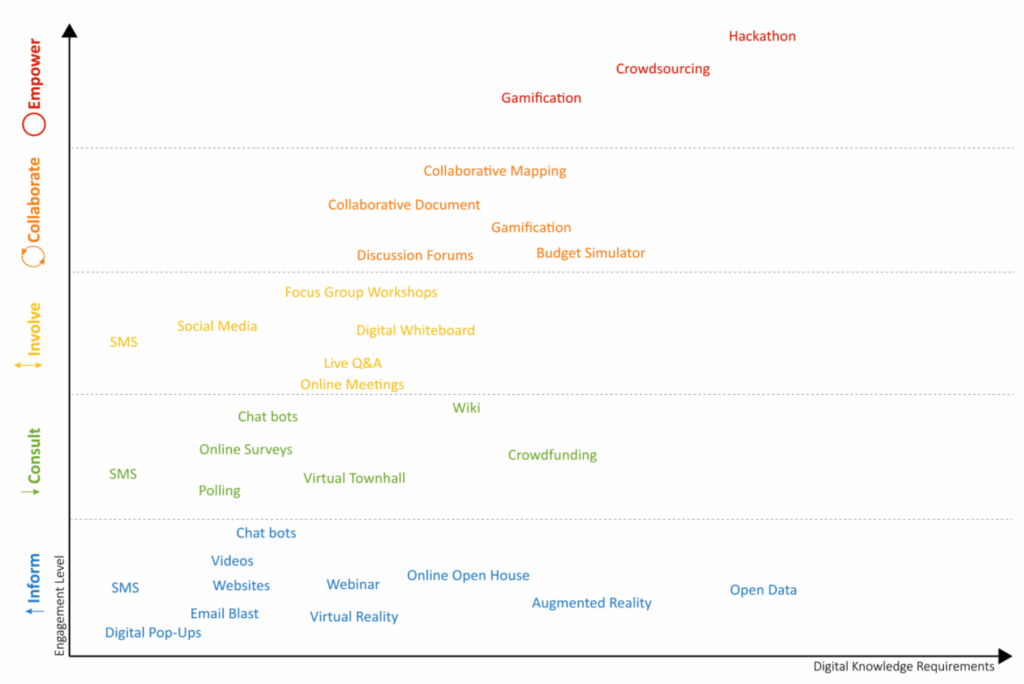
If considering public participation as a way to include a diversity of voices in decision making, this is not reflected in current practices of digital public participation. As the matrix shows, most digital engagement tools (39%) exist within the lowest level of engagement (inform). At this level, tools range from the lowest requirement of digital literacy, for example, the use of text messages or digital pop-ups, to levels that require more elaborated digital knowledge, such as open data. The last example also requires a sophisticated technical understanding of how to manipulate and visualize the data.
Meanwhile, as we climb the chart vertically, the variety of tools decrease. At levels four (collaborate) and five (empower), for example, which foresee higher community participation, there is a much smaller number of tools, all of which require more complex digital knowledge. For instance, collaborative mapping – the elaboration of a web mapping that allows interaction with the public – requires that community members have sufficient knowledge to access a platform and pinpoint their opinions on a map.
This matrix shows that the current practices of digital engagement are perpetuating relations of exclusion and power. Only those with sufficient digital knowledge and with access to technology can collaborate or take urban planning decisions. On the other hand, those without digital education end up remaining in their places of non-participation or limited participation.
Conclusions and recommendations
Digital public participation is inevitable. If there was already a tendency to digitize public participation, the current situation has strengthened and accelerated this trend. It is highly likely that, even after the pandemic is softened, the predisposition to use online public participation methods will remain a central element of every public participation plan.
However, before planning for an engagement, it is essential to understand the consequences that digital practices can bring, especially as they tend to provide a reduced level of diversity in participation and maintain existing dynamics of exclusion. The analysis presented in this research demonstrates that the greater is the desired level of participation and empowerment, the more limited are the alternatives to engage with the public, and the larger the requirement for digital knowledge. Therefore, the current scheme of online public participation is maintaining – if not worsening – the social exclusion and alienation of some classes from the possibilities to influence decision-making. In other words, only those with enough knowledge will be able to influence decisions. On the other hand, those digitally uneducated will most likely only be informed of what urban planning decisions will be made, without being able to influence it.
To achieve equality in digital participation practices, it is essential to follow several recommendations, which apply to government agencies, and public participation practitioners. First of all, when using digital engagement for urban planning, urbanists need to be creative and use a mixture of tools that reaches individuals with limited digital knowledge, giving a preference to low-tech tools.
Secondly, governments and policymakers should acknowledge and address the digital divides of infrastructure and influence in the digital world. That means providing technological infrastructure, which includes access to computers in public buildings, and access to wi-fi and broadband. Additionally, governments should go beyond infrastructural challenges and analyze social values that may be interposing digital participation. To that point, it is essential to implement digital educational programs, which should not only teach digital skills but also highlight the importance of voicing an opinion, be that in the online or the offline environments.
Annex One – List of digital engagement tools
| Tool | Definition | Common Uses in Urban Planning | Potentialities of use for Public Participation |
|---|---|---|---|
| Augmented Reality | An interactive experience where objects of the digital world appear in the real world through the use of an interface such as smartphones or computers. | Used to visualize the new land use regulation or new buildings and constructions. | Can be used to promote a more realistic image of urban projects and enable informed decision-making by community members. |
| Budget Simulator | Website or app that allows the modification of a project or product budget according to the public specifications. | Used by government agencies to simulate the use of the budget in public projects. | Can be used to map community priorities according to their allocation of resources (for example, what percentage of the budget goes to which urban improvement). |
| Chatbots | Software or application that conducts an online conversation with the public. | Used to provide quick automatic responses to the community. | In addition to providing quick answers, it can generate data on the most frequently asked questions and topics of most interest to members of the community. It can also collect data (if authorized by the user) to sending blast emails and inviting other community events. |
| Collaborative Document | A file that allows multiple people to work together, visualize and alter the document. | Used internally (in government agencies and private companies) to ensure project team collaboration. | It can be used to collect community opinions and feedback on projects in development. Members should not be allowed to delete content and should have filters and constant monitoring to avoid inappropriate language. |
| Collaborative Mapping | Web mapping allows interaction with the public, by allowing user- interactive content. | Used to georeference community feedback and to analyze clusters of concerns to better inform outcomes and decision-making based on the geography of public inputs. | It must be easily accessible and manipulated by the community. Attention should be paid to the design and user experience. It can be integrated with “offline” maps placed in places of high circulation or community organizations. |
| Crowdfunding | The practice of collaboratively funding a project. | Rarely used in urban planning, except for small projects and generally with a very strong community nature. | Can increase the feeling of ownership and public participation, through community empowerment. It can be integrated with other mechanisms, such as social media, to increase outreach. |
| Crowdsourcing | Collaborative gathering of data, ideas, or information to create a task or project. | Rarely used in urban planning. There are some institutions and think tanks conducting crowdsourcing incubators for urban planning. | Can provide creative solutions to urban problems and provide citizens with a political voice through collective problem-solving. |
| Digital Pop Up | Virtual or in-person experience that is placed on a façade of a building or website that creates more appealing and public-facing content. | Used to give visibility to changes that will occur in neighborhoods and to create appealing visualizations for the urban project. | Interactive models can be used to increase integration with the public, such as integrative panels or integration with virtual reality. |
| Digital Whiteboard | Digital board that allows users to write their opinion or post sticky notes in an online environment. | Used to simulate the placement of sticky notes during online public meetings and workshops. | It can be combined with gamification to create integrative and engaging mechanisms for collecting information. It can be used to carry out collective mapping and ideation sessions. |
| Discussion Forum | Online discussion site, where members can ask questions and hold conversations. | Used to promote interactive online questions and answers and information sharing, by and from the public. | Can have greater participation of government agents and urban planners interacting, mediating, and responding to questions from the public. |
| Email Blast | The strategy of sending emails to a large number of people. | Used to send information notices, newsletters, and calls to public meetings. | |
| Focus Group Workshop | An online discussion that only a few members, usually up to 10, participate and engage in discussion. | Used to ensure greater interaction between participants. | Can be a way to make culturally adequate community engagement sessions, with sessions held in several languages. The meeting should be facilitated in such a way that there is balanced participation among the participants. |
| Gamification | Application of game strategies into a project, process, or program. | Still little is used in urban planning due to the technical difficulties that it may generate in the participants. When used, they generally produce a high level of participation (empowerment). | Use simple games, with constant facilitation and encouragement to the participants. Conduct brief training (or provide explanatory video) before the engagement session to ensure that participants understand the game. |
| Hackathon | An event in which a large number of people engage to investigate and decide about a program or plan. | Rarely used in urban planning. But used to generate ideas and results related to technology and programming. | Determine specific problems within an urban project or area and invite members of the community, schools, or universities to discuss and solve the problems as a group. |
| Live Q&A | Questions and Answers about a project, program, or process that are discussed online. | Usually held after an online virtual meeting. | It can be held at a time separate from the virtual meeting (for example, one week after the virtual meeting) to give community members time to understand the project and ask any questions and concerns they may have. |
| Online Meeting | Online discussion in which participants engage in a discussion. | Used for almost all urban projects, to explain project concepts and collect inputs from the community. | Can be combined with other more engaging activities, such as polling, digital whiteboard, and even gamification or collaborative mapping. |
| Online Open House | Online environment or website that offers interactive information about a project or plan. | Made to simulate the experience of the open house of projects. Generally simulate rooms with project boards, in which the user can “walk” and check image by image. | The open house offline image should be left aside and focused on the online experience, which should be engaging and interactive. It can be reached through 3D or 360o images, or interactive panels. |
| Online Surveys | An online questionnaire that community members can complete through the internet. | Used to collect information about community members and their opinion on specific issues. | |
| Open Data | Free availability of data. | Used to give access to urban resources and data, which can be used for personal projects or a better understanding of a specific place or neighborhood. | They can be mapped in an interactive web mapping and easily accessible to users with little technological knowledge. |
| Poling | Online survey. | Used to collect short and quantitative information. | |
| SMS | Short text messages used to send messages to mobile phones. | Rarely used in urban projects. used for sending urban alerts and updates. | It can be used to conduct surveys, translated into several languages to ensure greater participation of immigrant populations, and used to call for public meetings or update on urban projects (if authorized by the user). |
| Social Media | Websites and apps that allow people to connect and share information. | Used to share information, videos, and updates about projects. Also used to provide a dialogue between public agencies and communities. | It can be a tool to measure the feeling of the community concerning a given project and also to carry out two-way communication with community members. |
| Videos | Recording of visual images. | Used to explain urban projects to the community and to show interviews with public agents, urban public agents, urban planners and community members. | It can be used to show the progress of projects and increase the feeling of participation during the progress of urban works. |
| Virtual Reality | Simulated three- dimensional experience of images and spaces. | Little used in urban planning, generally placed in exhibition spaces on urban projects, where the user can experience what the project will look like after its competition. | Can be used to promote a more realistic image of urban projects and enable informed decision-making by community members. |
| Virtual Townhall | An online meeting where politicians and decision-makers meet and interact with the public. | Provide information to communities in real-time. | |
| Webinar | Seminar conducted online. | Promote one-way communication to inform about urban projects and plans. | Should transition to an online meeting after the urban project and plan explanation is completed, to enable greater public participation. |
| Website | Group of pages that give information about a topic. | Used to share information about urban projects in a complete and integrative way, and to share images, plans, maps, photos, information about upcoming community meetings, and project progress. | It must always be multilingual to guarantee access to immigrants and vulnerable populations, as well as translating technical terms so that they are understood by the general population. They must be easy to access and use. |
| Wiki | A website that allows collaborative editing. | Rarely used in urban planning. | They can be used to translate complex urban planning terms, ensuring comprehension by the general public. |
References
- MacQueen, KM, E McLellan, D S Metzger, S Kegeles, R P Strauss, R Scotti, L Blanchard, and R T Trotter 2nd. “What Is Community? An Evidence-Based Definition for Participatory Public Health.” American Journal of Public Health91, no. 12 (December 2001): 1929–38. https://doi.org/10.2105/ajph.91.12.1929.
- Montgomery, C. Happy City: Transforming Our Lives Through Urban Design. Penguin Books Limited, 2013. https://books.google.com/books?id=3KVc2AVftI4C.
- Laskey, Allison B., and Walter Nicholls. “Jumping Off the Ladder.” Journal of the American Planning Association85, no. 3 (July 3, 2019): 348–62. https://doi.org/10.1080/01944363.2019.1618729.
- Konsti-Laakson, S., Rantala, T. “Managing community engagement: a process model for urban planning.” European Journal of Operational Research, 3, n.268 (August 1, 2018): 1040-1049. https://doi.org/10.1016/j.ejor.2017.12.002.
- Falco, E., Kleinhans, R. “Digital Participatory Platforms for Co-Productions in Urban Development: A Systematic Review” International Journal of E-planning3, n. 3 (March 2018): 1-27 https://doi.org/10.4018/IJEPR.2018070105
- Haklay, M., Jankowski, P., Kowelinski, Z. “Selected modern methods and tools for public participation in urban planning – A review. Quaestiones Geographicae, 3, n. 37 (2018): 127-149. http://dx.doi/org.exproxy.cul.columbia.edu/10.2478/quageo-2018-0030
- Babelon, I. Digital participatory platforms in urban planning (Order No. 28391071). Available from ProQuest Dissertations & Theses Global. (2497605536). Retrieved from http://ezproxy.cul.columbia.edu/login?url=https://www-proquest-com.ezproxy.cul.columbia.edu/dissertations-theses/digital-participatory-platforms-urban-planning/docview/2497605536/se-2?accountid=10226
- The researcher consulted reports from the following companies: Articulous, an Australian-based communications and engagement consultant; CoUrbanize, a Massachusetts-based company that develops technology for community engagement for urban planning and real estate developments; StateUp, an English company that develops digital technology for public policy; Hester Street Collaborative, a New York City-based urban planning non-profit organization; the civic engagement team from Salt Lake City, a small city in Utah, US; Smith Group, an architecture, and planning firm based in several cities in the United States and China; WSP, an international planning, and transportation firm; and the National Association of City Transportation Officials (NACTO), an association of 86 major North American cities and transit agencies.
- Babelon, I. Digital participatory platforms in urban planning (Order No. 28391071). Available from ProQuest Dissertations & Theses Global. (2497605536). Retrieved from http://ezproxy.cul.columbia.edu/login?url=https://www-proquest-
com.ezproxy.cul.columbia.edu/dissertations-theses/digital-participatory-platforms-urban-planning/docview/2497605536/se-2?accountid=10226 - Babelon, I. Digital participatory platforms in urban planning (Order No. 28391071). Available from ProQuest Dissertations & Theses Global. (2497605536). Retrieved from http://ezproxy.cul.columbia.edu/login?url=https://www-proquest-
com.ezproxy.cul.columbia.edu/dissertations-theses/digital-participatory-platforms-urban-planning/docview/2497605536/se-2?accountid=10226 - Haans Lyons, Susan. “Digital Engagement, Social Media & Public Participation.” International Association for Public Participation Canada, 2017. https://www.iap2canada.ca/resources/Documents/Newsletter/2017_social_media_white_paper.pdf.
- Le Blanc, David. “E-Participation: A Quick Overview of Recent Qualitative Trends.” DESA Working Papers, ST/ESA/2020/DWP, 163 (January 2020). https://www.un.org/esa/desa/papers/2020/wp163_2020.pdf.
[13] Haans Lyons, Susan. “Digital Engagement, Social Media & Public Participation.” International Association for Public Participation Canada, 2017. https://www.iap2canada.ca/resources/Documents/Newsletter/2017_social_media_white_paper.pdf. - [13] Haans Lyons, Susan. “Digital Engagement, Social Media & Public Participation.” International Association for Public Participation Canada, 2017. https://www.iap2canada.ca/resources/Documents/Newsletter/2017_social_media_white_paper.pdf.
- Babelon, I. Digital participatory platforms in urban planning (Order No. 28391071). Available from ProQuest Dissertations & Theses Global. (2497605536). Retrieved from http://ezproxy.cul.columbia.edu/login?url=https://www-proquest-
com.ezproxy.cul.columbia.edu/dissertations-theses/digital-participatory-platforms-urban-planning/docview/2497605536/se-2?accountid=10226 - Le Blanc, David. “E-Participation: A Quick Overview of Recent Qualitative Trends.” DESA Working Papers, ST/ESA/2020/DWP, 163 (January 2020). https://www.un.org/esa/desa/papers/2020/wp163_2020.pdf.
- Wharton, University of Pennsylvania. “You’re on Mute: Inside the Online Video Communications Market.” Wharton, University of Pennsylvania, September 8, 2020. https://kwhs.wharton.upenn.edu/2020/09/back-to-school-business-online-learning/.
- Koeze, Ella, and Nathaniel Popper. “The Virus Changed the Way We Internet.” The New York Times. April 7, 2020.
https://www.nytimes.com/interactive/2020/04/07/technology/coronavirus-internet- use.html?auth=login-google. - Wharton, University of Pennsylvania. “You’re on Mute: Inside the Online Video Communications Market.” Wharton, University of
Pennsylvania, September 8, 2020. https://kwhs.wharton.upenn.edu/2020/09/back-to-school-business-online-learning/. - NYC Engage (2021, March 16). Retrieved from: https://www1.nyc.gov/site/nycengage/index.page
- NACTO. “Public participation During COVID-19.” National Association of City Transportation Officials, April 23, 2020.
https://nacto.org/event/community-engagement- during-covid-19/. - Articulous Academy. “Digital and Online Engagement.” Australia, June 2020; CoUrbanize. “Public participation in the Age of COVID-19.” CoUrbanize. Accessed September 5, 2020. https://courbanize.foleon.com/content/covid-19-toolkit/updating-the- community/.; Filer,
Tanya, and Riley Kaminer. “From Literature to Manufacturing, Crisis and Creativity Have Often Gone Hand-in-Hand.” StateUp. Accessed September 5, 2020. https://stateup.co/how-governments-can-engage-digital-resources-to-manage-their-covid-19-response/.; Hester Street. “Public participation in Times of COVID-19.” New York: Hester Street, August 25, 2020.
https://hesterstreet.org/2020/08/community-engagement-covid-19- resource/.; Salt Lake City Civic Engagement Team. “Practices for Engagement in the Times of COVID.” Salt Lake City, US: Salt Lake City Engagement Team, March 2020. https://www.slc.gov/can/civic- engagement/. - Articulous Academy. “Digital and Online Engagement.” Australia, June 2020; Hester Street. “Public participation in Times of COVID-19.” New York: Hester Street, August 25, 2020. https://hesterstreet.org/2020/08/community-engagement-covid-19- resource/.
- Arnstein, Sherry. “A Ladder of Citizen Participation.” Journal of the American Planning Association85 (January 2, 1969): 24–34. https://doi.org/10.1080/01944363.2018.1559388.
- White, Sarah C. “Depoliticising Development: The Uses and Abuses of Participation (La Dépolitisation Du Développement: Usages et Abus de La Participation / Despolitisando o Desenvolvimento: Participação: Usos e Abusos / Despolitizando El Desarrollo: Los Usos y Abusos de La Participación).” Development in Practice6, no. 1 (1996): 6–15. http://www.jstor.org/stable/4029350.
- Babelon, I. Digital participatory platforms in urban planning (Order No. 28391071). Available from ProQuest Dissertations & Theses Global. (2497605536). Retrieved from http://ezproxy.cul.columbia.edu/login?url=https://www-proquest-com.ezproxy.cul.columbia.edu/dissertations-theses/digital-participatory-platforms-urban-planning/docview/2497605536/se-2?accountid=10226, p. 79
- International Association for Public Participation. “IAP2 Spectrum of Public Participation.” International Association for Public Participation, 1996. https://cdn.ymaws.com/www.iap2.org/resource/resmgr/pillars/Spectrum_8.5x11_Print.pdf.
- International Association for Public Participation. (n.d.). The spectrum of Public Participation. Retrieved March 16, 2021, from https://www.iap2.org/page/pillars
- Le Blanc, David. “E-Participation: A Quick Overview of Recent Qualitative Trends.” DESA Working Papers, ST/ESA/2020/DWP, 163 (January 2020). https://www.un.org/esa/desa/papers/2020/wp163_2020.pdf.
- Bonney, R., Cooper, C. B., Dickinson, J., Kelling, S., Phillips, T., Rosenberg, K. V., & Shirk, J. (2009). Citizen Science: A Developing Tool for Expanding Science Knowledge and Scientific Literacy. BioScience, 59(11), 977–984. https://doi.org/10.1525/bio.2009.59.11.9;
Aristeidou, Maria, Eileen Scanlon, and Mike Sharples. “Profiles of Engagement in Online Communities of Citizen Science Participation.” Computers in Human Behavior74 (September 1, 2017): 246–56. https://doi.org/10.1016/j.chb.2017.04.044. - Haklay, Muki. “Citizen Science and Volunteered Geographic Information: Overview and Typology of Participation.” In Volunteered Geographic Information, Public Participation and Crowdsourced Production of Geographic Knowledge, 105–22, 2013. https://doi.org/10.1007/978-94-007-4587-2_7.
- Hasler, S. Chenal, J.. Soutter, M. “Digital Tools as a Means to Foster Inclusive, Data-Informed Urban Planning.” Civil Engineering and Architecture5, n. 6 (November 2017) https://doi.org/10.13189/cea.2017.050605
- Falco, E., Kleinhans, R. “Digital Participatory Platforms for Co-Productions in Urban Development: A Systematic Review” International Journal of E-planning3, n. 3 (March 2018): 1-27 https://doi.org/10.4018/IJEPR.2018070105
- Babelon, I. Digital participatory platforms in urban planning (Order No. 28391071). Available from ProQuest Dissertations & Theses Global. (2497605536). Retrieved fromhttp://ezproxy.cul.columbia.edu/login?url=https://www-proquest-
com.ezproxy.cul.columbia.edu/dissertations-theses/digital-participatory-platforms-urban-planning/docview/2497605536/se-2?accountid=10226, p. 79 - Schradie, Jen. “The Digital Production Gap: The Digital Divide and Web 2.0 Collide.” Poetics39, no. 2 (April 1, 2011): 145–68. https://doi.org/10.1016/j.poetic.2011.02.003.
- Babelon, I. Digital participatory platforms in urban planning (Order No. 28391071). Available from ProQuest Dissertations & Theses Global. (2497605536). Retrieved fromhttp://ezproxy.cul.columbia.edu/login?url=https://www-proquest-
com.ezproxy.cul.columbia.edu/dissertations-theses/digital-participatory-platforms-urban-planning/docview/2497605536/se-2?accountid=10226, p. 79 - Bennett, Lance. “Changing Citizenship in the Digital Age.” Civic Life Online: Learning How Digital Media Can Engage Youth1 (January 1, 2008); Jenkins, Henry. “Confronting the Challenges of Participatory Culture: Media Education for the 21st Century.” United States: MacArthur Foundation, 2006. https://www.macfound.org/media/article_pdfs/JENKINS_WHITE_PAPER.PDF.; Ognyanova,
Katherine, Nancy Chen, Sandra Ball-Rokeach, Zheng An, Minhee Son, Michael Parks, and Daniela Gerson. “Online Participation in a Community Context: Civic Engagement and Connections to Local Communication Resources.” International Journal of Communication7 (January 1, 2013): 2433-2456.; Babelon, I. Digital participatory platforms in urban planning (Order No. 28391071). Available from
ProQuest Dissertations & Theses Global. (2497605536). Retrieved from http://ezproxy.cul.columbia.edu/login?url=https://www-proquest-
com.ezproxy.cul.columbia.edu/dissertations-theses/digital-participatory-platforms-urban-planning/docview/2497605536/se-2?accountid=10226. - Min, Seong-Jae. “From the Digital Divide to the Democratic Divide: Internet Skills, Political Interest, and the Second-Level Digital Divide in Political Internet Use.” Journal of Information Technology & Politics7, no. 1 (February 5, 2010): 22–35. https://doi.org/10.1080/19331680903109402.
- Hargittai, Eszter. “Second-Level Digital Divide.” First Monday7, no. 4 (April 2002).
http://firstmonday.org/issues/issue7_4/hargittai/index.html. - Hargittai, Eszter. “Second-Level Digital Divide.” First Monday7, no. 4 (April 2002).