A Four-Part Series on Philosophical Aesthetics
As renewed excitement builds around the science of aesthetics, it’s important to remember that many of these concepts—beauty, taste, awe, and more—have long histories in philosophy. In the first part of this series, we looked at beauty, that “queen” of aesthetic values, often associated with harmony, proportion, and delight. But not all powerful experiences are gentle or pleasing.
Sometimes we are struck not by elegance, but by enormity. By force. By something that nearly overwhelms our senses or our sense of self. That feeling is at the heart of what philosophers have called the sublime.
Awe in Architecture and Nature
Step into a Gothic cathedral and your body responds almost involuntarily. Your eyes lift. Your breath slows. The soaring ceilings, intricate vaults, and floods of colored light evoke a quiet sense of reverence. These structures do more than impress; they provoke awe.
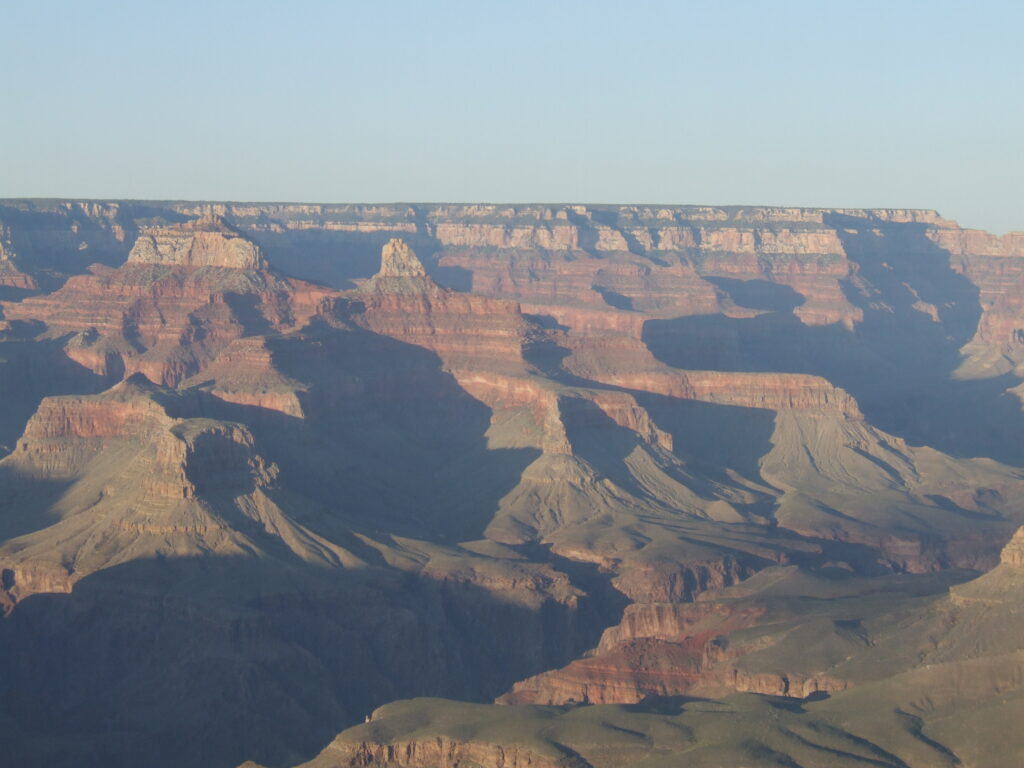
But cathedrals are not alone in this. Secular spaces can also provoke the sublime: standing at the edge of the Grand Canyon, looking up at the Hoover Dam, or gazing from the base of the Burj Khalifa. Each presents us with something vast, powerful, and beyond full comprehension.
The sublime often emerges where scale exceeds familiarity. Architects and designers know this intuitively. Monumental scale, dynamic massing, verticality, and dramatic contrast between light and shadow can all induce a feeling of smallness in the viewer—a kind of humbled wonder.
Longinus and the Origins of the Sublime
The first known account of the sublime comes from the first century CE, in a treatise commonly attributed to Longinus. Though writing about literature, Longinus lays the groundwork for later developments. As Emily Brady summarizes, he identified two main sources of the sublime: “the power of grand conceptions” and “the inspiration of vehement emotion.”
In literature, as in architecture, grandeur and emotional force can elevate the soul. Though Longinus focused on rhetoric and poetic intensity, his basic idea—that something can stir the human spirit beyond the ordinary—has proven durable.
From Beauty to Terror: The 18th Century Turn
Philosophers in the 18th century expanded the sublime beyond language to include landscapes and physical experiences. This was especially true during the rise of the Grand Tour, when upper-class Europeans traveled through Italy and the Alps to complete their education. While on such a tour in 1699, Joseph Addison wrote that “the Alps fill the mind with an agreeable kind of horror.”
This phrase captures something essential: the sublime is not merely pleasurable. It is aesthetic fear at a safe distance—an experience that blends attraction with unease.
Edmund Burke: The Terrible and the Distant
Edmund Burke, writing in A Philosophical Enquiry into the Origin of Our Ideas of the Sublime and Beautiful (1757), rooted his aesthetics in bodily sensation. He divided emotional responses into three types: pleasure, pain, and indifference. For Burke, the sublime emerged not from beauty, but from experiences that verge on pain, danger, or terror.
“Whatever is fitted in any sort to excite the ideas of pain, and danger, that is to say, whatever is in any sort terrible, or is conversant about terrible objects, or operates in a manner analogous to terror, is a source of the sublime; that is, it is productive of the strongest emotion which the mind is capable of feeling.”
However, there’s a crucial condition: we must feel safe. If a tidal wave is rushing toward us, we feel terror, not sublimity. The sublime requires a distance—physical, emotional, or conceptual—that allows us to contemplate danger without being consumed by it.
Burke’s version of the sublime is visceral. Vastness, darkness, obscurity, and power can overwhelm the senses and stimulate awe. Even architecture, when it adopts dramatic proportions or stark minimalism, can echo this physical intensity.

Immanuel Kant: Reason Confronts the Infinite
Immanuel Kant, writing a few decades later in the Critique of Judgment (1790), brought the sublime into the realm of the mind. For him, the sublime occurs not in the object itself but in the subject’s mental experience.
Kant famously distinguished between two types of sublime:
- The Mathematical Sublime arises from sheer size. When something is so vast we cannot take it in—like the Grand Canyon, the night sky, or a monumental skyscraper—it exceeds our sensory grasp.
- The Dynamical Sublime comes from power. Nature’s force—lightning, waterfalls, or storms—threatens our sense of control, yet reminds us that reason can withstand it.
Importantly, Kant thought the sublime reflects human dignity. We may be physically small, but through reason, we can comprehend vastness and survive symbolic danger. Even when nature overpowers us, we sense the supremacy of the human mind. In this way, the sublime becomes morally uplifting.
In architectural terms, the Kantian sublime is not merely big—it challenges the viewer to think, to reckon with the limits of perception and the scope of human ambition.
Arthur Schopenhauer: The Sublime as Escaping the Self
Arthur Schopenhauer, writing in the 19th century, offered a slightly different interpretation. In The World as Will and Representation, he described the sublime as an aesthetic experience in which we momentarily transcend the restless will—our striving, desiring selves.
For Schopenhauer, beauty gives us peaceful satisfaction. The sublime, however, brings us face to face with something powerful or indifferent to human concerns. Think of a mountain, a storm, or the vast sea. These scenes remind us of our smallness, and yet, instead of fear or despair, we feel awe and clarity.
He too saw degrees of the sublime: from the mildly disquieting to the overwhelming. In these moments, we become disinterested observers, no longer driven by practical concerns. The self dissolves into the scene.
This aligns with certain architectural experiences, such as the feeling of insignificance within a monumental space. The sublime is not just a design effect, but a perceptual shift—it opens us to something beyond ourselves.
Emily Brady and Contemporary Perspectives
In her book The Sublime in Modern Philosophy: Aesthetics, Ethics, and Nature, Emily Brady revisits these theories and brings them into dialogue with modern aesthetics and environmental thought.
She accepts Kant’s distinction between mathematical and dynamical sublime and highlights size and force as central characteristics. But she notes that most traditional artworks fall short of being sublime. A painting of a thunderstorm or a cliff may depict sublimity, but rarely provokes the experience itself.
Instead, Brady points to land art and architecture as uniquely capable of evoking the sublime today. Works like Robert Smithson’s Spiral Jetty or James Turrell’s Roden Crater don’t just represent the sublime—they immerse the viewer in it. Certain architectural works, especially those emphasizing scale, voids, and light, have similar power.
As with the cathedrals of Europe or the stark geometries of brutalism, the built environment can participate in the sublime when it overwhelms, humbles, or silences the viewer.

From Philosophy to Psychology: Awe and Human Flourishing
Today, the conversation about the sublime continues through studies of awe, particularly in psychology and neuroscience. Researchers like Dacher Keltner and Jonathan Haidt describe awe as a key emotion that expands our sense of time, increases generosity, and diminishes the ego.
Their findings echo what philosophers long claimed: that profound experiences—especially those involving vastness, complexity, or power—can transform us. Whether in nature, art, or architecture, the sublime still holds the potential to stretch the self and reconnect us with something greater.
Even in a digital age, we seek out these experiences: gazing at satellite images of galaxies, visiting towering temples or desert sculptures, standing beneath skyscrapers at night. The sublime persists.
Conclusion
From Longinus to Burke, Kant to Brady, the sublime has charted a path through centuries of thought. It has moved from poetic intensity to physical terror, from psychological awe to moral elevation. Whether stirred by nature or created through architecture, it calls us to confront limits—of perception, of control, of the self.
Unlike beauty, the sublime does not always soothe. But it awakens. In a world filled with convenience and comfort, we still crave moments that unsettle us, expand us, and place us in relation to something vast.
The sublime reminds us: not everything that matters can be grasped, but that doesn’t mean it isn’t worth encountering.
Look for the next post on aesthetic taste.