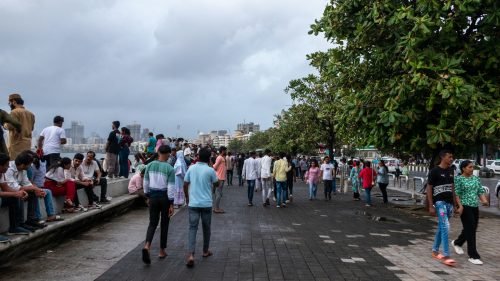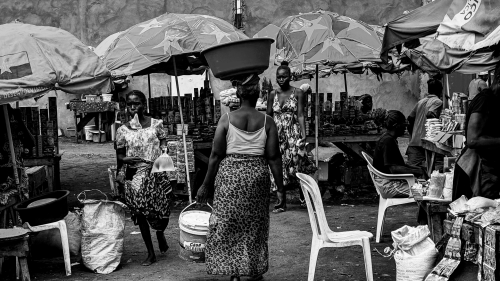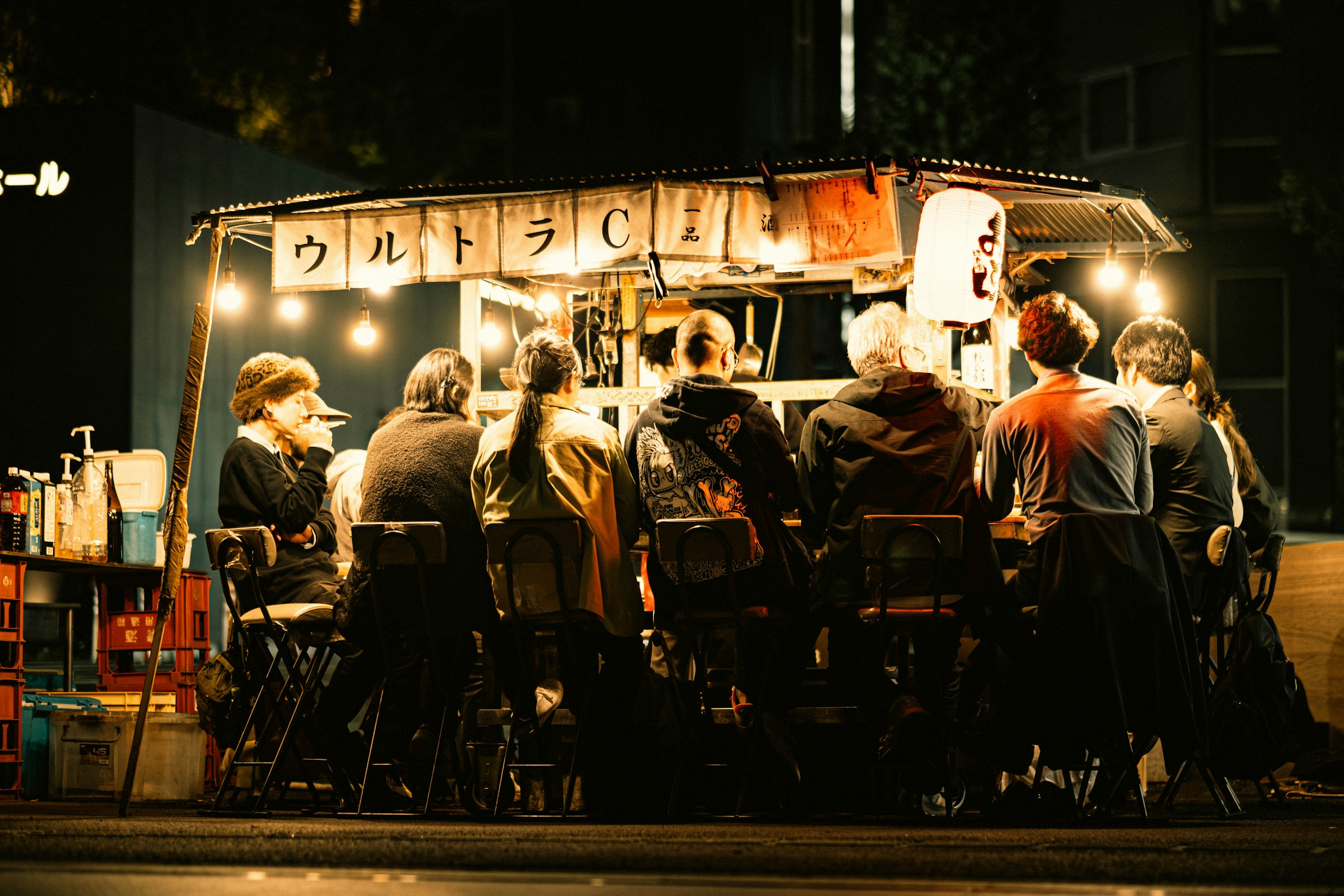


A growing body of literature demonstrates that social infrastructure — city spaces such as libraries, parks, and plazas — supports diverse forms of urban sociality.1_4 Scholars show the design and quality of these environments shape social sustainability by influencing health and wellbeing and by nurturing the formation of meaningful social ties.5, 6 This growing emphasis on interaction and wellbeing prompts urban theorists to rethink cities, not as static assemblies of built form, but as dynamic relational ecosystems constituted through lived experience.7, 8 But how, exactly, does built form become relational? While the relational turn in urban scholarship offers insight into this shift, one critical domain remains largely overlooked: leisure.
When urbanists mention leisure, they often treat it as amusement, entertainment, or an amenity.9,10 In doing so, they position it as supplemental, perhaps even trivial, rather than structural. If urban designers genuinely wish to foster connection and belonging, however, they need to recognize leisure as an essential component of how cities generate connection. Leisure creates space for belonging by fostering shared experience, spontaneous interactions, and mutual support, which makes it an effective platform for connection and mitigating isolation.11, 12 By leveraging leisure, cities become more relational.
With this perspective in mind, in this commentary, I argue leisure constitutes a meaningful, albeit largely missing, conceptual layer in conscious city design. Designers cannot foster connection by shaping form alone. They must also attend to the sociable practices through which urban inhabitants voluntarily relate to one another in shared space. Leisure, as I aim to demonstrate, provides that relational medium. What follows clarifies this relational understanding of leisure, situates it within current debates on social infrastructure and urban belonging, and explores its implications for urban designers seeking to support connection intentionally.
Leisure as a Sphere of Sociability
Leisure scholars define leisure as time freed from obligation,13, 14 as a psychological state characterized by intrinsic motivation and perceived freedom,15 and as identifiable forms of activity.16 While these intellectual traditions illuminate important dimensions of leisure, they primarily foreground time, individual experience, and activity type. They also privilege individual experience over relational process. With this in mind, I propose a complementary emphasis: leisure as a relational sphere of sociability.17 In leisure contexts, individuals gather, talk, play, observe, and linger in the presence of others. They engage voluntarily in shared space, sometimes together in activity, but often simply alongside one another. Through repeated encounters, they relate as co-present participants in social life. Leisure, therefore, does more than fill time; it organizes interaction.
This distinction matters for urban design. Spatial proximity creates the conditions for interaction, but only through repeated, patterned copresence does it begin to generate recognition. Leisure transforms adjacency into encounter. For example, a weekly food truck night in a neighbourhood park can convert a passive green space into a recurring social node where residents begin to recognize familiar faces, exchange brief conversations, and gradually build a sense of local familiarity. Similarly, a drop-in community yoga class held in a public plaza may begin as a shared activity among strangers, but through repeated participation, it creates a predictable rhythm of co-presence that supports recognition and low-stakes social exchange. Over time, these returns establish rhythms of interaction, and repetition thickens thin ties and sustains strong ones.18 Leisure, thus, operates as the mechanism through which spatial form becomes relational.
These encounters also expose individuals to difference. Public leisure settings rarely gather only the like-minded. City spaces introduce what Sennett referred to as social friction,19 the low-stakes opportunities to negotiate unfamiliarity and ambiguity without retreat. When leisure environments remain open rather than over-determined, they enable precisely this intermixing. Contact theory, furthermore, suggests sustained intergroup contact can reduce prejudice and foster mutual understanding, particularly when interaction occurs under conditions of relative equality and shared purpose.20 Leisure frequently provides such a context of recurring, informal engagement across difference.
Through repeated leisure practices, urban inhabitants appropriate specific spaces as meaningful territories for their leisure, carving out affective geographies within the larger city. Leisure, in other words, helps configure a personal “city within the city” or a lived landscape defined less by administrative boundaries than by rhythms of encounter and emotional investment.21 In doing so, it inscribes space with meaning, therein making spaces into places.22 Leisure binds people affectively to the territory and weaves subjective identity into urban form. It follows, then, that built form alone cannot produce this relational and territorial depth.
Infrastructure Does not Animate Itself
Urban scholars increasingly use the term social infrastructure to describe physical spaces and organizations that shape interaction.2,7 Commonly referenced spatial forms of social infrastructure, such as parks, recreation centres, and plazas, almost always support “leisure-in-public” — those “activities that take place outside of the home in the view of others for eudaimonic (i.e. personal enrichment) and/or hedonic (i.e. pleasure) purposes”23(p.158). These settings facilitate intermixing among different social circles,24 which exposes inhabitants to a variety of social ties.25 While such intermixing does not guarantee relational intimacy, it does sustain the ongoing (re)creation of a never-in-a-final-state community.26
Infrastructure alone does not animate itself, however. Design offers affordances, to be sure, but people animate space through repeated use.27 A well-designed plaza may offer seating, shade, and aesthetic coherence, while remaining underused if no one activates it. Even modest spaces can generate vibrancy when inhabitants program them through festivals, games, and informal gatherings.12, 28_30 Through such animation, urban space acquires rhythm and purpose. Leisure, thus, actualizes interaction by transforming physical settings into stages for repeated sociability. More than an accessory to design, programming acts as a mechanism through which spaces become socially legible and repeatedly inhabited. Designers seeking to foster connection must, therefore, consider not only form, but how leisure activates and reanimates space over time.
Belonging Emerges through Power
To be sure, designing for connection requires more than programming. It demands critical reflexivity. Public space never operates neutrally.31 Every design decision “establishes fluid boundaries of inclusion and exclusion”27(p9). Seating that prevents laying down, surfaces that deter skateboarding, and lighting that intensifies surveillance signal exclusivity, while regulating who belongs.32 Conversely, flexible seating, open surfaces, and permissive programming can signal invitation, which enables a wider range of leisure practices to unfold, from informal play to spontaneous gathering. Such interventions shape leisure directly. They expand opportunities for some users, while constraining others. They define permissible behaviours and marginalize alternative practices. Ultimately, defensive placemaking modifies what bodies can do in space and, therefore, reinforces distinctions between those who feel entitled to linger and those who feel displaced.27, 33
Research on belonging within community leisure settings reinforces the importance of inclusion. Fortune et al. identified welcoming environments, opportunities for meaningful contribution, shared interests, and inclusive policies as critical to belonging, particularly for individuals vulnerable to exclusion.34 Their work underscores that belonging requires intentional relational practices embedded in space.
To be sure, leisure reproduces social hierarchies.35 We know space can perpetuate the power of dominant groups by normalizing the authority of specific social groups, setting out spatial boundaries and functioning as a symbol of social values.36 Festivals may celebrate dominant identities, while marginalizing cultures; pop-up installations may appeal to highly mobile urban professionals, while alienating long-term residents; and convivial programming can unintentionally privilege those already comfortable in public. For instance, culturally specific festivals or programming can either broaden participation by inviting diverse publics or reinforce exclusion when they fail to reflect the communities that share the space. With these examples in mind, we must always pay critical attention to the ways leisure spaces are produced and maintained through social conflict.
These tensions do not undermine the value of leisure. They clarify its stakes. If leisure activates social infrastructure, then designers must examine whose leisure activates it. Who feels invited to play? Who interprets design cues as welcoming? Who perceives regulation rather than invitation? A leisure-conscious city confronts these questions directly by treating connection and belonging as structured outcomes.
Designing for Relational Capacity
Clearly, cities bring people into physical proximity with multiply opportunities for encounter. But proximity does not guarantee relational depth. Urban social ties exist along a spectrum — from strong bonds among intimate partners, family members, and close friends, to weak and invisible ties among neighbours and familiar strangers, respectively.37 Many of these relationships remain fleeting or impersonal. Even durable weak ties do not necessarily evolve into intimate connection.38,39 Social infrastructure can foster bridging across diverse groups, but without repeated, meaningful engagement these connections often remain shallow.40 Indeed, for some inhabitants, even minimal relational ties remain absent from their lives. Physical proximity can coexist with profound social isolation and feelings of loneliness.
In response to mounting evidence that chronic isolation and loneliness severely undermine health and wellbeing,41 scholars have advanced the concept of social fitness—the strength and quality of one’s relationships and the intentional habits that sustain them.25, 42 Like physical health, relational capacity requires enabling environments. Cities build walking paths and trails to support bodily wellbeing; they should similarly sustain contexts for social engagement. By comparison, regularly scheduled, low-barrier activities, such as walking clubs, drop-in sports, or routine neighbourhood gatherings, create parallel infrastructures for social wellbeing by normalizing repeated, shared participation. Capacity, in this sense, develops through intentional and repeated practices of gathering, cooperating, and showing up in shared space.
Leisure supplies the conditions under which relational capacity can develop. As a domain of voluntary, intrinsically motivated activity, leisure lowers the social stakes of interaction.15, 25 People gather because they derive enjoyment, interest, or meaning from participation. This affective tone makes a difference, as fun and play invite openness.43 Leisure settings create spaces in which individuals can experiment with sociability (e.g., introducing themselves, navigating difference, cooperating, or simply lingering in the presence of others) without the rigid expectations that govern workplaces or formal institutions.44 A pick-up basketball game, for example, allows participants to negotiate cooperation, competition, and communication with minimal consequence, which makes the site accessible for practicing social interaction. Because leisure practices often recur (e.g., weekly games, neighbourhood events, daily walks), they generate patterned interaction over time. Repetition transforms fleeting contact into recognition; recognition creates familiarity; familiarity enables trust. In this way, leisure functions as a training ground for social fitness, developing habits, dispositions, and competencies that sustain relational life.
Urban designers who prioritize circulation, efficiency, and aesthetic coherence without attending to sociability risk producing cities that function smoothly, but feel relationally thin.45 Designing for relational capacity means creating environments that invite return, tolerate improvisation, and sustain low-stakes encounter across difference. Generative spaces are hospitable to repetition. They support lingering as much as movement, and participation as much as observation. They allow inhabitants to practice cooperation, navigate ambiguity, and accumulate familiarity over time. In doing so, they nurture the habits and competencies that constitute social fitness. Leisure provides this generative capacity because it embeds connection with enjoyment, voluntariness, and shared rhythm. When designers take leisure seriously, they create the conditions under which social life can deepen.
Toward the Leisure-Conscious City
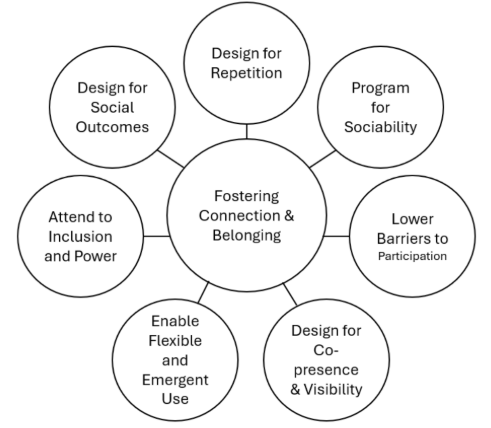
To understand leisure as a generative layer of social infrastructure, we must design for social connection beyond providing space (see Figure 1). Doing so calls for an intentional focus on the conditions that support repeated interaction, shared activity, and the gradual emergence of belonging. The following principles offer a starting point for planners and urban designers who seek to integrate leisure into conscious city design:
1. Design for Repetition, not just Encounter
Design should prioritize conditions that support regular return and sustained participation, rather than one-time episodic use. Space that host recurring activities, such as weekly markets, drop-in programs, or seasonal events, enable individuals to encounter one another repeatedly, which builds familiarity over time.
2. Program for Sociability
Social interaction does not arise automatically from proximity. Designers and planners should treat programming as integral to infrastructure by embedding opportunities for play, performance, and informal gathering into the life of a space. Even modest interventions, including games, temporary activations, or facilitated activities, can catalyze interaction.
3. Lower Barriers to Participation
Leisure-based social infrastructure is most effective when it is accessible, low-cost, and easy to join. Drop-in formats, visible activities, and minimal skill requirements reduce the social risk of participation and invite broader publics into shared experience.
4. Design for Co-presence and Visibility
Spaces should be arranged to make social activity visible, legible, and inviting. Sightlines, flexible seating, and clustered activity zones can support co-presence and increase the likelihood of spontaneous interaction among unfamiliar others.
5. Enable Flexible and Emergent Use
Rather than over-programming space, designers should allow for adaptability and user appropriation. Open-ended environments enable residents to shape leisure practices in ways that reflect local culture, which supports diverse forms of sociability.
6. Attend to Inclusion and Power
Not all leisure infrastructures are equally welcoming. Designers must critically examine how rules, aesthetics, and spatial arrangements may include or exclude particular groups. Creating socially inclusive environments requires attention to whose leisure practices are supported, legitimized, or constrained.
7. Design for Social Outcomes
Finally, planners and designers should expand their evaluative frameworks to include social outcomes, such as interaction, familiarity, and belonging, alongside traditional metrics like usage, density, or economic return. Leisure offers a pathway through which these outcomes can be intentionally cultivated.
Cities represent dynamic stages of public life. Their vitality depends on the informal, recurring practices that animate them. Conscious design rightly foregrounds human experience. Leisure specifies how that experience becomes relational—that is, how proximity becomes familiarity, how familiarity become recognition, and how recognition sometimes becomes care. To design for connection, then, is to design for leisure as generative infrastructure. Without leisure, urban form may achieve beauty, coherence, and even efficiency. With it, cities support the patterned sociability through which strangers become familiar, neighbours become known, and public space becomes shared experience. To advance connection and belonging, the conscious city must also become the leisure-conscious city.
References
1. Campbell LK, Svendsen E, Johnson M, Landau L. Activating urban environments as social infrastructure through civic stewardship. Urban Geogr. 2022;43(5):713-734.
2. Latham A, Layton J. Social infrastructure and the public life of cities: Studying urban sociality and public spaces. Geogr Compass. 2019;13(7):e12444.
3. Mouratidis K. Built environment and social well-being: How does urban form affect social life and personal relationships? Cities. 2018;74:7-20.
4. Mouratidis K, Poortinga W. Built environment, urban vitality and social cohesion: Do vibrant neighborhoods foster strong communities? Landsc Urban Plan. 2020;204:103951.
5. Grum B, Kobal Grum D. Concepts of social sustainability based on social infrastructure and quality of life. Facilities. 2020;38(11-12):783-800.
6. Yıldız S, Kıvrak S, Gültekin AB, Arslan G. Built environment design-social sustainability relation in urban renewal. Sustain Cities Soc. 2020;60:102173.
7. Klinenberg E. Palaces for the People: How Social Infrastructure Can Help Fight Inequality, Polarization, and the Decline of Civic Life. Crown; 2018.
8. Larkin B. The politics and poetics of infrastructure. Annu Rev Anthropol. 2013;42:327-343.
9. Florida R. The Rise of the Creative Class. Basic Books; 2002.
10. Yang S, Xiao H, Tse CY. Leisure in an urban environment—a perspective of university students. In: Li M, Bihu W, eds. Urban Tourism in China. Routledge; 2013:65-80.
11. Glover TD. Leisure, social space, and belonging. In: Spracklen K, Lashua B, Sharpe E, Swain S, eds. The Palgrave Handbook of Leisure Theory. Palgrave Macmillan; 2017:873-890.
12. Glover TD. The transformative (and potentially discriminatory) possibilities of animating public space. World Leis J. 2019;61(2):144-156.
13. de Grazia S. Of Time, Work, and Leisure. Twentieth Century Fund; 1962.
14. Dumazedier J. Toward a Society of Leisure. Free Press; 1967.
15. Neulinger J. The Psychology of Leisure: Research Approaches to the Study of Leisure. Charles C Thomas; 1974.
16. Kelly JR. Leisure. In: Borgatta EF, ed. Encyclopedia of Sociology. Macmillan; 1992:1099-1107.
17. Glover TD, Parry DC. Friendships developed subsequent to a stressful life event: The interplay of leisure, social capital, and health. J Leis Res. 2008;40(2):208-230.
18. Glover TD. Leisure and social connectedness: “Doing community” to combat social isolation and loneliness. In: Stodolska M, Scott D, Liechty T, eds. Leisure Matters: Exploring Leisure in a Changing World. Sagamore-Venture; 2024:333-340.
19. Sennett R. Together: The Rituals, Pleasures, and Politics of Cooperation. Yale University Press; 2012.
20. Pettigrew TF, Tropp LR. A meta-analytic test of intergroup contact theory. J Pers Soc Psychol. 2006;90(5):751-783.
21. de Certeau M. The Practice of Everyday Life. University of California Press; 1984.
22. Gieryn TF. A space for place in sociology. Annu Rev Sociol. 2000;26(1):463-496.
23. Glover TD. Playing with the city: Leisure, public health, and placemaking during COVID-19 and beyond. In: Gammel I, Wang J, eds. Creative Resilience and COVID-19: Figuring the Everyday in a Pandemic. Routledge; 2022:157-165.
24. Kuzuoglu S, Glover TD. Social infrastructure: Directions for leisure studies. Leis Sci. 2026;48(1):229-246.
25. Glover TD, Kuzuoglu S. Social fitness, leisure, and wellbeing. Leisure/Loisir. 2026;50(1):31-57.
26. Studdert D, Walkerdine V. Being in community: Re-visioning sociology. Sociol Rev. 2016;64(4):613-621.
27. Aldoori M, Kuzuoglu S, Glover TD. The spectrum of defensive placemaking: Affordances and perceptibility in public spaces of leisure. Leis Sci. 2025:1-15.
28. Glover TD. Bringing public spaces to life: The animation of public space. In: Mehta V, Palazzo D, eds. The Routledge Companion to Public Space. Routledge; 2020:414-425.
29. Sharpe EK, Glover TD. Placemaking in the playful city: Playing in and playing with the urban environment. In: Leisure Communities. Routledge; 2020:91-99.
30. Silberberg S, Lorah K, Disbrow R, Muessig A. Places in the Making: How Placemaking Builds Places and Communities. MIT Press; 2013.
31. Zukin S. Politics and aesthetics of public space: The “American” model. In: Ciutat Real, Ciutat Ideal. Centre de Cultura Contemporània de Barcelona; 1998.
32. de Fine Licht KP. Hostile urban architecture: A critical discussion of the seemingly offensive art of keeping people away. Etikk Praksis. 2017;11(2):27-44.
33. Glover TD, Munro S, Men I, Loates W, Altman I. Skateboarding, gentle activism, and the animation of public space: CITE—a celebration of skateboard arts and culture at the Bentway. Leis Stud. 2021;40(1):42-56.
34. Fortune D, Lord J, Walker E, Froehlich S. Enhancing belonging within community leisure settings. Soc Leis. 2021;44(2):218-232.
35. Dawson D. Social class in leisure: Reproduction and resistance. Leis Sci. 1988;10(3):193-202.
36. Lefebvre H. The Production of Space. Blackwell; 1991.
37. Felder M. Strong, weak and invisible ties: A relational perspective on urban coexistence. Sociology. 2020;54(4):675-692.
38. Sprecher S. Acquaintanceships (weak ties): Their role in people’s web of relationships and their formation. Pers Relatsh. 2022;29(3):425-450.
39. Ye J. The ambivalence of familiarity: Understanding breathable diversity through fleeting encounters in Singapore’s Jurong West. Area. 2016;48(1):77-83.
40. Fraser T, Awadalla O, Sarup H, Aldrich DP. A tale of many cities: Mapping social infrastructure and social capital across the United States. Comput Environ Urban Syst. 2024;114:102195.
41. Holt-Lunstad J. Social connection as a public health issue: The evidence and a systemic framework for prioritizing the “social” in social determinants of health. Annu Rev Public Health. 2022;43:193-213.
42. Waldinger R, Schulz M. The Good Life: Lessons from the World’s Longest Scientific Study of Happiness. Simon & Schuster; 2023.
43. Fine GA, Corte U. Group pleasures: Collaborative commitments, shared narrative, and the sociology of fun. Sociol Theory. 2017;35(1):64-86.
44. Glover TD. Leisure and social connectedness: “Doing community” to combat social isolation and loneliness. In: Stodolska M, Scott D, Liechty T, eds. Leisure Matters: Exploring Leisure in a Changing World. Sagamore-Venture; 2024:333-340.
45. Izurieta Varea J. The Gathering Economy: Metrics of Presence and Dwell Time. Storefront Mastery; 2026.